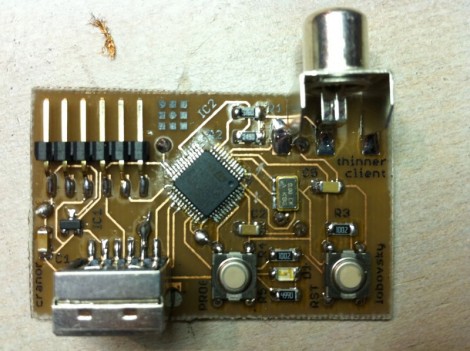
Thinner Client Using STM32 And NTSC Monitor

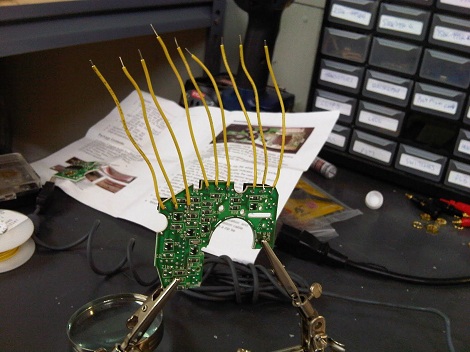
[David Cranor], along with [Max Lobovsky’s] help, managed to build a thin client that uses an NTSC television as a monitor for only $6. This is his first foray into the world of ARM architecture and he has vowed to never use an AVR again. The powerful little chip uses timers to manage sync and DMA to transfer the full 480×240 frame buffer to the screen. Overclocked at 80 MHz there’s a lot of potential in this little board and he plans to take on the challenge of a full-color display for his next trick.
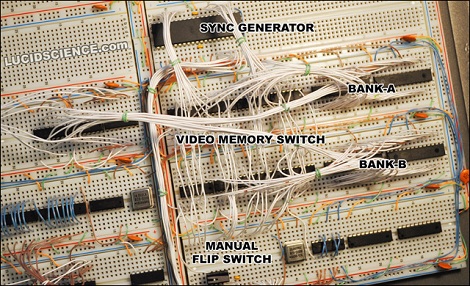
Lazarus-64, Not Actually 64 Bit But Still Blows Our Minds

Lazarus-64, breadboard game system; certainly sounds like something from the 1980s. We were surprised to find out not only the name, but also all the ICs used are only those available from the retro age of 30 years back (Save for the AVR controlling everything, of course). Even more amazing is how it has 256 flicker free color support, while not using NTSC chips. Which Goes to show that even if there are common solutions out there for cheap, building or compiling your own is not necessarily a bad thing or a waste of time.

There is a whole lot more to Lazarus, including double buffering and VMS, but sadly it appears progress has stopped on the Lazarus-64 breadboard game system, with the last update being last year. But we can still bask in the amazing glow that currently is.

Creepy Robot Really Wants Money…

As technology advances forward so does the numerous ways to beg for money. [Chris Eckert] has developed a robot to do the deed for him.  With an odd  eye mounted on the top of the robot to invoke pity presumably and a tin can out front to collect change from people it may encounter this is quite the hobo robot.  On his build log, you’ll find tons of great pictures of the entire process from start to finish.  With robots sent to beg people for money, it is only a matter of time until the first squeegee robot is cleaning your car at a red light.  Make sure to check out the video after the break.

Continue reading “Creepy Robot Really Wants Money…”

yo dog, we heard you liked simulations

16 Bit ALU In Minecraft

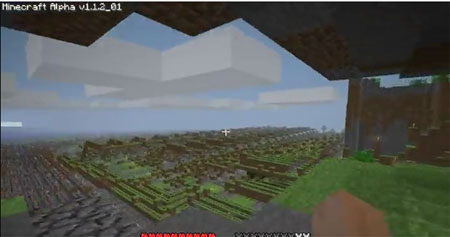
We love games here but we don’t often get a reason to write about them. This, however, is worth mentioning. The indie hit Minecraft is eating the entire internet right now. The game itself is hit and miss amongst our staff, but this project is unanimously accepted as awesome. [Theinternetftw} has created a simulation of the ALU section of a 16bit processor.  He can set it in motion and run around watching as the states change. This is part of an even bigger project to create the entire processor as shown in the book “The Elements of Computer Systems“.

For those that are wondering how long it took him to place all of those pieces, he actually imported most of it from another program. You can get more details on how they pulled this off in this forum thread. Be sure to catch the video after the break.

Continue reading “16 Bit ALU In Minecraft”

Woot Lights And Mice Transplants

[Nathan Long] sent in two fairly simple mods he’s been working on. The first is the control of Woot-off Lights via LPT port. A computer checks Woot for the Woot-off logo, and if the logo is spotted, on go the lights. It’s really just a twist on the LED/Arduino email message system, but the creativity is nice.

His other modification is the stuffing of a Microsoft Intellimouse inside of a Logitech Wingman. With the goal of giving the old PS/2 mouse USB capabilities and removing the terrible ball. For those that are asking themselves “why bother? Terrible ergonomics, no scroll wheel, etc.” [Nathan] claims it’s for Quake 2 nostalgia, to each their own we suppose.

Launchpad Not Limited To Value Line Chips

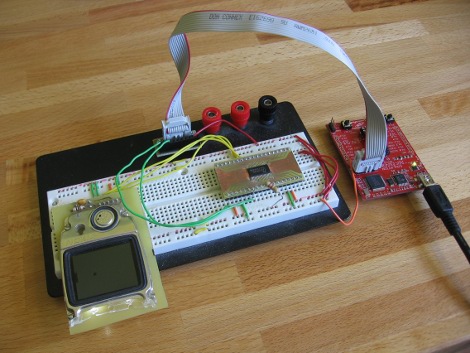
Wanting to use my TI Launchpad as more than just a development board I thought I’d do a few experiments using it as an in-system programmer. After a few tripping points I was able to get it working and then some. It seems that the device is not limited to just the value line of microcontrollers it was intended to support. In the image above I’m using it to program an MSP430F2272 which is a pretty powerful little chip with 32 KB of program space. Click through the break for more information on the setup.

Continue reading “Launchpad Not Limited To Value Line Chips”

Building A Crystal Oven

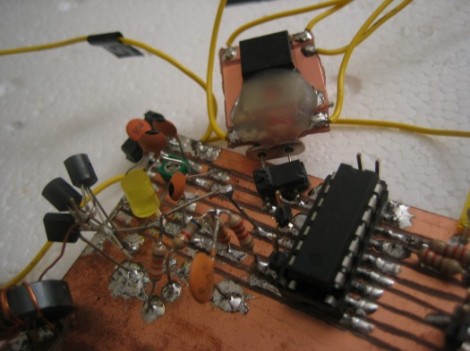
Radio communications depend on stable oscillator frequencies and with that in mind, [Scott Harden] built a module to regulate temperature of a crystal oscillator. The process is outlined in the video after the break but it goes something like this: A small square of double-sided copper-clad board is used as a base. The body of the crystal oscillator is mounted on one side of this base. On the other side there is a mosfet and a thermister. The resistance of the thermister turns the mosfet on and off in an attempt to maintain a steady temperature.

This is the first iteration of [Scott’s] crystal oven. It’s being designed for use outdoors, as his indoor setup uses a styrofoam box to insulate the oscillator from ambient temperatures. He’s already working on a second version, and mentioned the incorporation of a Wheatstone bridge but we’ll have to wait to get more details.

Continue reading “Building A Crystal Oven”