Robot Follows The Rules Of The Road

[youtube=http://www.youtube.com/watch?v=Y6R0wO1o01g]

This is a fantastic high school project. [Shmendrik213] built and robot a programmed it to follow common traffic rules. The robot drives itself with a DC motor, using one servo for steering and another to pan a webcam back and forth. The netbook that comes along for the ride is running a VB.NET program that can detect an upcoming intersection, read the street sign, and react based on other cars currently at the intersection.

The hardware is running on an Altera processor using firmware programmed in VHDL. We remember building a tissue box holder for one of our high school projects. Looks like the times have changed since then.
Androidome: Monome For Android

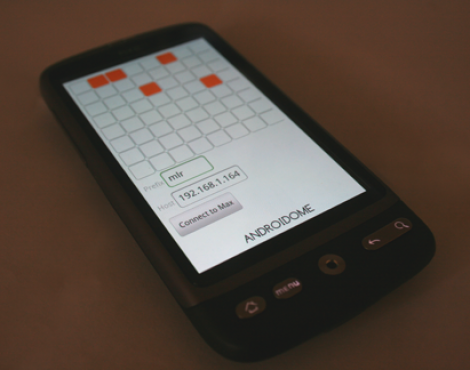
[Ewan Hemingway] tipped us off about his new Android app, Androidome. This is the first one he’s turned out after going through our Android development tutorials. It combines an app running on his Android 2.1 device with a computer running Max/MSP 5. The two don’t needed to be tethered, they just need to be on the same wireless network. This won’t be the best solution if you’re doing live performances, as the buttons on the screen end up being quite small. But as you can see after the break, it’s a great way to get into working with the Monome interface and decide if you want to build a dedicated physical version of the tool.

Continue reading “Androidome: Monome For Android”

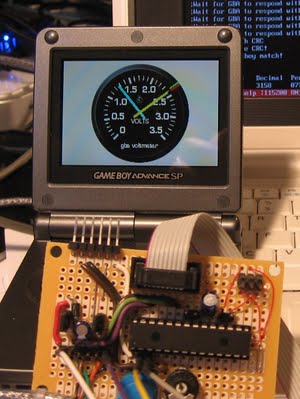
GameBoy Analog Meter

Boring game.

Here’s an interesting setup using a GameBoy Advance as an interface and power supply for a PIC microprocessor. He’s got the PIC connected to the serial port of the GameBoy Advance and is able to pass and retrieve data for display on the screen. You can see above that he is showing two analog values from the pic. You can download the schematic and source code and see a few more pictures, but that’s about it.

[via HackedGadgets]

Hackaday Links: August 15, 2010

Creepy or not?

Do you find these faces creepy or cute? They can display a huge range of facial gestures and the German engineers who designed them were trying to avoid the uncanny valley. That’s the point at which human features on a robot seem quite real, but are off in just the right way as to cause revulsion. [Thanks Simon]

Water in your ink cartridge

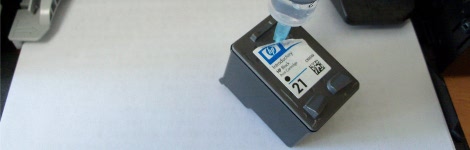
Like all great hackers [Dean] digs through his neighbors’ trash. He found an inkjet printer but wanted to test it out before buying new cartridges. The old ones were dried up but he revitalized them with an injection of filtered water. It might get you through that quick printing project without a trip to Walgreen’s.

Laser-cut LP record

[Niklas Roy] demonstrates a laser-cut LP record. He’s using acrylic as a medium, kind of like a big CD with grooves in it. He’s got several tracks that are simple loops instead of the longer spirals you may be familiar with. They definitely sound different but it’s up to you to decide if that’s by design, or a fluke.

Star Wars cinema

Ever wonder what to do with those classic toys you’ve got sitting around? Here’s a little video that envisions your life with an AT-AT as the house pet. [Thanks Gabe via Wired]

Making EL Wire

[youtube=http://www.youtube.com/watch?v=3RKBGxJJmwg]

[Jeri Ellsworth] adds electroluminescent wire to the list of things she makes. The materials list is incredibly low. The common components are epoxy coated magnet wire for the center conductor and bare wire for the second conductor. The part you don’t have on hand is phosphors, although she does link to a source.

The bad news: she doesn’t show us the build process or share the details about the inductor that fires this thing up. The good news: in-depth videos are on the way. In the mean time you can marvel in her glowing success at the end of the video, or check out some of her other electroluminescent fun.

More Car Audio Input Hacking

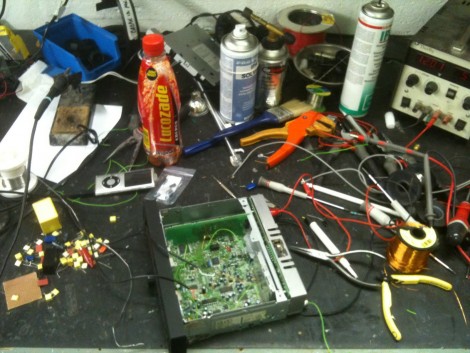
[Dave] pulled the head unit out of his dashboard to add an iPod input. He took a much more invasive route than the other hack we saw a few days ago. He actually patched into the audio lines going from the Dolby reader head chip to the amplifier.

The first step was to trick the deck into thinking it had a cassette inserted. He scoped an enable pin on one of the chips to discover the timing and emulated that signal using a PIC microprocessor. From there he popped off the chip that reads the tape data, patching directly into the audio out traces. This presented some noise issues when charging the iPod but [Dave] fixed that with some decoupling capacitors.

New Nook Says: No Root For You!

That is a blurry image of a Barnes & Noble Nook eReader stuck in an infinite reboot loop. This is the result of trying to downgrade the firmware to 1.0 in preparation to soft-root the device. So after a few failures the device will recover itself, right? It doesn’t look that way. No problem, don’t you just pop it open and re-write the OS to the SD card inside to do a hardware root? Nope, it looks like the newest hardware revision has replaced that convenient SD card with a memory chip.

For now it’s a brick, but we’re sure there will soon be a way to fix this. A bit of solder, some wires, and a reflash should work much in the same way an EEPROM recovery does. That is, if you have an original image to work with.

So for now, be careful not to attempt to root your nook if the serial number starts with 1003.

[Thanks Ken]