All About VLF Radio

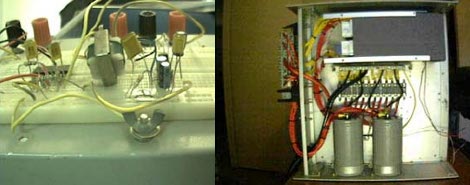
If you’re interested in learning about Very Low Frequency communications take a look at what Larry has to offer on his site. He’s put together a guide to VLF receivers that is short enough to read and clear enough to understand with rudimentary knowledge of circuits. He builds a simple receiver as a working example and a high-powered transmitter that can put out over 2600 watts. Let’s face it, radio operators were the original electronic hackers. Get back to our roots and learn the ways of the transistor.

[Thanks Buddy]
Electronic Wind Chime

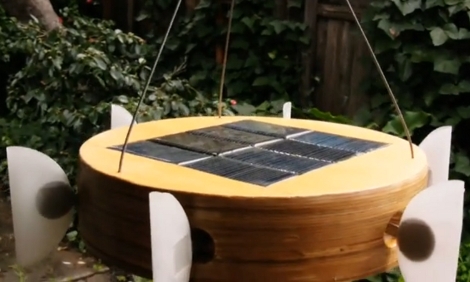
The Winduino II uses fins to pick up the movement of the wind and translate it into music. Each fin is attached to the main body using a piezo vibration sensor. The signals are processed by an Arduino housed inside and the resulting data makes its way to a computer via a Bluetooth connection to facilitate the use of Max/MSP for the audio processing. Included in the design is an array of solar panels used to keep the battery for the device charged up. Hear and see this creative piece after the break.

Continue reading “Electronic Wind Chime”

PWM Fan Controller For External Hard Drive

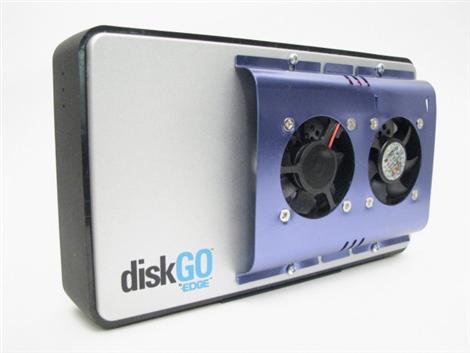
[Alan] noticed that his external hard drive was getting quite hot to the touch after a few hours. He says that it was probably designed to handle the heat sufficiently, he thought it would be fun to beef it up. He’s using a pic 12f675 microcontroller as the brain and an LM35 temperature sensor. The Fan speed is varried in 8 steps from 35 degrees C to 45 degrees C.

PICMAN, A Diy Prototyping Setup

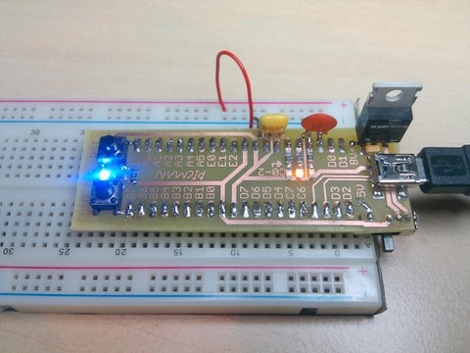
[Ytai Ben-Tsvi] wanted a rapid prototyping tool that could be easily and cheaply built at home. He came up with the PICMAN, a breadboard compatible PIC based board that has everything you need to get the ball rolling. He’s using a PIC18LF4553 which has built-in USB support that can be used with a bootloader for programming. The board also features a voltage regulator for non-USB power sources, some indicator LEDs, a user-defined button, and a reset button. The chip is on the underside and a combination of through-hole and surface-mount parts make for a one-sided PCB that can easily be etched using the toner transfer method. You will need a PIC programmer to burn the bootloader firmware the first time but once that’s done this becomes a self-contained package.

Laser Cut And Printable Cases

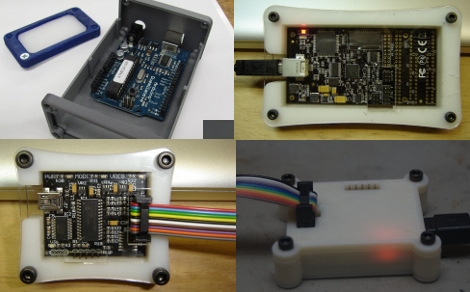
If you’re like us you’ve got quite a few prototyping tools that are bare PCB boards. If you’re using them a lot you might want to protect them with some type of case but the lack of mounting holes can make this difficult. One popular solution to this problem is to design a case for a perfect fit, then cut it with a laser or print it out of plastic. We’ve got examples of both.

[Stewart Allen] set to work designing laser cut cases for the AVR Dragon and the Bus Pirate V2go after seeing our post about on-the-go prototyping. We think this is especially important if you have an AVR Dragon as it’s been known to bite the dust if the bottom is shorted out. If you have access to a laser cutter you can download is DXF files and the models and cut your own.

If you don’t have a laser cutter but can get some time with a 3D printer check out the Bus Pirate V2go printed case and the Arduino printed case.

Mechanical Scanning Television

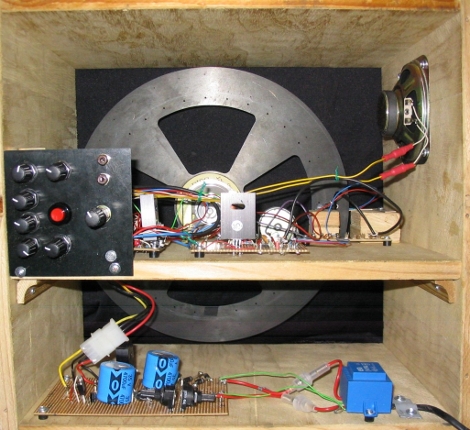
This project explores the early days of television. Above you see a view from the back side of a mechanically scanning television. The black disk spins and the holes, aligned in a spiral pattern, create vertical scan lines for projected light to shine through. In this case, [Eckhard Etzold] is using red, green, and blue LEDs to create a color picture. As you can seen in the video after the break it does a pretty good job. The main problem being that the scanning disc on a mechanical TV has to be much larger than the actual image. How big would the disk need to be and how fast would it spin to produce a forty inch image? We still think this is a better method than transmitting video data in parallel.

Continue reading “Mechanical Scanning Television”

Tiny Tube Amp For Headphones

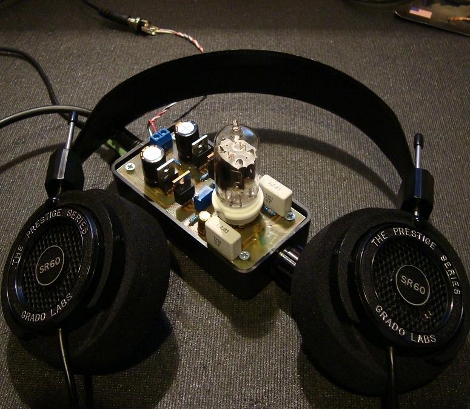
We like to check in from time to time on the scratch-built tube amp scene. [Rogers Gomez] recently posted his build of a headphone tube amp. This is somewhat related to his work from 2008, but this time around it’s simple enough to serve as an entry into amplifier construction for beginners. The PCB layout is clean and simple, makes for easy board etching, and it’s small enough to fit into an enclosure that can pass as a headphone accessory. Only one tube is needed, with a total parts bill coming in around the $50 mark. If you build it, heed his advice on testing with a pair of cheap headphones before you risk plugging in your prized pair.

Still want an amp but don’t care to source the vacuum tube? [Giovanni], who sent in the original tip, build one a while back and housed it in an external CD-ROM enclosure.