A Plotter Made From Lego Parts

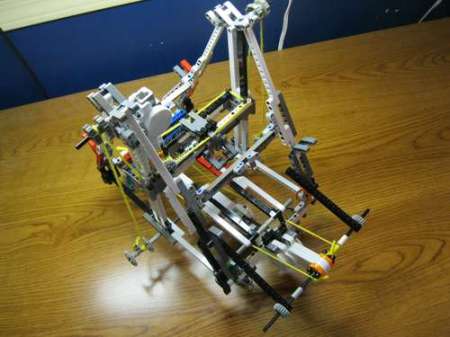
We’re always amazed at what people can come up with using Lego parts, but this hack certainly pushes the limits. Originally conceived as a 3D printer, this plotter is still an impressive proof-of-concept. Ironically, this “3D printer” was build with the hope of winning a Makerbot 3D printer, so be sure to vote for it if you’re impressed.

it’s pretty impressive seeing what [graphmastur] has done using only Lego parts. It’s especially entertaining to see a sheet of Lego “grass” used as the Y-axis table. The build was designed in Lego Digital designer, and the parts are available in “LDD” format or HTML.

This project is explained further in the video after the break. If you’d like to simply see it do a plotting operation, fast forward to around 4:30. The device is not perfect, but as the video says “it worked, pretty well” when drawing a square with an ordinary marker. Continue reading “A Plotter Made From Lego Parts”


Magic Locket

[Andrey] from RTFM has built himself a glowing LED pendant using only three parts and some simple code. The hack is not particularly complicated but [Andrey] provides some decent instructions on Pickaxe programming via an RS232 serial port and RGB LED control to produce the nice glowing effects. The pendant contains an RGB LED, a Pickaxe-08 microcontroller and a couple of button cell batteries. To cram everything inside the locket, [Andrey] had to grind down the LED and Pickaxe-08 to their minimum dimensions using a file.

All of the Basic code for the pendant is supplied on the project page and [Andrey] describes how he manages to PWM all three LED pins for the colour effects. The video after the break may be of interest to anyone who has not had a go at Picaxe programming before or for a beginner who wants to try out some new embedded devices without a big hit to the wallet.

Continue reading “Magic Locket”

Paper Craft Claw

Grab some stiff paper and get to work building your own paper claw. [Dombeef] posted the instructions to recreate the claw above because he was unsatisfied with his previous design which was flimsy and unable to pick up just about anything. This version is a bit larger and it internalizes all of the parts.

Being paper craft, you don’t need much in the way of materials or tools. A push-pin makes holes for the paperclip and wire which serve as the pivot points. Glue and some tape hold the rest of assembly together. You can see a video of the final product after the break. A shaft at the center closes the claw when pulled, and opens it when pushed to opposite way. This makes it perfect for that home-made crane game (or was that a claw game?)… as long as you’re not trying to pick up anything too heavy.

Continue reading “Paper Craft Claw”

GPS Lap Timer From Secondhand Parts

gps_racing_lap_timer

Hackaday forum member [nes] was training for an endurance race, and rather than having someone verbally call out his lap times, he wanted something he could keep in-vehicle to help keep track of his performance. With the race budget running dry, he and his teammates needed something cheap, if not free, to get the job done.

He scored a “broken” GPS receiver on eBay for a measly £4 and found that the receiver worked, but corrupted software prevented the unit from mapping routes. Since he didn’t require routing functions to keep track of his lap times, he splayed the GPS receiver open and started hunting around for a serial bit stream. He found what he was looking for after a bit of probing and hooked it up to his computer to see if the data contained NMEA sentences.

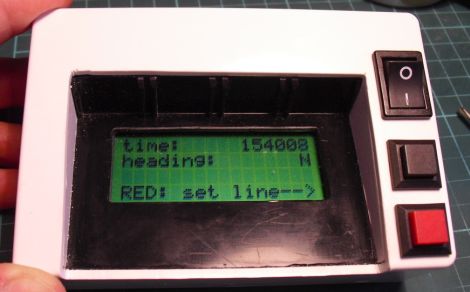
He cut the receiver down to the necessary parts and then started work on the lap timer itself. The timer uses an ATMega32 to run the show, displaying relevant time and location information on an LCD panel he scavenged from the trash bin.

He admits that the wiring is a bit questionable, but says that after about seven hours of rough use, everything is still intact and working great.

Electronics Tutorial Two-fer: Soldering Skills And Wires

electronics_tutorial_twofer_soldering_skills_and_wires

There is a plethora of electronics tutorials scattered about online. Sometimes it can be hard to separate the good ones from the bad, and the enlightening from the misinformed. We recently came across a pair that we found helpful, and thought they would appeal to anyone starting off in electronics.

In this video tutorial, [Dave Jones] at the EEVblog covers soldering, detailing good practices and common mistakes to avoid when working with through-hole components. As the second video in a series he picks up where part one left off, excitedly demonstrating the ins and outs of good soldering skills.

Hackaday reader [grenadier] is working on a series of beginner’s electronics tutorials, and this week’s entry covers wiring. He discusses wire types, gauges, and even provides a nifty self-computing chart that calculates power loss based on the length and gauge of the selected wire. Before wrapping things up, he briefly touches on fuses and the pitfalls of choosing wire that’s not up to the task at hand. While you’re over there looking over his tutorial, be sure to check out the Junkbox, there’s plenty of awesome stuff to be had!

flying_rc_superhero

Take To The Skies With This Flying RC Superhero

It’s a bird! It’s a plane! It’s….

A flying RC super hero?

No, you’re not imagining things. Maker [Greg Tanous] loves both RC airplanes and super heroes, so he thought it would be awesome to combine his two loves into one spectacular toy. The RCSuperhero comes in two flavors, measuring 75″ and 57″ tall. The larger plane can be purchased as a kit, but the smaller unit is only available in plan form.

The flying superhero weighs in at just about three pounds, and is constructed from foam, carbon fiber, and various other lightweight materials. When using the recommended motor, the RCSuperhero can be launched from a standing position, doing away with the need for runways. The craft looks to be just as maneuverable as any regular RC airplane, making it easy for any seasoned pilot to pick up the controls and get started.

RC planes are pretty cool, but we’ve got to admit that the idea of a vertically launching, flying superhero sounds like a lot of fun!

Stick around to see [Greg’s] RCSuperhero in action.

Continue reading “Take To The Skies With This Flying RC Superhero”

Kinect-controlled Quadrotor

kinect_quadrotor_control

The team over at the Flying Machine Arena has been busy combining two of our favorite toys – quadrotors and Kinect.

Like many other hacks, they are using Kinect to monitor their joint positions, mapping a handful of actions to the operator’s movements. Once the quadrotor is aloft, it can be directed around the room using the operator’s right hand. The gesture recognition system responds almost instantly, guiding the vehicle in all directions with ease. When the user’s left hand is raised, the quadrotor does a mid-air flip and awaits its next command, while a quick clap of the hands brings the machine to rest on the ground.

For the protection of anyone testing out the system, overhead motion tracking cameras are used to keep track of the Kinect’s position, creating an invisible midair barrier through which the quadrotor is not allowed to pass.

If you have a minute, check out the video below – controlling quadrotors looks way more fun than any Kinect game we’ve come across.

Continue reading “Kinect-controlled Quadrotor”