Work Station Includes A Smartcard Lock For USB Ports

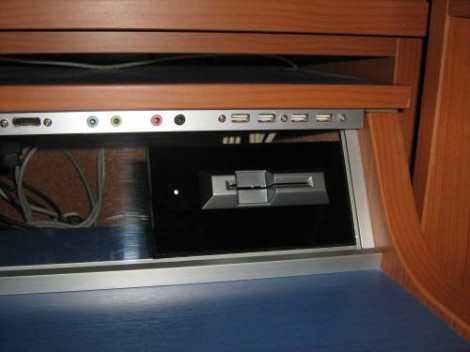
The USB ports on this work station are locked. In order to use a USB device you’ll need to insert a Smartcard into the reader seen above. The interesting thing here is that this shouldn’t affect your ability to charge a USB device. When you visit the link above make sure to check out the worklog tab as it contains nine pages worth of build information.

The device is conceived of in two parts. There is one board which does the USB switching, and another that takes care of the Smartcard reader. That reader is based on a PIC 16F1939. It readers the Smartcard, verifies the data, then controls the USB switching board via SPI. An ADG714 chip completes the circuit on eight data lines making up the four USB ports. There is also a mechanical relay on the board which can cut USB power. Since this is separate from the data switching, the power could be left on for charging or toggled separately by a card that has permission to charge but not to use the data ports. You can see a demonstration of the system embedded after the break.

Continue reading “Work Station Includes A Smartcard Lock For USB Ports”
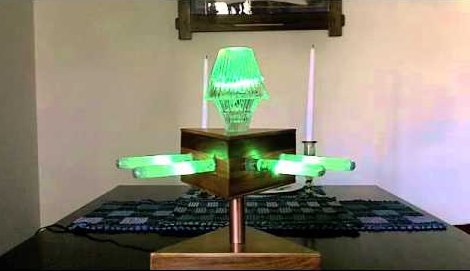
RGB Chandelier May Not Fly With The Wife

We understand where [Craig] is coming from, leaving no stone unturned when looking for new electronic projects to occupy his time. He tried to convince his wife that they needed a light show to accompany dinner, and while she was skeptical he went ahead and built this remote control RGB chandelier anyway.

He recently purchased fifteen feet of RGB LED strip and has since been trying to use it in his projects. What’s interesting is that he didn’t make direct use of the strip. Just 10 of the LED packages were used. He desoldered and extended each wire leads and used one of the driver chips to address them all. The main body of the light fixture is a triangle, and out of each side two test tubes host one LED each. To diffuse the light [Craig] mixed up some resin and laced it with glitter. Once hardened the resin holds the LEDs firmly in place. The glass shade in the center of the fixture hides four more LEDs.

[Craig] uses a remote control from a Roku box to control the chandelier. An IR receiver is monitored by an Arduino which drives the LEDs accordingly. After the break you can see a demonstration of the completed project. Unfortunately it doesn’t provide as much light as they need. We’d suggest an upgrade along these lines.

Continue reading “RGB Chandelier May Not Fly With The Wife”

Convert A Speaker To A Battery-powered Amplifying Party Box

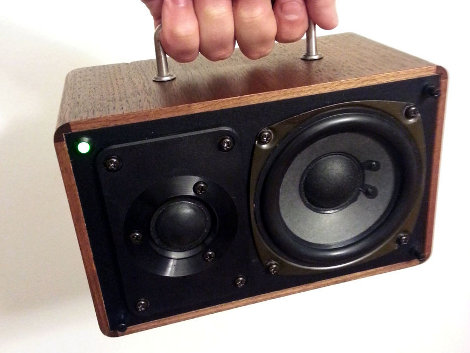
[Matt the Gamer] loved his pair of Minimus 7 bookshelf speakers. That is until a tragic hacking accident burned out the driver and left him with a speaker-shaped paper weight. But the defunct audio hardware has been given new life as a single portable powered speaker. Now he can grab it and go, knowing that it contains everything he needs to play back audio from a phone or iPod.

The most surprising part of the build is the battery. [Matt] went with a sealed lead-acid battery. It just barely fits through the hole for the larger speaker, and provides 12V with 1.2 mAh of capacity. He uses an 18V laptop power supply when charging the battery. The PSU is just the source, his own circuit board handles the charging via an LM317 voltage regulator. Also on the board is an amplifier built around a TDA2003A chip. He added a back panel which hosts connections for the charger and the audio input. Two switches allow the speaker to be turned on and off, and select between battery mode and charging mode. As a final touch he added a power indicator LED to the front, and a drawer pull as a carrying handle.

Fauxrarri Is The PPPRS Champion

The Power Racing Series (PPPRS) is an electric vehicle competition with a $500 price ceiling. This is Fauxarri, the 2012 Champion. It was built by members of Sector67, a Madison, WI hackerspace. To our delight, they’ve posted an expose on the how the thing was built.

It should come as no surprise that the guys behind the advance electric racer aren’t doing this sort of thing for the first time. A couple of them were involved in Formula Hybrid Racing at the University of Wisconsin. That experience shows in the custom motor controller built as an Arduino shield. It includes control over acceleration rate, throttle response, and regenerative braking. But you can’t get by on a controller alone. The motors they used are some special electric garden tractor motors to which they added their own water cooling system.

If you want to get a good look at how fast and powerful this thing is head on over to the post about the KC leg of PPPRS (it’s the one towing a second vehicle and still passing the competition by).

Southwest Tour: Scrap Tattoo Gun

I had an idea for keeping things interesting on this long road trip through the southwest. I was going to gather a few bits from each hackerspace and build something using minimal tools while we were driving down the road.  I settled on the idea of a really simple “jailhouse” tattoo gun. I knew I could build one from parts I could source very easily and that I wouldn’t need much in terms of tools to make it happen.

Continue reading “Southwest Tour: Scrap Tattoo Gun”

Copper Vapor Laser Is Amazing

What better way to spend a few months in the workshop than by heating Copper chloride to 400° C, building rotary spark gaps and 30kV capacitors, playing with high vacuums and building a very powerful laser? It’s just a day in [Jon]’s life as he builds a DIY Copper vapor laser.

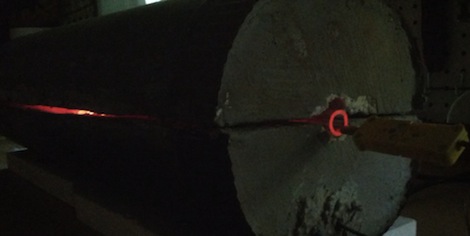
Copper vapor lasers require temperatures of about 1500° C, but this is only when using pure Copper. Compounds such as Copper chloride are able to bring the required temperatures for lasing down to about 400° C, a reasonable temperature for [Jon]’s home built laser tube furnace. The only problem with this setup is the requirement for two electrical pulses, one to disassociate the Copper and a second to make the Copper lase.

The professional way of creating these electrical pulses would be a Thyratron, but it seems [Jon] wanted something cooler. He built a rotary spark gap out of two 2 inch thick blocks of acrylic that allow him to perfectly time the frequency and separation of the electrical pulses needed for his laser.

There is no word on exactly how much power [Jon]’s Copper vapor laser will put out when it’s complete, but [Jon]’s build log is already an amazing display of awesome. You can check out a short video showing off [Jon]’s laser, spark gap, and huge home-made capacitor after the break.

Continue reading “Copper Vapor Laser Is Amazing”