Hackaday Retro Submission: Browsing With An Apple IIc

We’ve had the retro edition of Hackaday up for about a week now, and already a few people have sent in a few neat builds that use an ancient computer to pull this page up. The latest comes from [RetroAppleFanToday] who used an Apple IIc to browse the Internet.

To load our humble retro edition, [RetroAppleFan] used a serial connection between the Apple and a Mac Mini to get a terminal running on the 30-year-old computer. From there, it was a simple matter of running lynx to browse the Internet.

There are a few more retro submissions cataloged on our retro successes page including a NEXT cube. If you have an old computer lying around that can pull up our retro site, don’t feel shy about sending it in; it’s pretty much guaranteed to get a mention.

As far as the development of the retro site is going, we’re posting 5 random stories every day. There’s a script to generate the front page every day, but if we get enough complaints or compliments we may just generate a new front page for every visitor.
Multi-system Nintendo Emulator Uses Stock Controllers

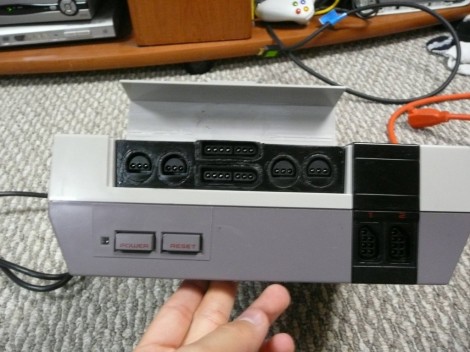
The first month of [WoolyDawg5’s] summer break went into building one Nintendo emulator to rule them all. He thinks there’s nothing like playing the games on the original controllers, and we agree with him 100%. Here you can see that the cartridge door on this NES enclosure hides the extra connectors he needs.

With that door closed this looks like a stock console, but only from the front. If you take a look at the back of it you’ll see how he pulled this off. There’s a Zotac motherboard whose I/O panel has been fitted into the back. It’s responsible for emulating games for the NES, SNES, and GameCube consoles — we’re sure it can do more but that covers the controller ports seen here. Each port is wired to a USB controller module. The cables for these modules exit the back of the case and plug into the motherboard’s I/O panel. There is WiFi for the board, and that’s what [WoolyDawg] uses for configuration, tunneling into the OS instead of connecting a keyboard or mouse.

Of course you could just shoehorn all-original console hardware into one package to accomplish something like this.

[Thanks KoldFuzion]

Hacking Together Two Shop Vacuums

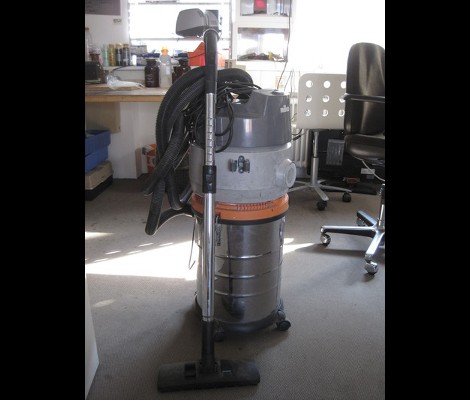
Unfortunately the result of hacking together two shop vacuums isn’t a double-power monstrosity. This is actually the story of combining broken and substandard parts into one usable machine. The guys at the Shackspace originally bought a cheap shop vacuum whose motor gave up the ghost way too quickly. The replacement had only a tiny container for rubbish. So they did what any group of hackerspace members would and combined the two.

Since they wanted to use the voluminous enclosure from the broken vacuum the first order of business was to remove the dead motor assembly. Quick work was made of this by melting away the plastic using an old soldering iron. The motor assembly from the small machine was then mounted in place with screws, and sealed with caulk. It was now working, thanks to salvaged hoses and attachments from other long-lost vacuums.

But a boring hack this might have been if they stopped there. The team added a wall outlet to the top, and adorned the beast with RGB LEDs which are powered from a wall wart (hence the added wall outlet). It can double as a mood light when not in use.

[Thanks Momo]

[Bob’s] Experience With Haxlr8r

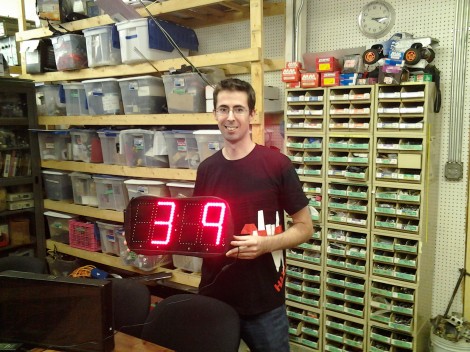
[Mike Szczys] recently got together with [Bob Baddeley] to talk about his experiences taking a hobby project to market. He’s not quite there yet, but [Bob] decided to travel a route which we find quite interesting. He has been taking part in a 111 day accelerator program called Haxlr8r. The idea is that this experience will give him the manufacturing chops he needs to meet the demand when his product actually launches. He spent a considerable amount of time in China, an experience he blogged about at length. The program also provides development cash in return for a percentage of the company.

The product he’s working on is an LED scoreboard, which explains why he calls the company Portable Scores. It started as a hobby project, and he brought one of the early prototypes along to show off in the video after the break. It’s a wooden frame, with foam board for the back and substrate, and clear acrylic on the front to protect the LEDs. All of the soldering is point-to point (there’s an image of this available after the break too). His redesigns have moved from Arduino to a PIC controller, made the entire face of the display one PCB, and added Bluetooth control. It’s great to see someone really go for it with a well-conceived project. We wish him all the best!

Continue reading “[Bob’s] Experience With Haxlr8r”

Blinky Seesaw Has ’em Queuing At The Playground

How long has it been since you were on a seesaw? Perhaps the plank-and-fulcrum toy of your youth no longer holds any interest. But add some blinky lights and a fancy enclosure and folks are lined up to get back in the saddle.

The video after the break gives just a glimpse of what’s inside of this thing. There are 33 sets of LED strips wrapping the plank from on end to the other. They’re covered in a translucent shell (we’d guess it’s acrylic that has been heated and bent). Judging from the children walking in the middle, it’s engineered well enough to hold up to some abuse. The seesaw can sense a change in orientation and sends light cascading from one end to the other as if aided by gravity.

We really like the clean lines of the installation; the spartan center mount, the use of half a tire as a ground bumper, and fact that the very end of the plank also lights up. If we happened upon this (it’s in Melbourne, Australia so not likely) we’d wait a while for our turn!

Continue reading “Blinky Seesaw Has ’em Queuing At The Playground”

Salvaged Robot Arm Makes A Big 3d Printer

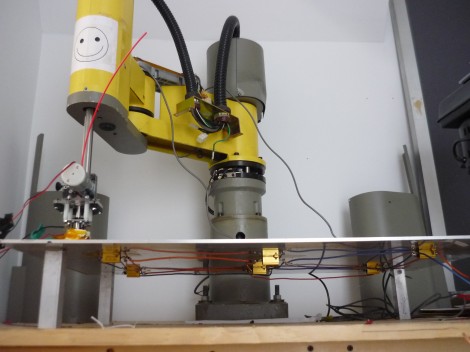
Wow, building a precision 3d printer is amazingly easy if you can get your hands on an industrial-quality robot arm. [Dane] wrote in to tell us about this huge extruder printer made from an ’80s-era SCARA robot arm. It is capable of printing objects as large as 25″x12″x6.5″.

This 190 pound beast was acquired during a lab clean out. It was mechanically intact, but missing all of the control hardware. Building controllers was a bit of a challenge since the it’s designed with servo motors and precision feedback sensors. This is different from modern 3d printers which use stepper motors and no feedback sensors. A working controller was built up one component at a time, with a heated bed added to the mix to help prevent warping with large builds. We love the Frankenstein look of the controller hardware, which was mounted hodge-podge as each new module was brought online.

You can see some printing action in the clip after the break. A Linux box takes a design and spits out control instructions to the hardware.

Continue reading “Salvaged Robot Arm Makes A Big 3d Printer”

Mini Waterproof LED Lanterns Charge Without Wires

inductive-charge-led-lights

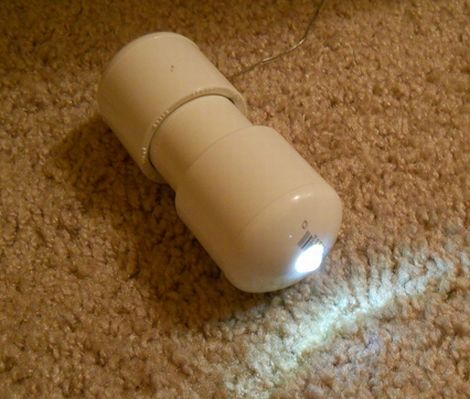
If you’re in search of a flashlight that can stand up to the elements, or simply looking for an easy way to spruce up your pool for those hot summer nights, check out these rechargeable PVC LED lights. Inspired by a post in Make: Magazine featuring Indestructible LED Lanterns, [John Duffy] decided to take the project one step further.

While he liked Make’s iteration of the waterproof lantern, he thought it would be best to permanently seal the lights for maximum durability. Not satisfied with a one-use light, he equipped the PVC lanterns with a single rechargeable AA battery, step-up circuitry to drive the LED, and an inductive charging coil.

His floating, waterproof lights sport a slightly bigger footprint than their predecessors to house the extra electronics, but we think that’s more than a fair trade off considering they can be charged wirelessly.

Place your Digikey/Mouser/Jameco orders now and check out [John’s] how-to video – you just might get some of these built in time for the weekend!

[via HackedGadgets]

Continue reading “Mini Waterproof LED Lanterns Charge Without Wires”