Blindingly Fast ADC For Your BeagleBone

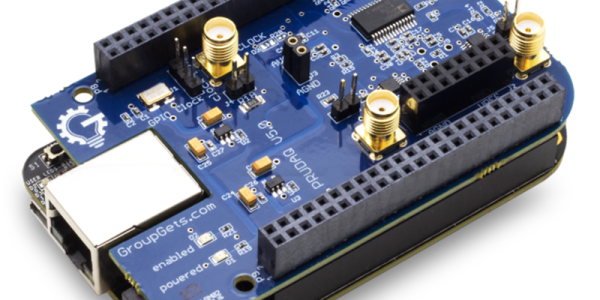
[Jason Holt] wrote in to tell about of the release of his PRUDAQ project. It’s a dual-channel 10-bit ADC cape that ties into the BeagleBone’s Programmable Realtime Units (PRUs) to shuttle through up to as much as 20 megasamples per second for each channel. That’s a lot of bandwidth!

The trick is reading the ADC out with the PRUs, which are essentially a little bit of programmable logic that’s built on to the board. With a bit of PRU code, the data can be shuttled out of the ADC and into the BeagleBone’s memory about as fast as you could wish. Indeed, it’s too fast for the demo code that [Jason] wrote, which can’t even access the RAM that fast. Instead, you’ll want to use custom kernel drivers from the BeagleLogic project (that we’ve covered here before).

But even then, if you don’t want to process the data onboard, you’ve got to get it out somehow. 100 mbit Ethernet gets you 11.2 megabytes per second, and a cherry-picked flash drive can save something like 14-18 megabytes per second. But the two 10-bit ADCs, running full-bore at 20 megasamples per second each, produces something like 50-80 megabytes per second. Point is, PRUDAQ is producing a ton of data.

So what is this cape useful for? It’s limited to the two-volt input range of the ADCs — you’ll need to precondition signals for use as a general-purpose oscilloscope. You can also multiplex the ADCs, allowing for eight inputs, but of course not at exactly the same time. But two channels at high bandwidth would make a great backend for a custom SDR setup, for instance. Getting this much ADC bandwidth into a single-board computer is an awesome trick that used to cost thousands of dollars.

We asked [Jason] why he built it, and he said he can’t tell us. It’s a Google Research project, so let the wild conjecture-fest begin!

Escalating To CNC Through Proxxon’s Tool Line

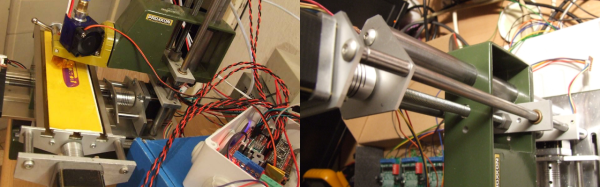
Proxxon is a mostly German maker of above average micro tools. They do sell a tiny milling machine in various flavors, from manual to full CNC. [Goran Mahovlić] did not buy that. He did, however, combine their rotary tool accessory catalog into a CNC mill.

Owning tools is dangerous. Once you start, there’s really no way to stop. This is clearly seen with Goran’s CNC machine. At first happiness for him was a small high speed rotary tool. He used it to drill holes in PCBs.

In a predictable turn of events, he discovered drilling tiny holes in PCBs by hand is tedious and ultimately boring. So he purchased the drill press accessory for his rotary tool.

Life was good for a while. He had all the tools he needed, but… wouldn’t it be better if he could position the holes more quickly. He presumably leafed through a now battered and earmarked Proxxon catalog and ordered the XY table.

A realization struck. Pulling a lever and turning knobs! Why! This is work for a robot, not a man! So he pestered his colleague for help and they soon had the contraption under CNC control.

We’d like to say that was the end of it, and that [Goran] was finally happy, but he recently converted his frankenmill to a 3D printer. We’ve seen this before. It won’t be long before he’s cleaning out his garage to begin the restoration and ultimate CNC conversion of an old knee mill. Videos after the break.

Continue reading “Escalating To CNC Through Proxxon’s Tool Line”

The Tiny Radio Telescope

Radio telescopes are one of the more high-profile pieces of scientific apparatus. There is an excitement to stories of radio astronomers of old probing the mysteries of the Universe on winter nights in frigid cabins atop massive parabolas, even if nowadays their somewhat more fortunate successors do the same work from the comfort of their labs using telescopes that may be on the other side of the world.

You might think if you look at the Arecibo Observatory, Lovell Telescope, or other famous pieces of apparatus, that this is Big Science, out of reach for mere mortals such as yourself without billion-dollar research programs. Maybe [Paul Scott] and [Allen Versfeld]’s Tiny Radio Telescope project will change that view.

The NRAO published a radio telescope design a few years ago for use mainly as an educational tool, the Itty Bitty Telescope. It used a satellite TV dish and LNB feeding a signal meter as a simple telescope to detect the Sun, and black body radiation from the surrounding objects. It’s a simple design for kids to get their heads around, and [Scott] and [Allen] have set out to turn it into something more useful with an RTL-SDR instead of a signal meter and a motorised mount for automated observations.

This is one of those projects on Hackaday.io that moves slowly but you know will eventually deliver on its promise. With a 1m dish and a consumer LNB it’s never going to make a discovery that will rock the world, but that’s not the point. It may be science that the astrophysicists moved on from decades ago, but it’s still quite an achievement that the radio sky can be imaged using such mundane equipment.

We’ve featured backyard radio astronomy before a few times, from this UHF school science project to another satellite TV based telescope. Keep them coming!

A thank you to Southgate ARC for the prod.

Taking The Converted PC PSU Bench Supply A Step Further

A quality bench power supply is essential for electronics work. Nobody wants to go through the trouble of digging through their electronics bin just to find a wall wart with the right output. And, even if you were so inclined, it would be folly to assume that its output would actually be clean.

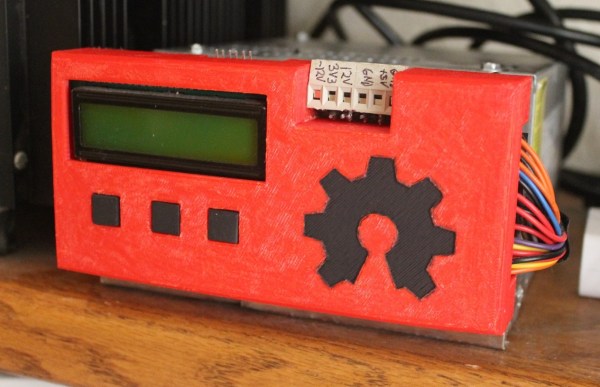
You could, of course, purchase a purpose-built bench power supply. But, this is Hackaday, and I’m sure many of you would rather build one yourself from an inexpensive PC power supply. Normally, you’d do this by separating out the different voltage lines into useful groups, such as 12V, 5V, and 3.3V. [Supercap2f] wanted to take this a step further, both to get a more useful unit and to practice his PCB-making.

His design uses a custom circuit design to fuse the circuits, and to provide some basic logic. Using the LCD display, you can see which lines are powered on. There is even a simple 3D printed cover to keep everything neat and tidy. [Supercap2f] has posted all of the design files, so you can build one of these yourself. We’ve seen similar builds in the past, but this is another nice one that anyone with the ability to etch PCBs can build.

Vending Coins For Your Vending Machine

Anyone who has worked in an office with a vending machine knows this problem well: someone wants a snack or a drink from the vending machine, but doesn’t have any small change. So, they proceed to walk around the office trying to find someone to make some change for them. It’s a hassle, and a surprisingly common one. Sure, a lot of vending machines now accept credit cards, but they’re still in the minority.

This was the problem facing Belgium-based automation company November Five. As automation and IoT specialists, their first thought was to hack the vending machine itself. But, unfortunately, they didn’t own it; as many of you know, vending machines are generally owned by the distributor. So, they needed a solution that allowed their employees access to the vending machine, without actually modifying the vending machine itself.

The solution they came up with was to attach an RFID-activated coin dispenser to the vending machine. Everyone at the company already has an RFID badge for opening doors and such, so the system wouldn’t add any burden to the employees. And keeping track of how many coins each employee used was a simple task of logging requests.

Continue reading “Vending Coins For Your Vending Machine”

Parent To The Power Wheels Rescue

If the [realjohnnybravo] is the one from the show, it appears he finally managed to get a girlfriend, marry her, and produce at least one son. As the old schoolyard rhyme goes, first comes love, then comes marriage, then comes filling the whole *!$&# backyard with brightly colored plastic garbage. One of these items, a Power Wheels quad bike,  suffered a blow from planned obsolescence leaving behind a traumatized child. [realjohnnybravo] decided to fix it.

He made frequent mention of how one could go to a store and purchase replacement gears for the toy. Perhaps it’s a German thing. Regardless, he shows experience with internet comments by justifying his adventure in gear manufacturing with, paraphrased, “I’m having fun and learning so back off you pedantic jerks.”

Resin casting is great, and is often overlooked vs 3D printing. He purchased some hardware store RTV silicone and some slow-cure resin. The faster cure resin would get too hot with this much volume and potentially burn.

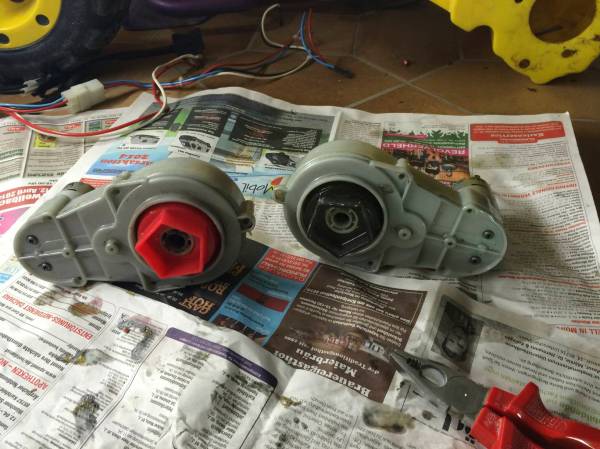
Materials procured he took apart both gearboxes from the machine. He first made a silicone mold of the broken parts (from the good copies out of the working gearbox) and removed the master. Without a vacuum or pressure casting chamber, the molds came out a little rough and bubbly, but it’s nothing some work with a carpet knife can’t fix. For big gears like this it hardly matters. Next he poured the two part resin into the molds and waited.

After some finishing with regular woodworking tools the parts fit right into the voids in the defective gearbox. His son can once again happily whir around the lawn, until the batteries die anyway.

Hackaday Prize Entry: You Have No Free Will

The concept of free will is the perfect example of human arrogance ever conceived. If a gas molecule collides with another gas molecule, simple physics can determine the momentum of the first gas molecule, the kinetic energy imparted to the second gas molecule, and the resulting trajectories of both molecule. Chemical reactions are likewise easy to calculate. Scale a system up to something the size of a human brain, and you have a perfectly predictable system. It’s complex, yes, but predetermined since the beginning of time. You are without moral agency, or any independent thought of your own. You are merely a passive observer in a vast, cold, uncaring universe. You are cursed with the awareness of this fact.

For his Hackaday Prize project, [Patrick Glover] is proving we don’t have free will. Will he win the Hackaday Prize? That’s up for the cold machinations of fate to decide.

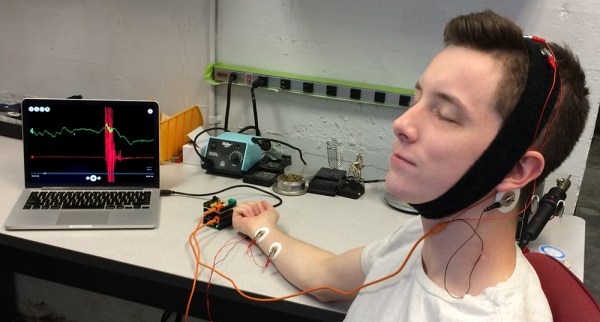
In the 1980s, psychologist [Benjamin Libet] performed an experiment. He connected an EEG to a subject’s arm and head, and asked them to flex their wrist whenever they felt like it. It turns out, an area of your brain generates an EEG potential a significant time before the subject is aware of deciding to flex their wrist. This is a foundational study in the physiology of consciousness, and direct evidence an IRB is okay with giving subjects an existential crisis.

[Patrick] is in the process of replicating the [Libet] study. Unlike the 1980s experiment, [Patrick] has access to handy Arduino shields and MATLAB, making the experimental setup very easy. The results, of course, will be the subject of philosophical debates continuing until the heat death of the universe, but we already knew that, didn’t we?

Check out the comments below for objectors predictably saying they do, in fact, have free will.