A Voltage Regulator Before Electronics

Did you ever wonder how the mechanical voltage regulator — that big black box wired up to the generator on a car from the ’60s or before — worked? [Jonelsonster] has some answers.

For most people in 2026 an old car perhaps means one from the 20th century, now that vehicles from the 1990s and 2000s  have become the beloved jalopies of sallow youths with a liking for older cars and a low budget. But even a 1990s vehicle is modern in terms of its technology, because a computer controls the show. It has electronic fuel injection (EFI), anti-lock braking system (ABS), closed loop emissions control, and the like.

Go back in time to the 1970s, and you’ll find minimal electronics in the average car. The ABS is gone, and the closest thing you might find to EFI is an electronic ignition where the points in the distributor have been replaced with a simple transistor. Perhaps an electronic voltage regulator on the alternator. Much earlier than that and everything was mechanical, be that the ignition, or that regulator.

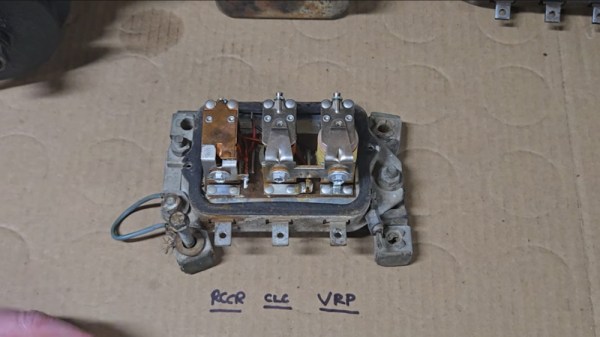
The video below the break has a pair of units, it seems from 1940s tractors. They would have had a DC generator, a spinning coil with a commutator and brushes, in a magnetic field provided by another coil. These things weren’t particularly powerful by today’s standards and sometimes their charging could be a little lackluster, but they did work. We get to see how, as he lifts the lid off to reveal what look like a set of relays.

We’re shown the functions of each of the three coils with the aid of a lab power supply; we have a reverse current relay that disconnects the generator if the battery tries to power it, an over-current relay that disconnects the field coil if the current is too high, and an over-voltage relay that does the same for voltage. The regulating comes down to the magnetic characteristics, and while it’s crude, it does the job.

We remember European devices with two coils and no field terminal, but the principle is the same. There is never a dull moment when you own an all mechanical car.

Continue reading “A Voltage Regulator Before Electronics”

Ternary RISC Processor Achieves Non-Binary Computing Via FPGA

You would be very hard pressed to find any sort of CPU or microcontroller in a commercial product that uses anything but binary to do its work. And yet, other options exist! Ternary computing involves using trits with three states instead of bits with two. It’s not popular, but there is now a design available for a ternary processor that you could potentially get your hands on.

The device in question is called the 5500FP, as outlined in a research paper from [Claudio Lorenzo La Rosa.] Very few ternary processors exist, and little effort has ever been made to fabricate such a device in real silicon. However, [Claudio] explains that it’s entirely possible to implement a ternary logic processor based on RISC principles by using modern FPGA hardware. The impetus to do so is because of the perceived benefits of ternary computing—notably, that with three states, each “trit” can store more information than regular old binary “bits.” Beyond that, the use of a “balanced ternary” system, based on logical values of -1, 0 , and 1, allows storing both negative and positive numbers without a wasted sign bit, and allows numbers to be negated trivially simply by inverting all trits together.

The research paper does a good job of outlining the basis of this method of computing, as well as the mode of operation of the 5500FP processor. For now, it’s a 24-trit device operating at a frequency of 20MHz, but the hope is that in future it would be possible to move to custom silicon to improve performance and capability. The hope is that further development of ternary computing hardware could lead to parts capable of higher information density and lower power consumption, both highly useful in this day and age where improvements to conventional processor designs are ever hard to find.

Head over to the Ternary Computing website if you’re intrigued by the Ways of Three and want to learn more. We perhaps don’t expect ternary computing to take over any time soon, given the Soviets didn’t get far with it in the 1950s. Still, the concept exists and is fun to contemplate if you like the mental challenge. Maybe you can even start a rumor that the next iPhone is using an all-ternary processor and spread it across a few tech blogs before the week is out. Let us know how you get on.

Recycled Plastic Compression Molding With 3D-Printed Molds

Recycling plastic at home using 3D printed molds is relatively accessible these days, but if you do not wish to invest a lot of money into specialized equipment, what’s the most minimal setup that you can get away with? In a recent [future things] video DIY plastic recycling is explored using only equipment that the average home is likely to have around.

Lest anyone complain, you should always wear PPE such as gloves and a suitable respirator whenever you’re dealing with hot plastic in this manner, just to avoid a trip to the emergency room. Once taken care of that issue, there are a few ways of doing molding, with compression molding being one of the most straightforward types.

With compression molding you got two halves of a mold, of which one compresses the material inside the other half. This means that you do not require any complex devices like with injection molding, just a toaster oven or equivalent to melt the plastic, which is LDPE in this example. The scrap plastic is placed in a silicone cup before it’s heated so that it doesn’t stick to the container.

The wad of goopy plastic is then put inside the bottom part of the mold before the top part is put in place and squeezed by hand until molten plastic comes out of the overflow opening(s). After letting it fully cool down, the mold is opened and the part released. Although the demonstrated process can be improved upon, it seems to work well enough if you are aware of the limitations. In terms of costs and parts required it’s definitely hard to come up with a cheaper way to do plastic molding.

Continue reading “Recycled Plastic Compression Molding With 3D-Printed Molds”

Every Ham Shack Needs A Ham Clock

Every ham radio shack needs a clock; ideally one with operator-friendly features like multiple time zones and more. [cburns42] found that most solutions relied too much on an internet connection for his liking, so in true hacker fashion he decided to make his own: the operator-oriented Ham Clock CYD.

A tabbed interface goes well with the touchscreen LCD.

The Ham Clock CYD is so named for being based on the Cheap Yellow Display (CYD), an economical ESP32-based color touchscreen LCD which provides most of the core functionality. The only extra hardware is a BME280 temperature and humidity sensor, and a battery-backed DS3231 RTC module, ensuring that accurate time is kept even when the device is otherwise powered off.

It displays a load of useful operator-oriented data on the touchscreen LCD, and even has a web-based configuration page for ease of use. While the Ham Clock is a standalone device that does not depend on internet access in order to function, it does have the ability to make the most of it if available. When it has internet access over the built-in WiFi, the display incorporates specialized amateur radio data including N0NBH solar forecasts and calculated VHF/HF band conditions alongside standard meteorological data.

The CYD, sensor, and RTC are very affordable pieces of hardware which makes this clock an extremely economical build. Check out the GitHub repository for everything you’ll need to make your own, and maybe even put your own spin on it with a custom enclosure. On the other hand, if you prefer your radio-themed clocks more on the minimalist side, this Morse code clock might be right up your alley.

Making A Better Kitchen Scale Out Of Junk Parts

Kitchen scales are plentiful and cheap, but their accuracy and measuring speed often leave a lot to be desired. In particular the filtering out of noise can make small changes a nightmare because adding a little bit of weight slowly can result in the result never updating. This frustrated [Mark Furneaux] enough that he dug up the load cell and metal base of a scrapped laboratory scale and added a strain gauge amplifier to build a better kitchen scale around it.

The only purpose-bought part was an HX710-based strain gauge amplifier module for $7 with LED display, with the metal base getting some metal bits welded onto it to hold said module as well as a push button and toggle switch. Existing wiring from the load cell was wired into the HX710 module, with power provided from a single 18650 Li-ion cell. This was paired with the standard TP4056-based module and its protection IC.

Ultimately the entire assembly looks very much bodged together, with plentiful zip ties, hot glue and messy welding, but it’s hard to deny that it seems to work well. A plastic cutting board makes for a good surface for the items being weighed, and measured drift across the range was about 200 mg, while the amplifier module updates the output in real-time so that you can see even the smallest changes and noise.

Even if you’re not lucky enough to have such a nice load cell and base kicking around, strain gauges are everywhere, and you can absolutely hack an existing (kitchen) scale to be better with some custom hard- and software.

Continue reading “Making A Better Kitchen Scale Out Of Junk Parts”

How I 3D Printed My Own Lego-Compatible Train Bridges

Lego train sets have been available for decades, now. The Danish manufacturer long ago realized the magic of combining its building block sets with motors and plastic rails to create real working railways for children and adults to enjoy. Over the years, Lego has innovated through several generations of trains, from classic metal-rail systems to the more modern IR and later Bluetooth-controlled versions. The only thing largely missing over all that time, though…? A bridge!

Yes, Lego has largely neglected to build any bridges for its mainstream train lineup. There are aftermarket solutions, and innovative hacks invented by the community, all with their own limitations and drawbacks. This glaring oversight, though, seemed like a perfect opportunity to me. It was time to fire up the 3D printer and churn out a fully-realized Lego rail bridge of my very own.

Bridges Are Hard

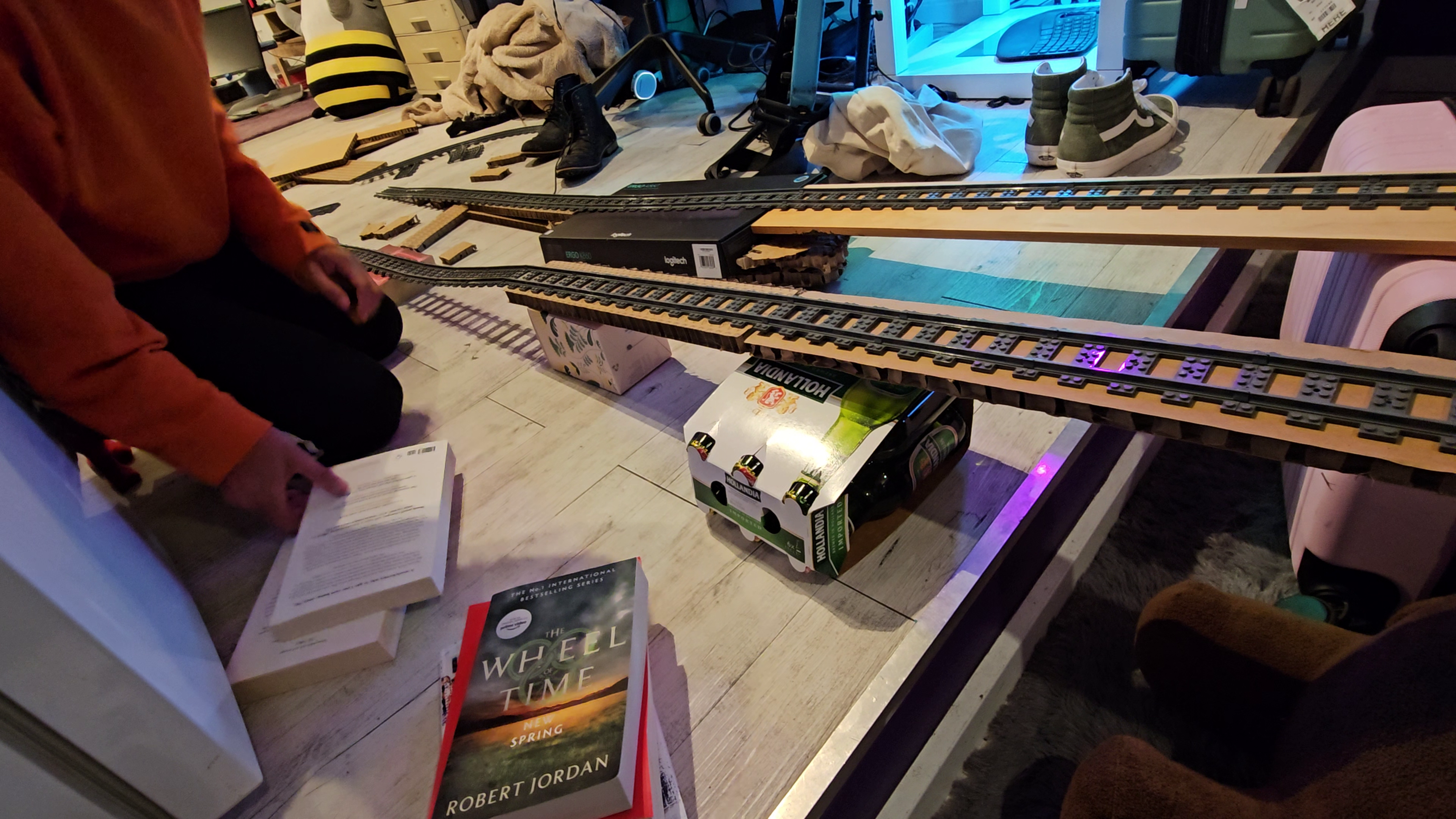
I’ve experimented with building Lego rail bridges before, using standard track and household objects like cardboard, books, and beer. Unfortunately, it can be very difficult to support the track evenly at the joints which occur every 150mm, and derailments are common. Credit: author

There’s actually a good reason Lego bridges aren’t a big thing in the company’s own product lineup, beyond a few obscure historical parts. This is probably because they aren’t very practical. Lego locomotives are not particularly strong haulers, nor do they have excellent grip on the rails, and this makes them very poor at climbing even mild grades. Any official Lego bridge would have to be very long with a shallow slope just to allow a train to climb high enough to clear a locomotive on a track below. This would end up being an expensive set that would probably prove unpopular with the casual Lego train builder, even if the diehard enthusiasts loved it. 

There are third-party options available out there. However, most rely on standard Lego track pieces and merely combine them with supports that hold them up at height. This can work in some cases, but it can be very difficult to do cool things like passing a Lego train under a bridge, for example. It can be hard to gain enough height, and the short length of Lego track pieces makes it hard to squeeze a locomotive between supports. Continue reading “How I 3D Printed My Own Lego-Compatible Train Bridges”

LEGO Machine Plays Tic-Tac-Toe Without Electronics

Tic-Tac-Toe is a relatively simple game, and one of the few which has effectively been solved for perfect play. The nature of the game made it possible for [Joost van Velzen] to create a LEGO machine that can play the game properly in an entirely mechanical fashion.

The build features no electronics to speak of. Instead, it uses 52 mechanical logic gates and 204 bits of mechanical memory to understand and process the game state and respond with appropriate moves in turn. There are some limitations to the build, however—the game state always begins with the machine taking the center square. Furthermore, the initial move must always be played on one of two squares—given the nature of the game though, this doesn’t really make a difference.

It’s also worth heading over to the Flickr page for the project just to appreciate the aesthetics of the build. It’s styled in the fashion of an 18th-century automaton or similar. It’s also been shared on LEGO Ideas where it’s raised quite a profile.

If you’ve ever wanted to think about computing in a mechanical sense, this build is a great example of how it can be done. We often see some fun LEGO machines around these parts, from massive parts sorters to somewhat-functional typewriters.

Continue reading “LEGO Machine Plays Tic-Tac-Toe Without Electronics”