3D Printing A Synthesizer

Before there were samplers, romplers, Skrillex, FM synths, and all the other sounds that don’t fit into the trailer for the new Blade Runner movie, electronic music was simple. Voltage controlled oscillators, voltage controlled filters, and CV keyboards ruled the roost. We’ve gone over a lot of voltage controlled synths, but [Tommy] took it to the next level. He designed a small, minimum viable synth based around the VCO in an old 4046 PLL chip

For anyone who remembers [Elliot]’s Logic Noise series here on Hackaday, this type of circuit should be very familiar. The only thing in this synth is a few buttons, a variable resistor for each button, and the very popular VCO for an analog square wave synth.

The circuit for this synth is built in two halves. The biggest, and what probably took the most time designing, is the key bed. This is a one-octave keyboard that’s completely 3D printed. We’ve seen something like this before in one of the projects from the SupplyFrame Design Lab residents, though while that keyboard worked it was necessary for [Tim], the creator of that project, to find a company that could make custom key beds for him.

The rest of the circuit is just a piece of perf board and the 4046. This project is all wrapped up in a beautiful all-wood enclosure with 3D printed hinges, knobs, and a speaker grille. The sound is phenomenal, and exactly what you want from a tiny monophonic square wave synth. You can check out a video of that below.

Continue reading “3D Printing A Synthesizer”

Hackaday Prize Entry: Open Source Electrospinning

Electrospinning is the process of dispensing a polymer solution from a nozzle, then applying a very high voltage potential between the nozzle and a collector screen. The result is a very, very fine fiber that is stretched and elongated down to nanometers. Why would anyone want this? These fibers make great filters because of their large surface area. Electrospinning has been cited as an enabling technology for the future of textiles. The reality, though, is that no one really knows how electrospinning is going to become a standard industrial process because it’s so rare. Not many labs are researching electrospinning, to say nothing of industry.

[Douglas Miller] is building his own electrospinning machine. Except for the ominous warning signs on the 40-kilovolt power supply, there’s nothing in this machine that makes it look any different from a normal, homebrew 3D printer. There are stepper motors inside to raise and lower a carriage, a syringe, and a handy USB port. If you didn’t know any better, you could easily assume [Doug]’s OpenESpin is designed to print fidget spinners and tiny tugboats instead of films of carbon nanotubes and piezoelectric thermoplastics.

The DIY electrospinning machine is really what the Hackaday Prize is all about. It’s an enabling technology anyone can build for a few hundred dollars that also allows real science to happen. The films and blobs being formed in [Doug]’s electrospinning machine could easily find a home in a PhD candidate’s thesis or as a component in cutting edge research on everything from battery technology to the Internet of Underpants.

Just In Time For Summer: A Remote Controlled Snowblower

It’s May, and you know what that means: we’re winding down from a worldwide celebration of the worker, pollen is everywhere, Hackaday readers in the southern hemisphere are somehow offended, and somewhere, someone is finishing up a remote-controlled snow blower build.

In this nine-part, two-hour-long video series, [Dave] covers the planning and fabrication of one of the most coveted of all cold weather yard instruments. It’s a remote-controlled snow blower. Just think: instead of bundling up to go blow the driveway off, [Dave] can get all the snow off his driveway from the comfort of his living room window. Sure, it may not sound like a big deal now that it’s Crocs & Socks weather, but this is going to be a great invention in seven or eight months.

This snow blower robot is built around two motors taken from an electric wheelchair. Most snowblowers already have tracks, so the ever-important traction for this build is already taken care of. A linear actuator takes care of the angle of the ‘scoop’, and a clever confabulation of bicycle sprockets, chain, and a motor allows the ‘chute’ of the snowblower to be pointed in any direction. The electronics are simple enough – a normal, off-the-shelf RC transmitter and receiver handles the wireless communication while an Arduino takes those signals and turns them into something the relays and motors understand.

This is one of the better build vlogs we’ve seen. There are nine parts to this build, we’ve included the final, wrapup video below.

Continue reading “Just In Time For Summer: A Remote Controlled Snowblower”

Precision Pressure In A Piston

[Scott] is building a DIY yeast reactor for his aquarium. What’s a yeast reactor? [Scott] wants to pump carbon dioxide into his aquarium so his aquatic plants grow more. He’s doing this with a gallon of sugary, yeasty water bubbling into a tank of plants and fish. In other words, [Scott] is doing this whole thing completely backward and utilizing the wrong waste product of the yeast metabolism.

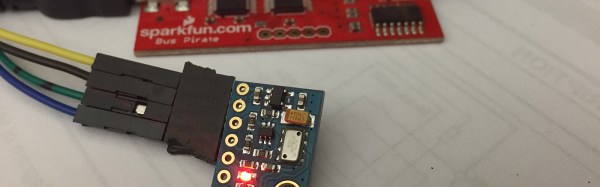
However, along the way to pumping carbon dioxide into his aquarium, [Scott] created a very high precision pressure sensor. It’s based on a breakout board featuring the MS5611 air pressure sensor. This has a 24-bit ADC on board, which translates into one ten-thousandths of a pound per square inch of pressure.

To integrate this pressure sensor into the aquarium/unbrewery setup, [Scott] created a pressure meter out of a syringe. With the plunger end of this syringe encased in epoxy and the pointy end still able to accept needles, [Scott] is able to easily plug this sensor into his yeast reactor. The data from the sensor is accessible over I2C, and a simple circuit with an ATmega328 and a character LCD displays the current pressure in the syringe.

We’ve seen these high-resolution pressure sensors used in drones and rockets as altimeters before, but never as a pressure gauge. This, though, is a cheap and novel solution for measuring pressures between a vacuum and a bit over one atmosphere.

Continue reading “Precision Pressure In A Piston”

Hackaday Prize Entry: Coaxial Drones

[Glytch] has been building drones since before they were called drones. Instead of submitting his time machine into the Hackaday Prize, he’s throwing his pocket sized, 3D printable coaxial drone into the ring.

His focus is on designing small and very portable drones, preferably one that has folding arms and can fit into a backpack. His portfolio even includes a clone of the DJI Mavic, the gimbaled camera-carrying consumer drone known for its small volume when folded.



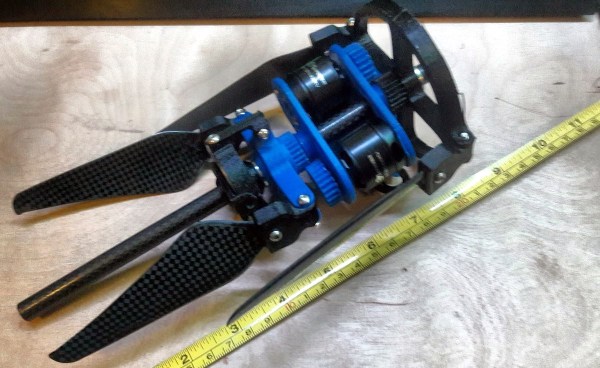
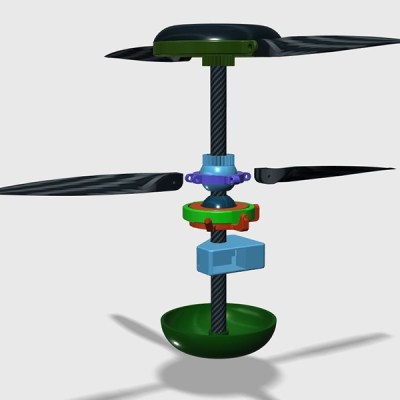
Navi — [Glitch]’s entry for the Hackaday Prize — is a complete departure from quadcopters with folding arms. It’s simple to use, and all he needs to do to launch it is hold it in the air and press a button. It does this by being a coaxial drone, or a cylinder with a pair of folding props sticking out the side. The chassis and mechanics for this drone are 3D printable, making this an awesome entry for the Hackaday Prize.

A Full Stack GPS Receiver

The usual way of adding GPS capabilities to a project is grabbing an off-the-shelf GPS module, plugging it into a UART, and reading the stream of NMEA sentences coming out of a serial port. Depending on how much you spend on a GPS module, this is fine: the best modules out there start up quickly, and a lot of them recognize the logical AND in ITAR regulations.

For [Mike], grabbing an off-the-shelf module is out of the question. He’s building his own GPS receiver from the ground up using a bit of hardware and FPGA hacking. Already he’s getting good results, and he doesn’t have to futz around with those messy, ‘don’t build ballistic missiles’ laws.

The hardware for this build includes a Kiwi SDR ‘cape’ for the BeagleBone and a Digilent Nexus-2 FPGA board. The SDR board captures raw 1-bit samples taken at 16.268 MHz, and requires a full minute’s worth of data to be captured. That’s at least 120 Megabytes of data for the FPGA to sort through.

The software for this project first acquires the GPS signal by finding the approximate frequency and phase. The software then locks on to the carrier, figures out the phase, and receives the 50bps ‘NAV’ message that’s required to find a position solution for the antenna’s location. The first version of this software was exceptionally slow, taking over 6 hours to process 200 seconds of data. Now, [Mike] has improved the channel tracking code and made it 300 times faster. That’s real-time processing of GPS data, using commodity off-the-shelf hardware. All the software is available on the Gits, making this a project that can very easily be replicated by anyone. We would expect the US State Department or DOD to pay [Mike] a visit shortly.

Of course, this isn’t the first time someone has built a GPS receiver from scratch. A few years ago, less than 1-meter accuracy was possible with an FPGA and a homebrew RF board.

Number Twitters

Grab a shortwave radio, go up on your roof at night, turn on the radio, and if the ionosphere is just right, you’ll be able to tune into some very, very strange radio stations. Some of these stations are just a voice — usually a woman’s voice — simply counting. Some are Morse code. All of them are completely unintelligible unless you have a secret code book. These are number stations, or radio stations nobody knows much about, but everyone agrees they’re used to pass messages from intelligence agencies to spies in the field.

A few years ago, we took a look at number stations, their history, and the efforts of people who document and record these mysterious messages used for unknown purposes. These number stations exist for a particular reason: if you’re a spy, you would much rather get caught with an ordinary radio instead of a fancy encryption machine. Passing code through intermediaries or dead drops presents a liability. The solution to both these problems lies in broadcasting messages in code, allowing anyone to receive them. Only the spy who holds a code book — or in the case of the Cuban Five, software designed to decrypt messages from number stations — can decipher the code.

Number stations are a hack, of sorts, of the entire concept of broadcasting. For all but a few, these number stations broadcast complete gibberish. Only to the person holding the code book or the decryption software do these number stations mean anything. However, since the first number stations went on the air over one hundred years ago, broadcasting has changed dramatically. We now have the Internet, and although most web services cannot be considered a one-to-many distribution as how broadcasting is defined, Twitter can. Are there number stations on Twitter? There sure are. Are they used by spies or agents of governments around the world? That’s a little harder to say.

Continue reading “Number Twitters”