MRRF 3D Printing Spectacular

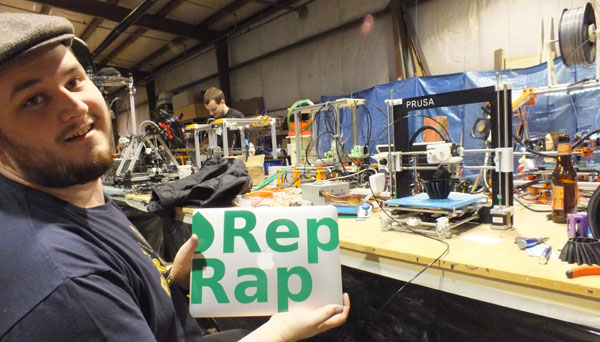
MRRF, the Midwest RepRap Festival, is in full swing right now. The venue is packed, attendance is way up this year, and the panorama is impressive:

Panoramamini
The 2016 Midwest RepRap Festival. Click to embiggen.

New Printers

MRRF is not really a trade show. Yes, there are companies here (Google is picking up the tab for Chinese food tonight), but this is assuredly a community-based event around open source hardware. That said, Lulzbot is here, SeeMeCNC is hosting, E3D, and Ultimachine are all here. This year, there are a few new printers.

Lulzbot’s Taz 6 – the latest update to their flagship printer made its first public appearance at MRRF this year. A product update from Lulzbot isn’t like a product announcement from a normal company. Lulzbot is using rapid prototyping for manufacturing (!). They can iterate quickly and release two new printers in the time it takes Stratasys to come up with a design. This also means the releases are incremental.

Click past the break for more photos and updates.

Continue reading “MRRF 3D Printing Spectacular”

Live From The Midwest RepRap Festival

It’s time once again for the world’s premier DIY 3D printer event, the 2016 Midwest RepRap Festival.

The 2016 Midwest RepRap festival is a yearly celebration of blue tape, aqua net, and tangled strands of 3D printer filament held at the Elkhart county fairgrounds in Goshen, Indiana. This year, the fairgrounds has fiber Internet, and we have a Dropcam. This can only mean one thing: live streaming from the best 3D printer convention on the planet.

The livestream is down because MRRF is over

This stream should be active the entire weekend, with the requisite breaks for sleep and to take the entire crew to the Chinese buffet down the street. Of course, if you’re in the area, you’re more than welcome to stop by. Registration is free, although a small donation would be appreciated.

The schedule for the event is as follows:

  • Friday: now until 10pm Eastern
  • Saturday: 10am to 6pm Eastern
  • Sunday: 10am to 3pm Eastern

The (incomplete) list of speakers (which might be livestreamed) is as follows:

  • E-Nable 3D printed prosthetics
  • B3 Innovations From MRRF to retail
  • IMade3D STEM + Jellybox
  • MakerOS Make Money with 3D Printing
  • J. Conway 3D Printer Adaptive Scanning Technologies

Testing DRAM, One Byte At A Time

A few weekends ago, [Chris] was in the mood for some retrogaming. That meant digging out the old Apple IIgs equipped with a monstrous RAM card with a whole three megabytes of RAM. This particular Apple IIgs had intermittent issues for a long time, and [Chris] was beginning to suspect the RAM was the culprit. Testing this required testing a few dozen individual RAM chips, so why not build something with an Arduino to make [Chris]’ life easier?

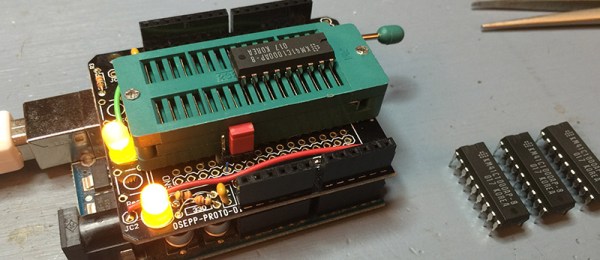
The chips found in [Chris]’ Apple are standard 1 M x 1 DRAM chips, the standard for late-80s computers. To test these chips on an Arduino, he picked up a beautiful ZIF socket, wired up the chip to an Arduino shield, and began the joyous process of figuring out how to interface DRAM to an Arduino.

Unlike static memories, DRAM needs to be refreshed periodically to recharge the capacitors. While this refresh cycle was the bane of designers and engineers throughout time, [Chris] actually doesn’t need to care about refreshing the DRAM. He’s just writing 1024 rows to the memory and reading it straight out – no need to refresh the memory. The trick comes from the multiplexed address bus. For his project, [Chris] needs to write 10 bits of the address, latch it, then write the other half of the address bits.

The DRAM tester was a success, and [Chris] put all the code and schematics up on GitHub. Solving the mystery of the broken Apple IIgs wasn’t as simple, as [Chris] thinks the problem might be in one of the support chips on the gigantic RAM card or the IIgs motherboard. Still, it’s a neat, quick build to test out a few DRAM chips.

Battery Backup For The Raspberry Pi

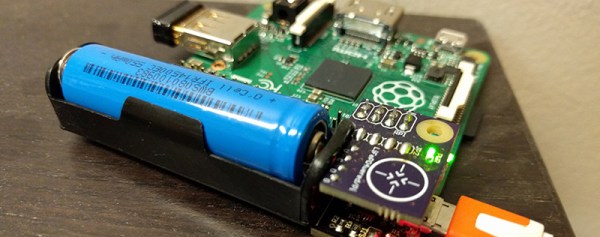
You can go to any dollar store, gas station, big box store, or your favorite Internet retailer and get a USB power bank. It’s a lithium battery mashed into a plastic enclosure with a USB port, probably poorly engineered, but it does serve as a great power supply for the Raspberry Pi. For the Raspberry Pi Zero contest we’re running over on hackaday.io, [Patrick] built a lithium phosphate battery pack that’s much better engineered and has some features a simple USB power bank will never have.

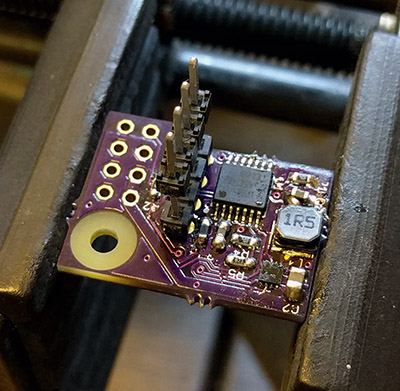
Battery[Patrick]’s Raspberry Pi UPS isn’t just a battery and charge controller attached to the power rails; this board has a microcontroller that has full control over when the Pi wakes up, when the Pi goes to sleep, and can put the Pi into a clean shutdown, even in headless mode. SD cards around the world rejoiced.

The electronics for this project are just a low-power MSP430 microcontroller and a boost regulator. The battery pack/power manager attaches to the Pi through the first few GPIO pins on the Pi’s 40-pin header. That’s enough to tap into the 3.3 and 5V supplies, along with the serial console so power events can be scripted on the Pi.

So far, [Patrick] has made a few time-lapse movies with his lithium battery backup, a Pi Model A+, and a Raspberry Pi camera. He managed to take 99 pictures over the course of about 24 hours, powered only by a single lithium-ion cell. You can check that video out below.

Continue reading “Battery Backup For The Raspberry Pi”

FAA Reauthorization Bill Includes Provisions For Hobbyists

Every year, Congress passes bills directing the funding for various departments and agencies. Sometimes, this goes swimmingly: congress recently told NASA to attempt a landing on Europa, Jupiter’s ice-covered moon. Sometimes, it doesn’t go as well. The draft of the FAA Reauthorization act of 2016 (PDF) includes provisions for drones and model airplanes amid fears of privacy-encroaching quadcopters.

As would be expected, the 2016 FAA Reauthorization act includes a number of provisions for unmanned aerial systems, a class of aircraft that ranges from a Phantom quadcopter to a Predator drone. The draft of the act includes provisions for manufacturers to prevent tampering of modification of their product, and provide the FAA with a statement of compliance, and prohibit these devices from being sold unless these conditions are met.

For a very long time, the Congress and the FAA have had special rules for model aircraft. Since 2012, the special rules for model aircraft have been simple enough: model aircraft are flown for hobby or recreational use, must operate in accordance with community-set safety guidelines, weigh less than 55 pounds, give way to manned aircraft, and not be flown within five miles of an airport. The 2016 FAA Reauthorization bill adds several updates. No model aircraft may be flown higher than 400 feet above ground level, and the operator of a model aircraft must pass a knowledge and safety test administered by the FAA. Under this draft of the FAA Reauthorization bill, you will have to pass a test to fly a quadcopter or model plane.

While this is only a draft of the 2016 FAA Reauthorization bill, there is a considerable risk flying model planes could quickly go the way of amateur radio with a Morse requirement for the license. This, of course, is due to Congress’ fears of the impact drones and model airplanes could have on safety, despite recent studies that show a 2kg drone is likely to cause injury to a human passenger once every 187 million years of operation. In other words, politicians don’t understand statistics.

The Origin Of QWERTY

There are very few things that are surrounded with as much hearsay and rumor as the origins of the QWERTY layout of typewriters and keyboards. The reason behind the QWERTY layout isn’t as simple as ‘so the bars for each letter don’t collide with each other.’ That’s nonsense – it would make far more sense to improve the mechanism before changing the arrangement of the keyboard around.

That’s not the only fallacious argument for the creation of QWERTY. It’s also been called a marketing ploy; Stephen Jay Gould popularized the idea of the QWERTY keyboard being as it is so a salesman could peck out TYPE WRITER on the top row [1]. This also makes little sense. Why would the top row and not the home row be so privileged as to contain all the letters the make up the name of the machine. For that matter, wouldn’t a sales pitch be more impressive if TYPE WRITER were typed with one hand?

This doesn’t mean there’s not a method behind the madness of QWERTY – it’s just not as simple as jammed typewriter mechanisms or appeasing the wishes of salesmen in the 1870s. QWERTY didn’t come out of thin air, though, but folk tale history of this keyboard layout is sadly deficient.

Continue reading “The Origin Of QWERTY”

Making Dumb Robots Evolve

Evolution is a fact of life, except in Kansas. It is the defining characteristic of life itself, but that doesn’t mean a stupid robot can’t evolve. For his entry into the Hackaday Pi Zero contest, [diemastermonkey] is doing just that: evolution for robots built around microcontrollers and a Raspberry Pi.

[diemastermonkey]’s project is a physical extension to genetic algorithms. Just like DNA and proteins have no idea what they’re actually doing, microcontrollers don’t either. Instead of randomly switching up base pairs and amino acids, [diemastermonkey]’s project makes random connections pins depending on the values of those pins.

The potential of these crappy, randomly programmed robots is only as good as the fitness function, and so far [diemastermonkey] has seen some surprising success. When putting these algorithms into a microcontroller connected to a tilting table mechanism and a PIR sensor, the robot eventually settled on a bit of code that would keep a ball in motion. You can check out the video of that below.


Raspberry_Pi_LogoSmall

The Raspberry Pi Zero contest is presented by Hackaday and Adafruit. Prizes include Raspberry Pi Zeros from Adafruit and gift cards to The Hackaday Store!
See All the Entries

Continue reading “Making Dumb Robots Evolve”