A $5 Graphics Card For Homebrew Computers

While not very popular, building a homebrew computer can be a fun and rewarding process. Most of the time, though, the video capabilities of these computers is as bare bones as it can get – running headless, connected to a terminal. While this is an accurate reproduction of the homebrew computers of the 1970s and 80s, there’s a lot to be said about a DIY computer with an HDMI-out port.

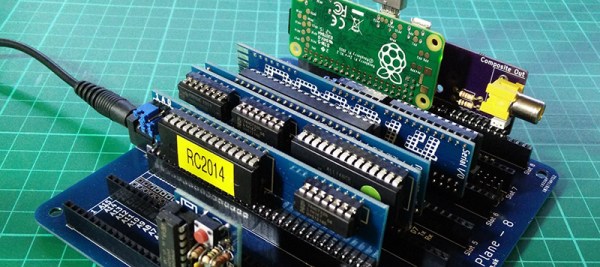
[spencer] built a Z-80-based homebrew computer a few years ago, and while connecting it to a terminal was sufficient, it was a build that could use a little more pizzazz. How did he manage to stuff a terminal in a tiny project box? With everyone’s favorite five dollar computer, the Raspberry Pi Zero.

The computer [spencer] built already had serial inputs, outputs, power, and ground rails – basically, a serial port. The Raspberry Pi also has TX and RX pins available on the 40-pin header, and with a stupidly simple board that [spencer] whipped up in KiCad, he could plug a Pi into the backplane of his homebrew computer. A few setup scripts, and a few seconds after turning this computer on [spencer] could mash a keyboard and wail away on some old school BASIC.

This isn’t a use case that is the sole domain of the Pi Zero. A Parallax Propeller chip makes for a great video terminal with inputs for PS/2 keyboards and mice. A largish AVR, with the requisite NTSC video library, also makes for a great video interface for a homebrew computer. The Pi Zero is only five dollars, though.


Raspberry_Pi_LogoSmall

The Raspberry Pi Zero contest is presented by Hackaday and Adafruit. Prizes include Raspberry Pi Zeros from Adafruit and gift cards to The Hackaday Store!
See All the Entries

Hackaday Links: March 13, 2016

Way back in 2014, Heathkit was a mystery. We knew someone was trying to revive the brand, but that was about it. Adafruit pulled out all the stops to solve this mystery and came up with nothing. The only clue to the existence of Heathkit was a random person who found a geocache in Brooklyn Bridge Park. Since then, Heathkit has released an odd AM radio kit and $150 antenna. These offerings only present more mysteries, but at least [Paul] was finally rewarded for finding the Heathkit geocache. Heathkit sent [Paul] the AM radio kit. He says it’s neat and well documented.

[David] is doing his masters thesis on, “The motivation of the maker community”. That means empirical data, and that (usually) means surveymonkey. You can take his survey on the motivations of the maker community here.

America’s best loved companies, Verizon and Makerbot, together at last.

The BeagleBone Black was launched in 2013. The BeagleBone Green – a Seeed joint – showed up last August. The BeagleBone Blue, released just a few months ago, is a collaboration between the UCSD engineering department and TI. Now there’s the BeagleBone Enhanced. Yes, they should have picked another color. Perhaps ecru. The BB Enhanced sports one Gigabyte of RAM, Gigabit Ethernet, two USB ports and two USBs via an expansion header, optional serial NOR Flash for a bootloader, optional six-axis gyro, and optional barometer.

Atmel is changing a few AVRs. There is a new die for the ATMega 44, 88, 168, and the ‘Arduino chip’, the ATMega328. Most of the changes are relatively inconsequential – slightly higher current consumption in power save mode – but one of these changes is going to trip up a lot of people. The Device ID, also known as the source of the avrdude: initialization failed, rc=-1 error, has changed on a lot of chips.

Makeit Labs in Nashua, New Hampshire has a problem. They were awarded $250,000 in tax credits to help them move and renovate. Sounds like a very good problem, right? Not so: they need to sell these tax credits before the end of the month, or they lose them. They’re looking for a few businesses in New Hampshire to buy these tax credits. From [Peter Walsh]: “Under the credit program, a typical business donating $10,000 would save $9,000 on their state and federal taxes! That $10,000 donation would cost them only $1006!” Does that make sense? No, it’s taxes, of course not. If you’re a business in New Hampshire and are looking to reduce your tax burden, this is the solution.

So I mentioned MRRF, right? You should go to MRRF. It’s next weekend.

A Pi Powered Recording Studio

In the mid-90s, you recorded your band’s demo on a Tascam cassette tape deck. These surprisingly cheap four-track portable studios were just low tech enough to lend an air of authenticity to a band that calls itself, ‘something like Pearl Jam, but with a piano’. These tape decks disappeared a decade later, just like your dreams of being a rock star, replaced with portable digital recording studios.

The Raspberry Pi exists, the Linux audio stack is in much better shape than it was ten years ago, and now it’s possible to build your own standalone recording studio. That’s exactly what [Daniel] is doing for our Raspberry Pi Zero contest, and somewhat predictably he’s calling it the piStudio.

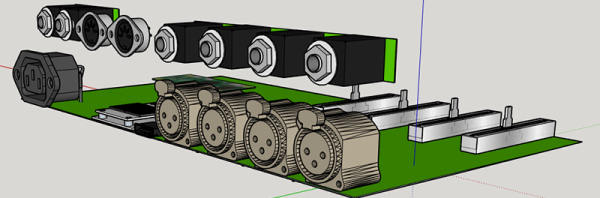
Although the technology has moved from cassette tapes to CompactFlash cards to hard drives, the design of these four-track mini recording studios hasn’t really changed since their introduction in the 1980s. There are four channels, each with a fader, balance, EQ, and a line in and XLR jack. There are master controls, a few VU meters, and if the technology is digital, a pair of MIDI jacks. Since [Daniel] is using a Raspberry Pi for this project, he threw in an LCD for a great user interface.

As with all digital recorders, the money is in the analog to digital converters. [Daniel] is using a 24-bit, 216kHz, four-channel chip, Texas Instruments’ PCM4204. That’s more than enough to confuse the ears of an audiophile, although that much data will require a hard drive. Good thing there will be SATA.

Although you can buy an eight-channel solid state recorder for a few hundred dollars – and [Daniel] will assuredly put more than that into this project, it’s a great application of a ubiquitous Linux computer for a device that’s very, very useful.


Raspberry_Pi_LogoSmall

The Raspberry Pi Zero contest is presented by Hackaday and Adafruit. Prizes include Raspberry Pi Zeros from Adafruit and gift cards to The Hackaday Store!
See All the Entries || Enter Your Project Now!
One Man’s Quest To Spend Less TIme In The Basement

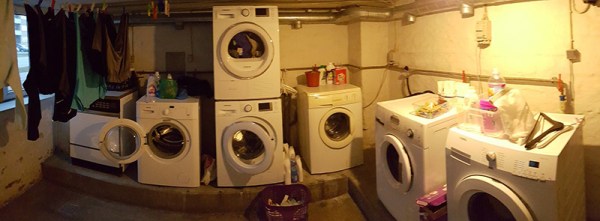
[Lars] has a second floor apartment, and the washing machines and clothes dryers are in the basement. This means [Lars] has spent too much time walking down to the basement to collect his laundry, only to find out there is 15 minutes left in on the cycle. There are a few solutions to this: leave your load in the washer like an inconsiderate animal, buy a new, fancy washer and dryer with proprietary Internet of Things™ software, or hack together a washer and dryer monitoring solution. We all know what option [Lars] chose.

Connecting a Pi to the Internet and serving up a few bits of data is a solved problem. The hard part is deciding which bits to serve. Washers and dryers all have a few things in common: they both use power, they both move and shake, they make noise, and their interfaces change during the wash cycle. [Lars] wanted a device that could be used with washers and dryers, and could be used with other machines in the future. He first experimented with a microphone, capturing the low rumble of a washer sloshing about and a dryer tumbling a load of laundry. It turns out an accelerometer works just as well, and with a sensor securely fastened to a washer or dryer, [Lars] can get a pretty good idea if it’s running or not.

With a reliable way to tell if a washer or dryer is still running, [Lars] only had to put this information on his smartphone. He ended up using PushBullet, and quickly had an app on his phone that told him if his laundry was done.


Raspberry_Pi_LogoSmall

The Raspberry Pi Zero contest is presented by Hackaday and Adafruit. Prizes include Raspberry Pi Zeros from Adafruit and gift cards to The Hackaday Store!
See All the Entries || Enter Your Project Now!
Join Us At The Greatest 3D Printing Festival On Planet Earth

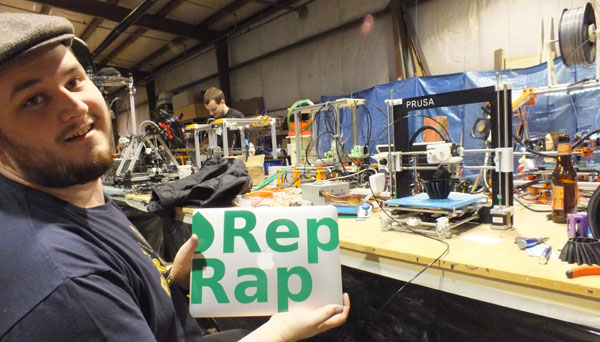
Winter is hanging on like clinical depression, which means it’s that time again for the greatest 3D-printing festival on the planet Earth. It’s time for the Midwest RepRap Festival, next weekend, March 18-20th in Goshen, Indiana.

I can’t explain why, but for some reason the Midwest RepRap Festival is an oasis of building, doing, and hacking right in the middle of the county fairgrounds for Elkhart County, Indiana. It’s free for everyone to attend. The event isn’t choked with vendors, leaving the people who actually do stuff left to fight over a few picnic tables on the outskirts of the venue. It is, by far, the most community-centered event we go to every year.

If you’re wondering what you can expect at a 3D printer convention in the middle of nowhere, check out a few of the posts we’ve published from MRRF over the last few years. We’ve seen 3D printed waffles, resin casting with 3D printed molds, bizarre movement platforms, Bioprinting, and stuff from Lulzbot. That’s just the stuff that has deserved its own Hackaday post: we’ve seen the world’s largest 3D printed trash can, R2D2, battle droids (it’s even money if BB-8 is going to show up this year), a Printer made out of K’nex, and the most beautiful 3D printer we’ve ever seen. There was a T-shirt cannon powered by 300 psi shop air.

Every year I write a post announcing that we’ll be heading to MRRF next week, simultaneously praising the event as one of the greatest ‘maker’ and ‘DIY’ meetups, while pointing out the local WalMart parking lot has a place to park horse-drawn buggies. Both observations are true. For one weekend a year, Goshen, Indiana is the place everyone reading Hackaday should go to, and that is why we are once again proud to sponsor this glorious event.

Stolen Tech: The Soviet Superfortress

Boeing’s B-17 was the most numerous heavy bomber of World War II, and its reputation of being nigh indestructible in the face of Messerschmidts and flak cannons is stuff of legend. The first flight of the B-17 was in 1935, and a decade later at the close of World War II, the B-17 would begin to show its age. It could only carry 6,000 pounds of ordnance; the first atomic bombs, Little Boy and Fat Man, weighed 9,700 pounds and 10,300 pounds, respectively. The Avro Lancaster notwithstanding, a new aircraft would be needed for the Allied invasion of Japan. This aircraft would be the Boeing B-29 Superfortress.

On paper, the B-29 nearly holds its own against all but the most modern bombers of aviation history. Yes, the B-29 is slow, but that’s only because jet engines were in their infancy in 1944. This bomber was a forgotten super weapon of World War II, and everyone – Japan, German, Great Britain and the USSR – wanted their own. Only the Soviets would go as far to build their own B-29, reverse engineering the technology from crashed and ditched American bombers.

Continue reading “Stolen Tech: The Soviet Superfortress”

Ask Hackaday: Is PLA Biodegradable?

The most popular plastic for 3D printers is PLA – polylactic acid – a plastic that’s either derived from corn starch, inedible plant detritus, or sugar cane, depending where in the world it was manufactured. Being derived from natural materials, PLA is marketed as being biodegradable. You don’t need to worry about low-poly Pokemon and other plastic trinkets filling landfills when you’re printing with PLA, all these plastic baubles will return to the Earth from whence it came.

3D printers have been around for a few years now, and now objects printed in PLA have been around the sun a few times. A few of these objects have been completely forgotten. How’s that claim of being biodegradable holding up? The results are mixed, and as always, more data is needed.

A few weeks ago, [LazyGecko] found one of his first experiments in 3D printing. In 2012, he was experimenting with tie dying PLA prints by putting his prints in a jar filled with water and blue dye. This jar was then placed in the back of his cupboard and quickly forgotten. 3.5 years later, [LazyGecko] remembered his experiment. Absolutely nothing happened, save for a little bit of blue dye turning the print a pastel baby blue. The print looks and feels exactly like the day it came off the printer.

[LazyGecko]’s blog post was noticed by [Bill Waters], and he has one datum that points to PLA being biodegradable. In 2015, [Bill] printed a filter basket for his fish tank. The first filter basket worked well, but made a small design change a week later, printed out another, and put the first print in storage. He now has two nearly identical prints, one in constant use in a biologically interesting environment, the other sitting on a shelf for a year.

[Bill]’s inadvertent experiment is very close to the best possible experimental design to make the case for PLA biodegradability. The 3D printed filter basket in constant use for a year suffered significant breakdown, and the honeycomb walls are starting to crumble. The ‘inert’ printed filter basket looks like it just came off the build plate.

If that’s not confusing enough, [Bill] also has another print that has spent a year in a fish tank. This end cap for a filter spray bar didn’t see any degradation, despite being underwater in a biologically active environment. The environment is a little different from a filter basket, though; an aquarium filter is designed to break down organics.

To answer the question, ‘is PLA biodegradable,’ the most accurate answer is, ‘maybe’. Three data points in uncontrolled environments isn’t enough to draw any conclusions. There are, undoubtedly, more forgotten 3D prints out there, and more data to back up the claim of PLA being biodegradable.

This is where you come in. Do you have some forgotten prints out there? Your input is needed, the fruits of your labors are evidence, your prints might be decaying and we want to know about it below.