Building One Thing In China

Conventional wisdom dictates that if you need to make a million of something, you go to China. China is all about manufacturing, and there aren’t many other places on the planet that have the industry and government-subsidized shipping that will bring your product from China to people around the world. Building a million things in China is one thing, but what about building one thing? How do you create a working prototype of your latest product, and how do you make that prototype look like something that isn’t held together with zip ties and hot glue? The folks at Hatch Manufacturing have a guide for doing just that, and lucky for us, it’s a process that’s easy to replicate in any well-equipped shop.

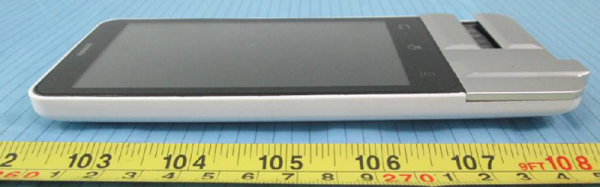
In this tutorial/case study/PR blitz, Hatch Manufacturing takes on constructing a one-off smartphone. The Huaqiangbei markets in Shenzhen are filled with vendors selling smartphones of all shapes and sizes. If you want a miniature iPhone running Android, that’s no problem. If you want a phone that looks like a 1969 Dodge Charger with the Stars and Bars on top, you can find it in China. But how are all these phones made, and how do you show off a prototype to factories begging for business?

The answer, as is always the case, comes from one-off manufacturing. Building, assembling and reworking PCBs is a well-trodden path whose process could fill several volumes, but for this post, Hatch Manufacturing decided to focus on the plastics that go into a smartphone or tablet.

Once the case or enclosure is designed with a few CAD tools, a block of plastic is run through a mill. After that, it’s a matter of painting and finishing the latest smartphone that will show up in the Chinese market. Putting a professional finish on a block of plastic is something that will look familiar to anyone who has ever assembled a miniature plastic model. There’s priming, airbrushing, sanding, more painting, sanding, wet sanding, and still more sanding. After that comes polishing the plastic part to a fine finish. It is extraordinarily labor intensive work even for a skilled hand with the right equipment.

Once the plastics are done, the PCB, display, battery, and everything else comes together in a completely custom one-off prototype. It’s very similar to how this would be done in any small shop with a benchtop mill and a dozen grades of wet/dry sandpaper. It’s also something anyone can do, provided they have enough practice and patience.


FTDI Drivers Break Fake Chips, Again

Just over a year ago, FTDI, manufacturers of the most popular USB to serial conversion chip on the market, released an update to their drivers that bricked FTDI clones. Copies of FTDI chips abound in the world of cheap consumer electronics, and if you’ve bought an Arduino for $3 from a random online seller from China, you probably have one of these fake chips somewhere in your personal stash of electronics.

After a year, we have the latest update to FTDI gate. Instead of bricking fake chips, the latest FTDI drivers will inject garbage data into a circuit. Connecting a fake FTDI serial chip to a computer running the latest Windows driver will output “NON GENUINE DEVICE FOUND!”, an undocumented functionality that may break some products.

FTDI gate mk. 1 merely bricked fake and clone chips, rendering them inoperable. Because fakes and clones of these chips are extremely common in the supply chain, and because it’s very difficult to both tell them apart and ensure you’re getting genuine chips, this driver update had the possibility to break any device using one of these chips. Cooler heads eventually prevailed, FTDI backed down from their ‘intentional bricking’ stance, and Microsoft removed the driver responsible with a Windows update. Still, the potential for medical and industrial devices to fail because of a random driver update was very real.

The newest functionality to the FTDI driver released through a Windows update merely injects unwanted but predictable data into the serial stream. Having a device spit out “NON GENUINE DEVICE FOUND!” won’t necessarily break a device, but it is an undocumented feature that could cause some devices to behave oddly. Because no one really knows if they have genuine FTDI chips or not – this undocumented feature could cause problems in everything from industrial equipment to medical devices, and of course in Arduinos whose only purpose is to blink a LED.

Right now, the only option to avoid this undocumented feature is to either use Linux or turn off Windows Update. Since the latter isn’t really a great idea, be prepared constantly roll back the FTDI driver to a known good version.

Rumors Of Xilinx Sale Abound

The companies that design and build the chips we all use – Atmel, Texas Instruments, Microchip, NXP, Freescale, Intel, Altera, Avago, Broadcom, and On Semi are all buying each other, merging, and slowly becoming two or three gigantic semiconductor companies. The question on everyone’s mind is, ‘which company will be next?’ The answer might be Xilinx, inventors of the FPGA and designers of some really cool parts.

The Wall Street Journal and Barron’s reported a few regulatory filings from Xilinx last week. This could signal an acquisition or merger of the company When this could happen is anyone’s guess, but rumors are flooding the Internet over who would buy Xilinx.

Until recently, Xilinx’s largest competitor in the FPGA market was Altera. That is, until Intel came by with a check for $16.7 Billion. The revenue, size, and market cap of both Xilinx and Altera aren’t too different, leading the question of who would have the money to buy Xilinx and isn’t Intel. Aren’t rumors fun?

Xilinx’s portfolio include high performance, mid-range and low-cost FPGAs as well as interesting hybrid devices. One such hybrid is Zynq, an FPGA and fast ARM Cortex A9 processor in the same package. All these chips will be made for years to come in one form or another. The only question is if Xilinx will make these chips, or will the company continue on under some new branding.

Hackaday Links: January 31, 2016

[Damien] has been working on MicroPython for a while now. We did an interview with him a while ago about porting Python to tiny microcontrollers, and soon the BBC micro:bit will be getting Python into the hands of millions of British schoolchildren. Now [Damien] has a Kickstarter to get MicroPython to the bare metal of an ESP8266. That would be extremely interesting; there’s a lot you can do with an easily scriptable Internet Thing running Python.

A little over a month ago, [Renier] won the Hackaday Prize Best Product competition with the Vinduino, a device that cuts water usage of vinyards (and orchards, I guess) by 25%. Now he’s won the IoT awards for Best DIY Project.

We have lost a great inventor. [Artur Fischer], inventor of the plastic drywall plug, fischertechnik, the plastic wall plug, photo flash light, and holder of over 1100 patents (more than the great Edison), passed away this week.

Who remembers Glider? That old Macintosh game where you fly a paper airplane around a house is now available on GitHub. The creator of Glider, [John Calhoun] put all the code up a few days ago. If you have Metrowerks Code Warrior sitting around on an old box, feel free to dig around.

 In the ‘this guy totally won’t get sued’ column is MagSafe for iPhones. The MagSafe power adapter is Apple’s largest contribution to humanity, but they are a little protective about it.

We have two calls for the community: [jimie] had a go at programming the latest, coolest, open source radio. Programming it is hard. Has anyone found an improved guide? Second, I now have a Tadpole Computer that was former property of Quallcom. I can’t find any info on getting *nix or *BSD on it. Anyone have any experience?

Building The Novena Laptop

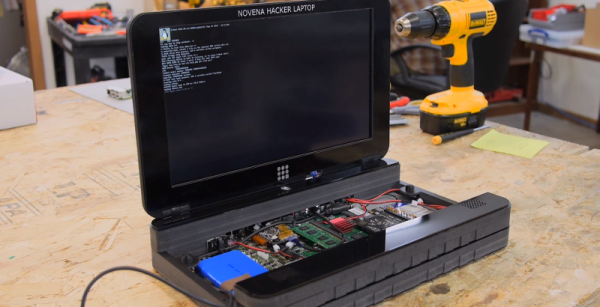
The latest hardware project from [Bunnie] is the Novena, a truly open source laptop where nearly every part has non-NDA’d datasheets. This is the ideal laptop for hardware hacking – it has an FPGA right on the motherboard, a ton of pin headers, and a lot of extras that make interfacing with the outside world easy.

While the crowdfunding campaign for the Novena included a completely custom laptop, it was terribly expensive. That’s okay; it’s an heirloom laptop, and this is a DIY laptop anyway. With the Novena now shipping, it’s time for people to build their laptops. [Ben Heck] is the first person to throw his hat into the ring with his own build of the Novena laptop, and it’s fantastic.

The second video of the build was dedicated to what is arguably the most important part of any laptop: the keyboard. For the keyboard, [Ben Heck] went all out. It’s a completely mechanical keyboard, with backlit LEDs built around the Phantom PCB with Cherry MX switches. Because this is a DIY laptop and something that is meant to be opened, the keyboard is completely removable. Think of something like the original Compaq luggable, but turned into a laptop that looks reasonably modern.

The laptop enclosure was constructed out of a sandwich of an aluminum and laser cut plastic. These layers were glued and screwed together, the parts were carefully mounted into the case. The USB keyboard was attached directly to one of the chips on the motherboard with a few flying wires and hot glue.

The finished build is fantastic, even if it is a bit thick. It’s the ultimate hacker’s laptop, with an FPGA, Linux, open source everything, and even a cute little secret compartment for storing tools and cable adapters. A great build from one of the best builders around.

Continue reading “Building The Novena Laptop”

VGA In Memoriam

The reports of the death of the VGA connector are greatly exaggerated. Rumors of the demise of the VGA connector has been going around for a decade now, but VGA has been remarkably resiliant in the face of its impending doom; this post was written on a nine-month old laptop connected to an external monitor through the very familiar thick cable with two blue ends. VGA is a port that can still be found on the back of millions of TVs and monitors that will be shipped this year.

This year is, however, the year that VGA finally dies. After 30 years, after being depreciated by several technologies, and after it became easy to put a VGA output on everything from an eight-pin microcontroller to a Raspberry Pi, VGA has died. It’s not supported by the latest Intel chips, and it’s hard to find a motherboard with the very familiar VGA connector.

Continue reading “VGA In Memoriam”

Augmented Reality Becomes Useful, Real

The state of augmented reality is terrible. Despite everyone having handheld, portable computers with high-resolution cameras, no one has yet built ‘Minecraft with digital blocks in real life’, and the most exciting upcoming use for augmented reality is 3D Dungeons and Dragons. There are plenty of interesting things that can be done with augmented reality, the problem is someone needs to figure out what those things are. Lucky for us, the MIT Media Lab knocked it out of the park with the ability to program anything through augmented reality.

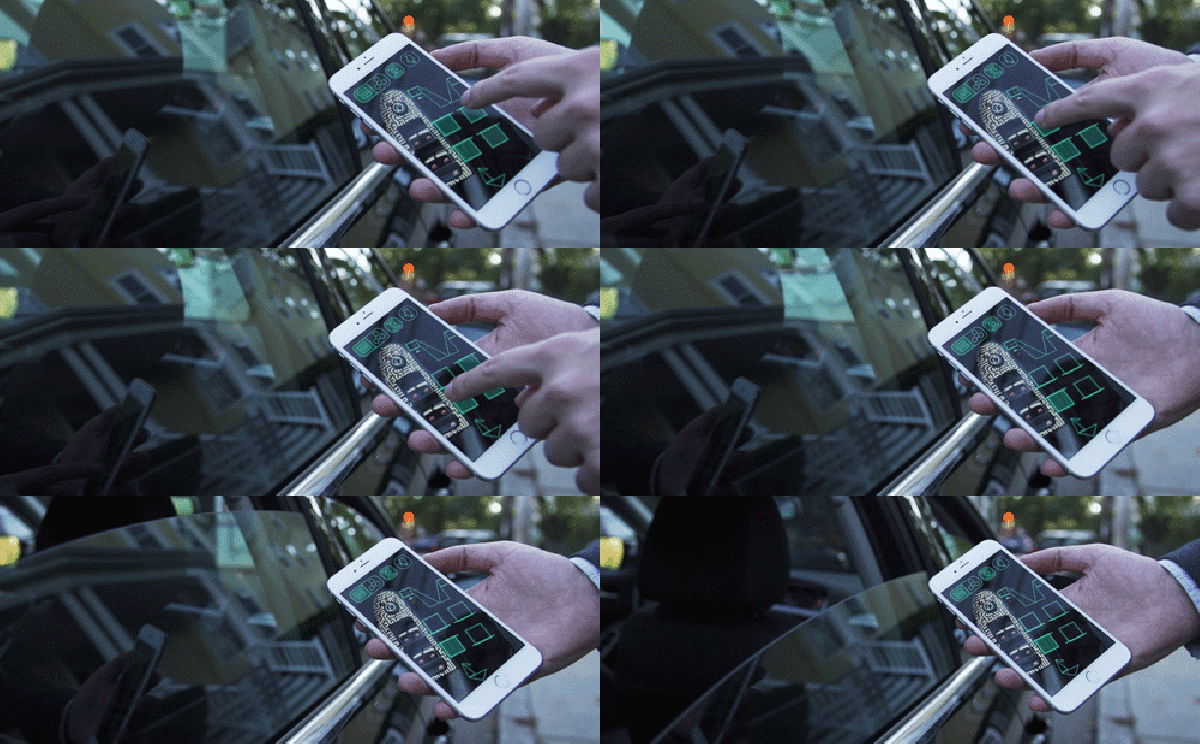
The Reality Editor is a simple idea, but one that is extraordinarily interesting. Objects all around you are marked with a design that can be easily read by a smartphone running a computer vision application. In augmented reality, these objects have buttons and dials that can be used to turn on a lamp, open a car’s window, or any other function that can be controlled over the Internet. It’s augmented reality buttons for everything.

This basic idea is simple, but by combining it by another oft-forgotten technology from the 90s, we get something really, really cool. The buttons on each of the objects can be connected together with a sort of graphical programming language. Scan a button, connect the button to a lamp, and you’re able to program the lamp with augmented reality.

The Reality Editor is already available on the Apple app store, and there are a number of examples available for people to start tinkering with this weird yet interesting means of interacting with the world. If you’ve ever wondered how we’re going to interact with the Internet of Things, there you have it. Video below.

Continue reading “Augmented Reality Becomes Useful, Real”