The Square Inch Project

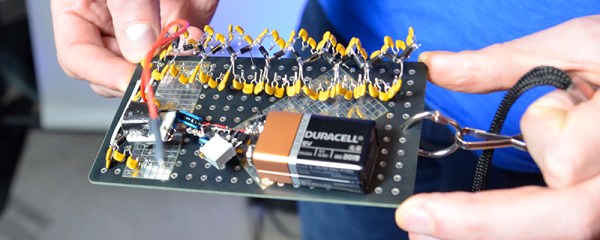
For the last few years, Hackaday has been putting together some amazing contests. We gave away a trip to space, but the winner took the money instead. We gave away another trip to space, but those winners took the money instead. But we had a ton of fun along the way and are glad to see some others are getting in on the action. In September, a contest appeared out of the blue on hackaday.io. It is the Square Inch Project, a contest with the goal of stuffing the most electronics on a square inch of printed circuit board.

This wasn’t a contest designed, planned, or organized by anyone in charge here; this is a completely organic competition arranged and implemented by the hackaday.io community. A few months ago, a few notable hackaday.io people just decided to have a contest. Awesome.

OSHPark was kind enough to give out credits for PCBs as prizes, a we added in a few gift certificates to the Hackaday Store. Apparently that’s all you need to get a lot of people making a lot of cool stuff.

There are a lot of really great entries – far too many to cover in a single post – but you’ll find a few great ones below.
Continue reading “The Square Inch Project”

3D Scanning Entire Rooms With A Kinect

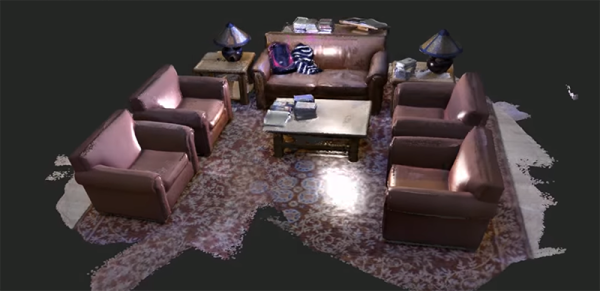
Almost by definition, the coolest technology and bleeding-edge research is locked away in universities. While this is great for post-docs and their grant-writing abilities, it’s not the best system for people who want to use this technology. A few years ago, and many times since then, we’ve seen a bit of research that turned a Kinect into a 3D mapping camera for extremely large areas. This is the future of VR, but a proper distribution has been held up by licenses and a general IP rights rigamarole. Now, the source for this technology, Kintinuous and ElasticFusion, are available on Github, free for everyone to (non-commercially) use.

We’ve seen Kintinuous a few times before – first in 2012 where the possibilities for mapping large areas with a Kinect were shown off, then an improvement that mapped a 300 meter long path though a building. With the introduction of the Oculus Rift, inhabiting these virtual scanned spaces became even cooler. If there’s a future in virtual reality, we’re need a way to capture real life and make it digital. So far, this is the only software stack that does it on a large scale

If you’re thinking about using a Raspberry Pi to take Kintinuous on the road, you might want to look at the hardware requirements. A very fast Nvidia GPU and a fast CPU are required for good results. You also won’t be able to use it with robots running ROS; these bits of software simply don’t work together. Still, we now have the source for Kintinuous and ElasticFusion, and I’m sure more than a few people are interested in improving the code and bringing it to other systems.

You can check out a few videos of ElasticFusion and Kintinuous below.

Continue reading “3D Scanning Entire Rooms With A Kinect”

Echo Of The Bunnymen: How AMD Won, Then Lost

In 2003, nothing could stop AMD. This was a company that moved from a semiconductor company based around second-sourcing Intel designs in the 1980s to a Fortune 500 company a mere fifteen years later. AMD was on fire, and with almost a 50% market share of desktop CPUs, it was a true challenger to Intel’s throne.

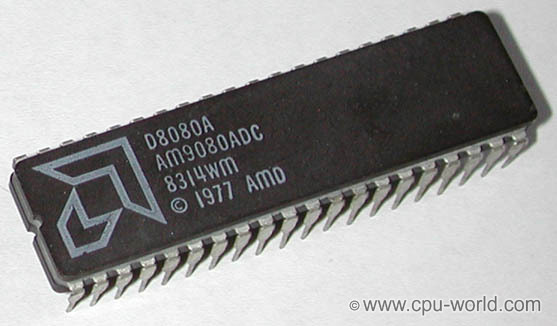
An AMD 8080A. source
An AMD 8080A. source.

AMD began its corporate history like dozens of other semiconductor companies: second sourcing dozens of other designs from dozens of other companies. The first AMD chip, sold in 1970, was just a four-bit shift register. From there, AMD began producing 1024-bit static RAMs, ever more complex integrated circuits, and in 1974 released the Am9080, a reverse-engineered version of the Intel 8080.

AMD had the beginnings of something great. The company was founded by [Jerry Sanders], electrical engineer at Fairchild Semiconductor. At the time [Sanders] left Fairchild in 1969,  [Gordon Moore] and [Robert Noyce], also former Fairchild employees, had formed Intel a year before.

While AMD and Intel shared a common heritage, history bears that only one company would become the king of semiconductors. Twenty years after these companies were founded they would find themselves in a bitter rivalry, and thirty years after their beginnings, they would each see their fortunes change. For a short time, AMD would overtake Intel as the king of CPUs, only to stumble again and again to a market share of ten to twenty percent. It only takes excellent engineering to succeed, but how did AMD fail? The answer is Intel. Through illegal practices and ethically questionable engineering decisions, Intel would succeed to be the current leader of the semiconductor world.

Continue reading “Echo Of The Bunnymen: How AMD Won, Then Lost”

The Best Badges Of The SuperCon

A few weeks ago, we took a look at the best badge hacks at the Hackaday Supercon. These were the best badge hacks anyone has ever seen – including what comes out of DEF CON and the SDR badge from the latest CCC. I’m ascribing this entirely to the free-form nature of the badge; give people a blank canvas and you’re sure to get a diverse field of builds. Now it’s time to take a look at the cream of the crop, hear what the jolly wrencher sounds like, and how to put 1000 Volts in a badge.

There were three categories for the badge hacking competition at the SuperCon – best deadbug, best blinky, and most over the top. A surprising number of people managed to solder, glue, and tape some components to a the piece of FR4 we used as a conference badge, but in the end, only three would win.

Continue reading “The Best Badges Of The SuperCon”

Creating Art In A Robot That Tastes With Its Feet

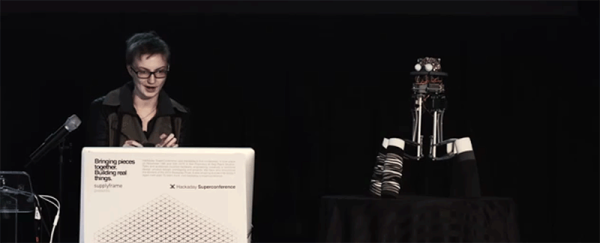
[Sarah Petkus] started off her career as a visual artist with traditional mediums. She has a webcomic called Gravity Road, but somewhere along the line she wanted her creations to come alive. These characters are robots – artistically designed robots – and turning this type of art into a real object isn’t something that happens very often.

Robots usually aren’t art. A Roomba is just a vacuum cleaner that’s meant to turn on a dime, thus the circular shape. The welding robots in a car factory aren’t art, they’re only tools to assemble cars. These are just devices built for a single purpose, and art is for any or every purpose. It’s not something you can really design, but you can engineer a few interesting solutions.

Continue reading “Creating Art In A Robot That Tastes With Its Feet”

The Filmomat Home Film Processing System

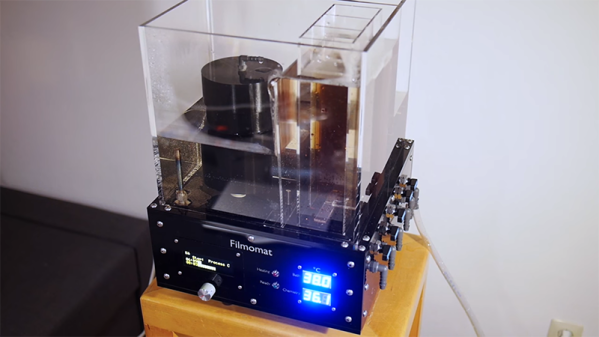
The death of film has been widely reported, but technologies are only perfected after they’ve been made obsolete. It may not be instant photography, but there is at least one machine that will take 35mm film and 5×7″ prints and develop them automatically. It’s called the Filmomat, and while it won’t end up in the studios of many photographers, it is an incredible example of automation.

The Filmomat is an incredible confabulation of valves, tubes, and pumps that will automatically process any reasonably sized film, from 35mm to 5×7 color slides. The main body of the machine is an acrylic cube subdivided into different sections containing photo processing chemicals, rinse water, and baths. With a microcontroller, an OLED display, and a rotary encoder, different developing processes can be programmed in, the chemicals heated, developer agitated, and film processed. The Filomat is capable of storing fifty different processes that use three chemicals and a maximum of ten steps.

The video for this device is what sells it, although not quite yet; if enough people are interested, the Filmomat might be sold one day. This is likely the easiest film developing will ever get, but then again a technology is only perfected after it has been made obsolete.

Thanks [WhiteRaven] for sending this one in.

Continue reading “The Filmomat Home Film Processing System”

A Structural PVC Cyr Wheel

PVC is a great building material that can be used for everything from yurts and geodesic domes to pressure vessels. One thing we haven’t seen a lot of is bending PVC pipe. [Lou] wanted to build a Cyr wheel for his daughter, and instead of shelling out five hundred big ones for an aluminum version, he build one out of PVC using techniques usually reserved for woodworking.

A Cyr Wheel is usually a large aluminum hoop built for acrobatic performances. These performances are pretty impressive and look like a lot of fun, but the wheels themselves are rather expensive. Figuring PVC was a good enough solution, [Lou] built his own Cyr wheel for $50 in materials.

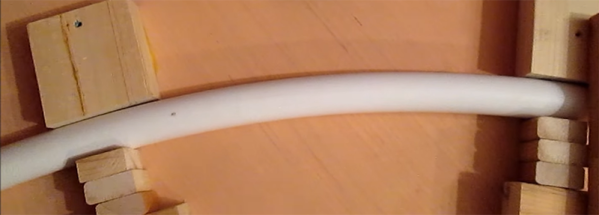
The build started off by laying out a jig on the floor. Two sheets of plywood were laid out, a radius for the wheel traced, and a bunch of blocks were glued to the perimeter of this mold. With the mold in place, a few pieces of PVC were flexed into position, clamped, heated with a hair dryer to relieve stress, and glued to a second course of PVC.

The process [Lou] used to build his Cyr wheel isn’t that different from extremely common woodworking techniques. In fact, it wouldn’t be unreasonable for [Lou] to build a wooden Cyr wheel with the same jig. We’re wondering how well this project will stand up to abuse, so if you have any insight to the uses of structural PVC drop a note in the comments.