Hackaday Links: December 6, 2015

[Camus] had it all wrong. After a few hundred years of rolling a stone up a mountain, Sisyphus would do what all humans would do: become engrossed in novelty. The stone would never reach the summit, but it could roll off some pretty sweet ramps. That mountain goat that ticked him off a few decades ago? If Sisyphus let go right now, the stone would probably take that goat out. Sisyphus, like all of us, would be consumed in meaningless novelty. One must imagine Sisyphus happy.

The pumpkin spice must flow. It’s the holidays and for a lot of us that means copious amounts of baked goods. How about an edible sandworm? It looks like something close to a cinnamon roll.

This December’s Marie Claire – whatever that is, I have no idea – features haute circuits. These circuit boards are the work of [Saar Drimer] and Boldport, makers of fine circuit board art. We’ve seen his work a number of times featuring squiggly traces and backlit panels. This seems to be the first time Boldport and the entire idea of PCB art has infiltrated the design world. He also does puzzles.

Raspberry Pi cases simply do not look cool. There’s ports coming out everywhere, and plastic really doesn’t look that great. You know what does look great? Walnut. [Karl] made a few of these out of walnut, MDF and solid aluminum. He’s thinking he might bring this to market, you can check out his webzone here.

Self-driving cars being sold right now! That’s an eBay link for a DARPA Grand Challenge vehicle, a heavily modified Isuzu VehiCross loaded up with computers, a laser scanner, camera, and connected to actuators for steering, brake, pedals, and shifter.

A few years ago, a snowboarding company realized they could use YouTube as a marketing device. They made some really cool projects, like a snowboard with battery-powered heaters embedded in the core of the board (yes, it works). There’s only so many different snowboards you can build, so they turned to surfboards. In fact, they turned to cardboard surfboards, and last week they made a cardboard electric guitar in the Fender custom shop. It’s a completely understandable linear progression from A to B to I don’t know what kind of glue they’re using.
Experiences In Developing An Electronics Kit

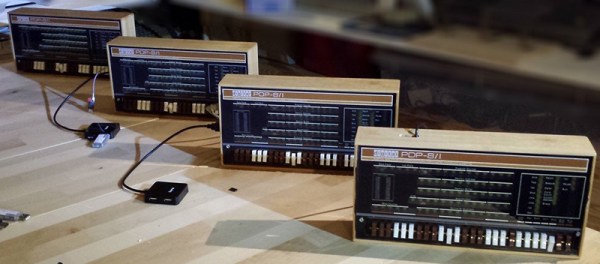
This year’s Hackaday Prize included a category for the Best Product, and there is perhaps no project that has inspired more people to throw money at their computer screens than [Oscar Vermeulen]’s PiDP-8/I. It’s a replica of the PDP-8/I from 1968. Instead of discrete electronics driving the blinkenlights and switches on the front of this computer, [Oscar]’s version uses a Raspberry Pi and the incredible SIMH emulator for dozens of old mainframes and minicomputers. It is, for all intents and purposes, a miniaturized version of a 50 year old computer that will fit on your desk and is powered by a phone charger.

Check out the video of [Oscar]’s talk below then join us after the break for more discussion of his work.

Continue reading “Experiences In Developing An Electronics Kit”

Chromatic Clocks With A Steampunk Twist

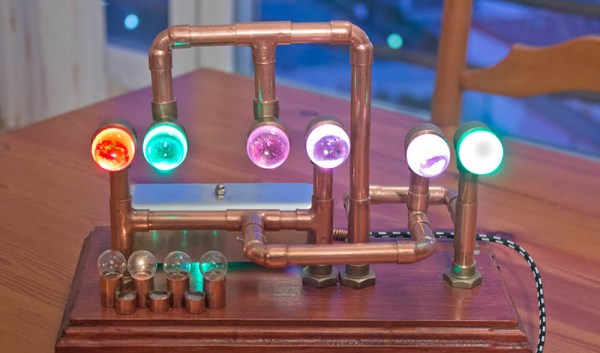
There’s nothing like a good clock project, and tacking the steampunk modifier on it only makes it better. [José] built a steampunk clock that does it much better than just gluing some gears on an enclosure and calling it a day. This build includes glowing jewels displaying the time in different colors while displaying the a steampunker’s prowess with a pipe cutter.

The body of the clock is a piece of finely lacquered wood, hiding a perfboard construction with a DS3231 real time clock, a DHT22 temperature and humidity sensor, and a light sensor for dimming the WS2812 LEDs according to the ambient light level.

The rest of the clock is a bunch of 12mm copper pipe, elbows, and t couplers. The end of these pipes are capped off with marbles, with the RGB LEDs behind each of the ‘digits’ of the clock. This is a chromatic clock, with the digits 0 through 9 assigned a different color, based on the resistor color code scheme with exceptions for black and brown. Once you’ve figured out how to tell time with this clock, you should have no problem finding that single 56k resistor in your junk box.

You can check out the video of the clock below.

Continue reading “Chromatic Clocks With A Steampunk Twist”

A Teensy Logic Analyzer For A 6502

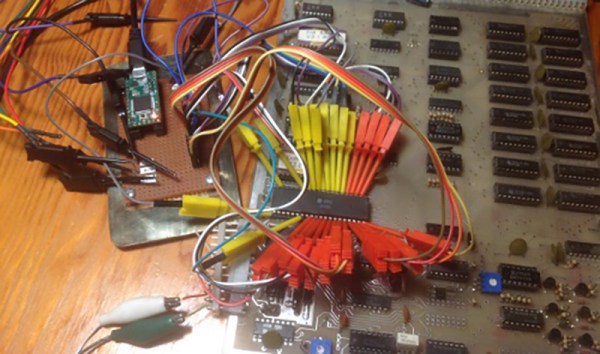
[John] has an interesting, if old piece of tech sitting on his workbench. It’s an Ohio Scientific C3-8P computer from the late 70s by way of a few garages, basements, and attics. As with most tech of this vintage, there are some problems, and [John] found debugging a little frustrating without the ability to trace and watch the programs. He needed a logic analyzer, and found one in an unlikely piece of hardware. [John] built one using a Teensy microcontroller, and further refinement of this project could turn it into a full in-system emulator.

The old Ohio Scientific computer [John] is trying to bring back from the dead is based on the 6502 CPU. That’s sixteen address lines to monitor, eight data lines, and four control lines. These were wired directly to a Teensy 3.1.

Reading and controlling all the signals from a 6502 is a task that falls to Linux. A command line program controls the Teensy and is capable of reading memory, setting trigger addresses, dumping the entire address space to a file, or just recording the last 5,000 clock cycles. This kind of tech existed back in the late 70s and early 80s. It also cost a fortune. Now, with a $20 Teensy and probably another $30 in ribbon cables and test clips, anyone can build a logic analyser for a very old computer system.

Videos below.

Continue reading “A Teensy Logic Analyzer For A 6502”

Windows 10 On A Tiny Board

Over the past few months, a number of companies and designers have started picking up the newest Intel SoCs. Intel has to kill ARM somehow, right? The latest of these single board x86 computers is the Lattepanda. It’s a tiny board that can run everything a 5-year-old desktop computer can run, including a full version of Windows 10.

This isn’t the first time we’ve seen a tiny x86 board in recent months. Last October, an x86 board that takes design cues from the Raspberry Pi 2 hit Kickstarter. These are proper PCs, with the ability to run Windows 10, Linux, and just about every other environment under the sun.

The specs for the Lattepanda include a quad-core Cherry Trail running at 1.8GHz. the RAM is either 2GB or 4GB depending on configuration, and 32GB of eMMC Flash. Peripherals include USB 3.0, Ethernet, WiFi, Bluetooth, and integrated graphics supporting either HDMI or a DSI connector.

But of course a computer is just a computer, and you can’t sell a machine that only runs Skype to the ‘maker’ market. The Lattepanda also includes an ATMega32u4 as a coprocessor, giving this board ‘Arduino functionality’. In my day we walked uphill both ways to get a parallel port, but I digress.

While these tiny x86 boards might not be available in a year’s time, and the companies behind them may fall off the face of the planet, the introduction of these devices portends a great war over the horizon. Intel wants the low-power SoC market, a space until now reserved entirely for ARM-based devices.

Matthias Builds A Belt Sander

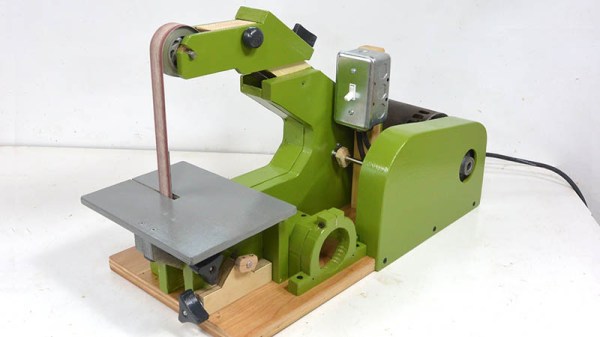
[Matthias Wandel] is the preeminent YouTube woodworker, with dozens of machines constructed from wooden gears, amazing machines that produce perfect mortise and tenons, and home-built table saws and jointers. Actually building something instead of buying it is a hallmark of [Matthias]’ channel, and he’s at it again, building his own woodworking machines. This time it’s a 1″ wide belt sander. Of course anyone can go out and simply buy one of these sanders for under $100, but what’s the point in that when you can build one out of plywood and a motor you picked out of the trash?

The design of this belt sander – just like the commercial version he’s improving upon – uses three wheels to guide the 42″ long strip of sandpaper around its course. [Matthias] is using rollerblade wheels for the front wheels. Rollerblade wheels aren’t the best shape for bearings, this can be fixed by using a table saw as a lathe. Yes, [Matthias] lathes with a table saw. He’s just that good.

The rest of the frame was carefully constructed out of plywood and powered by a 1/3 horsepower furnace fan motor pulled from the trash. There are a few interesting features that make this belt sander exceptionally useful: a rounded platen behind the belt makes sanding interior corners very easy, and is something that isn’t usually found on commercial belt sanders.

You can check out [Matthias]’ video below.

Continue reading “Matthias Builds A Belt Sander”

Hackaday Links: November 29, 2015

The Raspberry Pi Zero was announced this week, so you know what that means: someone is going to destroy a Game Boy Micro. If you’re interested in putting the Zero in a tiny handheld of your own design, here are the dimensions, courtesy of [Bert].

[Ahmed] – the kid with the clock – and his family are suing his school district and city for $15 Million. The family is also seeking written apologies from the city’s mayor and police chief.

There are a lot — a lot — of ‘intro to FPGA’ boards out there, and the huge variety is an example of how the ‘educational FPGA’ is a hard nut to crack. Here’s the latest one from a Kickstarter. It uses an ICE40, so an open source toolchain is available, and at only $50, it’s cheap enough to start digging around with LUTs and gates.

Over on Hackaday.io, [Joseph] is building a YAG laser. This laser will require a parabolic mirror with the YAG rod at the focus. There’s an interesting way to make one of these: cut out some acrylic and beat a copper pipe against a form. A little polish and nickel plating and you have a custom mirror for a laser.

You know those machines with wooden gears, tracks, and dozens of ball bearings? Cool, huh? Tiny magnetic balls exist, and the obvious extension to this line of thought is amazing.

[David Windestål] is awesome. Completely and totally awesome. Usually, he’s behind the controls of an RC plane or tricopter, but this time he’s behind a slo-mo camera, an RC heli, and a watermelon. That’s a 550-sized heli with carbon fiber blades spinning at 2500 RPM, shot at 1000 FPS.

How do you label your cables? Apparently, you can use a label printer with heat shrink tubing. Nothing else, even: just put heat shrink through a label maker.