Pip Boys As A Service

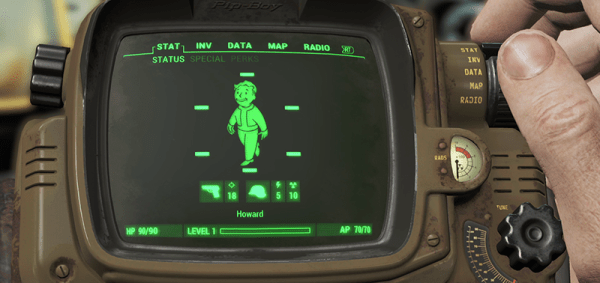
A few weeks ago Fallout 4 was released, and like all future games of the year, productivity has fallen through the floor, cosplayers are busy crafting outfits, and modders are busy tearing the game to pieces. As with all big game releases, Fallout 4 has a super-deluxe, ultra-collectible edition, and this version comes with its own Pip Boy, the in-game wrist-mounted user interface that manages stats, inventory, and quests.

This Pip Boy is actually functional, relying on a smartphone to mirror the display in-game Pip Boy. This, of course, means there must be some sort of communication between the game and a phone. [Kyle] found this somewhat interesting and decided to dig into these communications to see what else could be done with the real life mirror of the in-game Pip Boy

With a simple swipe of nmap, [Kyle] discovered two ports open on his PS4. By creating a relay to listen in on whatever is passing through these ports, [Kyle] built a tool that allows anyone to dump data from the in-game Pip Boy to any other service.

The library and command line tool work with PS4 and PC and are able to dump stats and data from the in-game Pip Boy to the outside world. It will be interesting to see what kind of mashups could be created with this; especially interesting would be a leaderboard for an entire office of vault dwellers, but a TV-sized Pip Boy would also suffice.

Yes, that is a challenge.

3 Billion Devices And A Sega Genesis Run Java

A few years ago, [Mike]’s friend gave him an old Sega Genesis with the very cool and somewhat rare SegaCD drive attached. The SegaCD gave him an idea – while it’s not easy to burn a cartridge and play homebrew games on a real Genesis console, everyone has a CD burner somewhere. [Mike] began writing his demo and then realized adding Java would be easy on the 68000. The result is Java on three billion devices and a Sega Genesis.

This project is built around Java Grinder a Java byte code compiler that will compile classes, factories, and all the horrible Java design.design.pattern.pattern.patterns() into assembly language. Already, there are a lot of platforms supported by Java Grinder, including the Commodore 64, the TI99, and thanks to some work from [Joe Davisson], the Apple IIgs

With a byte code compiler, an assembler, and an API for the Sega-specific hardware, [Mike] set about building his demo. Since this was a Sega, it needed the ‘SEGA’ sound at the start. [Mike] ended up recording his voice saying ‘JAVA!’ This plays through the Z80 on the Genesis.

The complete demo – viewable in its emulated format below – has everything you would expect from a proper demo. Starfields, dancing sprites, and even a Mandelbrot pattern make it into the three-minute long demo.

Continue reading “3 Billion Devices And A Sega Genesis Run Java”

Hackaday Links: November 22, 2015

There’s a new documentary series on Al Jazeera called Rebel Geeks that looks at the people who make the stuff everyone uses. The latest 25-minute part of the series is with [Massimo], chief of the arduino.cc camp. Upcoming episodes include Twitter co-creator [Evan Henshaw-Plath] and people in the Madrid government who are trying to build a direct democracy for the city on the Internet.

Despite being a WiFi device, the ESP8266 is surprisingly great at being an Internet of Thing. The only problem is the range. No worries; you can use the ESP as a WiFi repeater that will get you about 0.5km further for each additional repeater node. Power is of course required, but you can stuff everything inside a cell phone charger.

I’ve said it before and I’ll say it again: the most common use for the Raspberry Pi is a vintage console emulator. Now there’s a Kickstarter for a dedicated tabletop Raspi emulation case that actually looks good.

Pogo pins are the go-to solution for putting firmware on hundreds of boards. These tiny spring-loaded pins give you a programming rig that’s easy to attach and detach without any soldering whatsoever. [Tom] needed to program a few dozen boards in a short amount of time, didn’t have any pogo pins, and didn’t want to solder a header to each board. The solution? Pull the pins out of a female header. It works in a pinch, but you probably want a better solution for a more permanent setup.

Half of building a PCB is getting parts and pinouts right. [Josef] is working on a tool to at least semi-automate the importing of pinout tables from datasheets into KiCad. This is a very, very hard problem, and if it’s half right half the time, that’s a tremendous accomplishment.

Last summer, [Voja] wrote something for the blog on building enclosures from FR4. Over on Hackaday.io he’s working on a project, and it’s time for that project to get an enclosure. The results are amazing and leave us wondering why we don’t see this technique more often.

Building A Better 3D Printed Gun

Back in 2013, [Cody Wilson] of Defense Distributed designed and built the world’s first completely 3D printed pistol. He called his gun the Liberator, after a World War II-era single-shot pistol designed to be cheap and easy to manufacture, easy to conceal, and for members of the French Resistance, ‘a great gun to obtain a better gun’.

cyl[Cody]’s Liberator turned out to be a great gun to obtain two or three fewer fingers. Not only was this a single-shot pistol, it was a single barrel pistol; with each round fired requiring a new 3D printed barrel. Tests were carried out, explosions happened, and we couldn’t even get the thing to print. For all the media hubbub, for all the concerned legislators, the first 3D printed pistol was much ado about nothing.

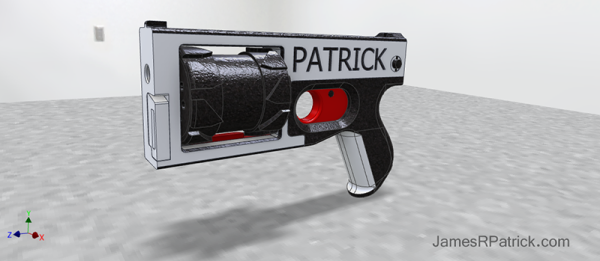
3D printers are still an extremely interesting technology, and if history has proved one thing, it’s that engineers and tinkerers will keep building guns. Last week, [James Patrick] released his latest design for a working 3D printed gun. It still fires the .22lr of the Liberator, but this is a double action revolver, it won’t blow up, and if you drop it, it won’t discharge. It’s the little things that count.

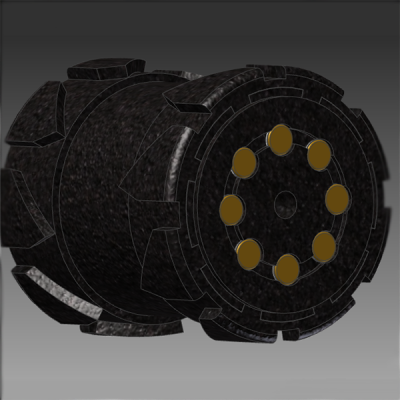
[James]’ revolver is either a 6 or 8-shot revolver uses a pepper-box design, where the gun has multiple chambers and barrels in one gigantic cylinder. The double action design first rotates the cylinder to the next chamber, pulls back a striker loaded up with a firing pin nail, and (hopefully) fires a round. In the video below, [James] goes over the design of his action, and ends up showing off a few test firings of his newly designed gun.

What’s very interesting about this build is how closely the development of 3D printed firearms is following the development of historical firearms. First, we had guns that probably shouldn’t be fired, ever. Now, the technology for 3D printed guns is about up to 1830 or thereabouts. Give it a few more years and we’ll be up to 1911.


Disclaimer: if you live in the US and think this sort of thing should be illegal, contact your state representative and tell them you support a constitutional convention to remove the personal right to own and operate firearms. This right has been upheld many, many times by the judiciary, and a constitutional convention is the only way your wishes could be carried out. Your state representative probably doesn’t read Hackaday; there is no need to comment here. Let’s talk about engineering and technology instead.

Continue reading “Building A Better 3D Printed Gun”

Hacklet 85: Alternative Audio Amplifiers

When you think of amplifiers, you’re probably thinking of audio or some big ‘ol power amps for radios. While interesting, there are some very interesting ‘alternative’ amplifiers floating around hackaday.io that are more than just power amps, and exceedingly useful, to boot.

1601181393316190625[Ronald] bought an XMS amplifier a few years ago, and although it worked well, every time he changed the input, the loudness had to be toggled. One thing led to another, and he realized this amplifier had a four-channel audio processor that could be controlled by I2C. This was the beginning of his Network Amplifier.

Inside the box is a Raspberry Pi that controls a PT2314-based amplifier. Also included is a 2×16 character LCD, a few LEDs, switches, and a rotary encoder.  There was an Android app that controlled the amplifier, but this was discarded for a better looking web-based solution. Now [Ronald] has every audio source available over WiFi.
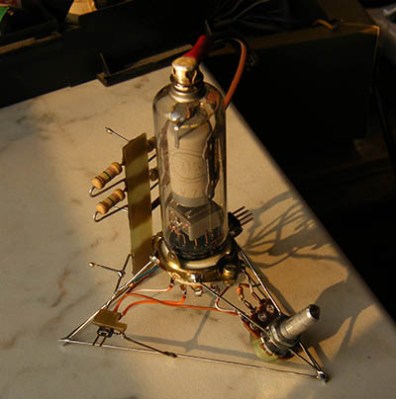
973501443636885535What if you want an audio amplifier without a speaker? Wait, what? That’s what [DeepSOIC] is doing with his experiments in ion wind loudspeakers.

‘Ion wind lifters’ have been around for decades now, mostly in the labs of slightly off-kilter people who believe this is the technology aliens are using to visit earth. Nevertheless, ion wind lifters produce an airflow, and if you make that wind variable, you get sound. Pretty cool, huh?

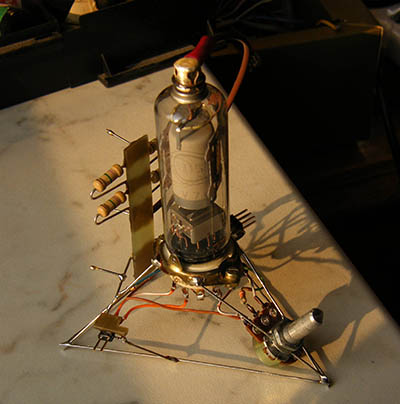
The amplifier for this project uses a tube to modulate kilovolt supply through the ion ‘blower’. Does it work? Sure does. [DeepSOIC] got a piece of 0.2 mm nichrome wire to discharge ions into the air, after which the ions drift into the second electrode. The result is sound, and the entire project is built deadbug style. It really doesn’t get cooler than this.
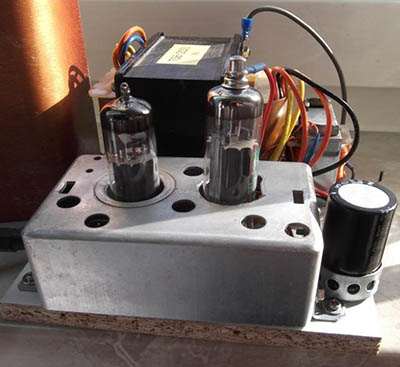
 

2981611414932529525Continuing with the tube amp trend, [Marcel] built the cheapest little tube amp around.

The design of an audio tube amp is fairly simple business. First, you start with a big ‘ol transformer, and rectify the AC into DC. This gets fed into a preamp tube, and this is fed into a bigger power tube.

In about 50 years of development, tube designers had the technology down pat by the mid 1950s, and triode/pentode tubes were created. This allowed tube designers to condense two amplifier stages into a single tube. While this setup was usually used for cheap, toy-like electronics, you can still buy the ECL82 tube today.

[Marcel] took one of these tubes, added a rectifier tube, transformer, and big cap to create the simplest possible tube amp. Use it for guitars, use it for hi-fis, it’s all the same. It’s not going to sound great, but it is a very easy amp to build.

All of these interesting audio amplifier projects are curated on this new list! If you have a build that amplifies sound in an interesting way, don’t be shy, just drop [Adam] a message on Hackaday.io and he’ll add it. That’s it for this week’s Hacklet. As always, see you next week. Same hack time, same hack channel, bringing you the best of Hackaday.io!

The Best Conference Badge Hacking You’ve Ever Seen

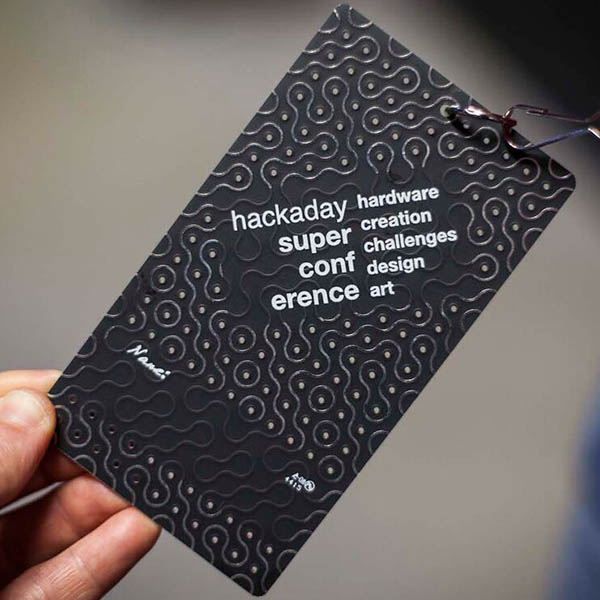
72EJpM5noCVCOQOeMV74_fmZeSQKcPxiqv70JYc9psgAs with any proper hardware con, the Hackaday Supercon needed a badge, and preferably one that was electronic. This conference centered around hardware creation, and the badge was no exception.

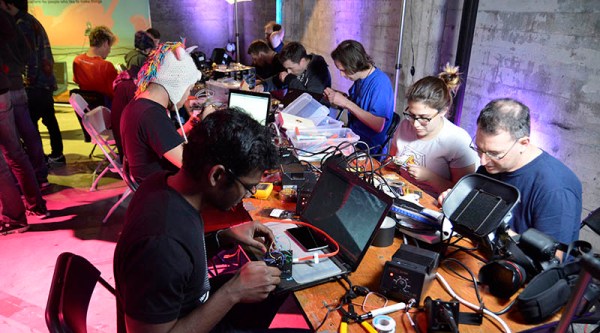
Designed on a tight timeline, it was possible to deliver a PCB badge for the attendees but it didn’t include microcontrollers, FPGAs, or software defined radios. This blank slate was the foundation for a completely unconstrained freestyle electronics soldering session.

The front of the badge includes a matte black solder mask with Truchet tiles of traces. Put multiple badges edge-to-edge and the pattern continues indefinitely. Inside of each curved trace is a through-hole via and those makes up a grid of holes on the back of the badge. On that back side there are also two rectangular grids that presented a nice area to which hackers soldered their components.

More than a few people took up the challenge of hacking their badge, and despite a strange pitch for the through holes (0.230″), and traces that didn’t go anywhere, there were some amazing builds. I would go so far to say that the badge hacking at the Supercon was the best I’ve ever seen, and this includes DEFCON and CCC.

Continue reading “The Best Conference Badge Hacking You’ve Ever Seen”

ON Semiconductor Acquires Fairchild

In the continuing process of semiconductor companies buying each other up, ON Semiconductor has acquired Fairchild Semiconductor for $2.4 Billion.

ON Semi and Fairchild’s deal is only the latest in a long line of mergers and acquisitions. We’ve recently seen Dialog’s buyout of Atmel, Avago’s purchase of Broadcom,  NXP and Freescale’s merger, and soon might see TI buy Maxim. We’re currently in the great time of acquisition, with nearly $100 Billion flowing from company to company in just a few months.

Companies have cash to spend and costs to cut. This latest deal is expected to save $150 Million in annual costs.

Fairchild has a long and storied history in the semiconductor industry, with the first integrated circuit produced in a Fairchild lab in Palo Alto. [Bob Widlar] made Fairchild his home until famously leaving for National Semiconductor in 1965. Somewhat ironically, Fairchild Semiconductor was bought by National Semiconductor in 1987.

ON Semiconductor’s history is not nearly as interesting, being spun off of Motorola’s semiconductor business in 1999. Although ON’s main line of business was discrete components, ON also has a catalog of quite a few power management ICs.

Unfortunately, because ON Semi bought Fairchild and not the other way around, we’re stuck with what is probably the worst logo in the entire semiconductor industry: drop-shadowed balls are so mid-90s!