The Digistump Oak; An ESP8266 On Kickstarter

When it was first released, the ESP8266 was a marvel; a complete WiFi solution for any project that cost about $5. A few weeks later, and people were hard at work putting code on the tiny little microcontroller in the ESP8266 and it was clear that this module would be the future of WiFi-enabled Things for the Internet.

Now it’s a Kickstarter Project. It’s called the Digistump Oak, and it’s exactly what anyone following the ESP8266 development scene would expect: WiFi, a few GPIOs, and cheap – just $13 for a shipped, fully functional dev board.

The guy behind the Oak, [Erik Kettenburg], has seen a lot of success with his crowdfunded dev boards. He created the Digispark, a tiny, USB-enabled development board that’s hardly larger than a USB plug itself. The Digispark Pro followed, getting even more extremely small AVR dev boards out in the wild.

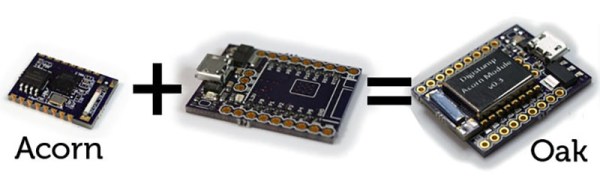
The Digistump Oak moves away from the AVR platform and puts everything on an ESP8266. Actually, this isn’t exactly the ESP8266 you can buy from hundreds of unnamed Chinese retailers; while it still uses the ESP8266 chip, there’s a larger SPI Flash, and the Oak is FCC certified.

Yes, if you’re thinking about building a product with the ESP8266, you’ll want to watch [Erik]’s campaign closely. He’s doing the legwork to repackage the ESP into something the FCC can certify. Until someone else does it, it’s a license to print money.

The FCC-certified ESP8266 derived module, cleverly called the Acorn, will be available in large quantities, packaged in JEDEC trays sometime after the campaign is finished. It’s an interesting board, and we’re sure more than one teardown of the Acorn will hit YouTube when these things start shipping.
FPGA Based Ambilight Clone

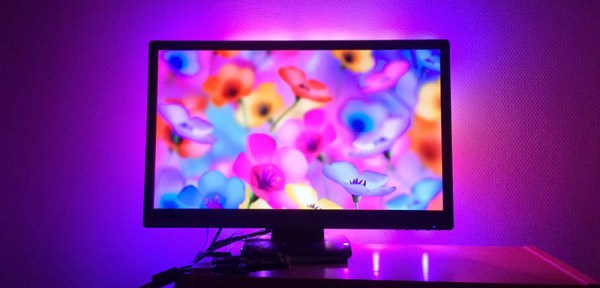
The Philips Ambilight – a bunch of rear-facing RGB LEDs taped to the back of a TV – is becoming the standard project for anyone beginning to tinker with FPGAs. [DrX]’s is the best one we’ve seen yet, with a single board that reads and HDMI stream, makes blinkey lights go, and outputs the HDMI stream to the TV or monitor.

[DrX] is using an FPGA development board with two HDMI connectors – the Scarab miniSpartan6+ – and a strand of WS2801 individually addressable RGB LEDs for this project. With a bit of level shifting, driving the LEDs was easily taken care of. But what about decoding HDMI?

Most of the project is borrowed from a project that displays a logo in the corner of a 720p video stream. The hardware is the same, but for an Ambilight clone, you need to read the video stream and process it, not just write to it. By carefully keeping track of the R, G, and B values for each pixel along with the pixel clock,  the colors along the edge of a display can be averaged. It’s not as difficult or as memory-intensive as building a frame buffer; nearly all of the picture data is thrown out when assembling the averages around the perimeter of the display. It does work, though.

After figuring out the average color around the perimeter of the display, it’s just a simple matter of driving the LEDs. Tape those LEDs to the back of a TV, and there’s an Ambilight clone, made with an FPGA.

[DrX] has a few videos of his project in action. You can check those out below.

Continue reading “FPGA Based Ambilight Clone”

The Raspberry Pi Action Camera

Action cameras like the GoPro, and the Sony Action Cam are invaluable tools for cyclists and anyone else venturing into the great outdoors. These cameras are not really modifiable or usable in any way except for what they were designed for. [Connor] wanted a cheaper, open-source action camera and decided to build one with the Raspberry Pi.

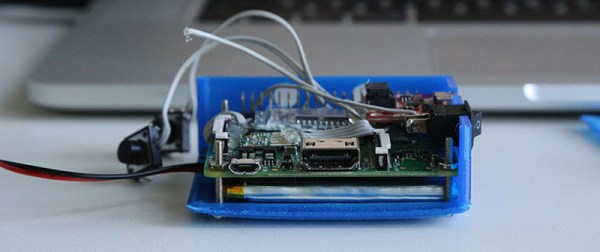
[Connor]’s Pi action cam is built around the Raspberry Pi Model A+ and the Pi camera. This isn’t a complete solution, so [Connor] added a bluetooth module, a 2000 mAh battery, and a LiPo charger.

To keep the Pi Action Cam out of the elements, [Connor] printed an enclosure. It took a few tries, but eventually he was able to mount everything inside a small plastic box with buttons to start and stop recording, a power switch, and a USB micro jack for charging the battery. The software is a script by [Alex Eames], and the few changes necessary to make this script work with the hardware are also documented.

This was the most intensive 3D printing project [Connor] has ever come up with, and judging by the number of prints that don’t work quite right, he put a lot of work into it. Right now, the Pi action cam works, but there’s still a lot of work to turn this little plastic box into a completed project.

Mapillary For The Raspberry Pi

If you live out in the boondocks, out of reach from the Google Maps car, you might have noticed there aren’t too many pictures of your area on the Internet. Mapillary is hoping to change that with crowdsourced photos of the entire planet, with mobile apps that snap a pic and upload it to the web. [sabas1080] is bringing this capability to the most popular ARM dev board out there, the Raspberry Pi.

The Raspberry Pi is not a phone, the usual way to upload pics to Mapillary. There’s no GPS, so geotagging is out of the question. The Pi doesn’t have a camera or a screen, and if you’re taking pictures of remote locations, a battery would be a good idea.

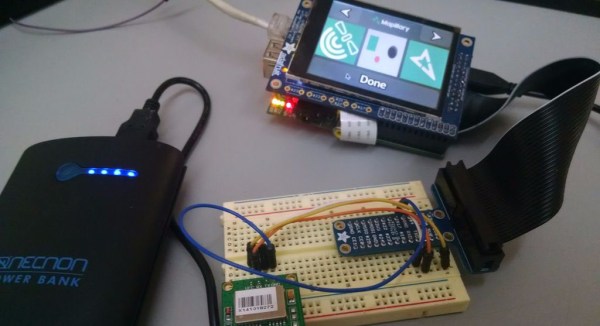
All these pieces are available for the Pi, though; [sabas1080] sourced a display from Adafruit, the camera is a standard Raspi affair, and the GPS is a GY-NEO6MV2 module from the one of the numerous Chinese retailers. Add a big power bank battery, and all the hardware is there.

The software is where this build gets tricky. Mapillary has a nice set of free tools written in Python, no less, but this is only part of the build. [sabas1080] needed to connect the camera, set up the display, and figure out how to make everything work with the Mapillary tools. In the end, [sabas] was able to get the entire setup working as a programmable, mobile photo booth.

Chili-Gation With The MSP430

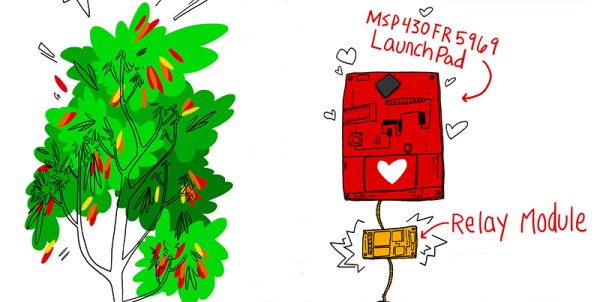
[Dave] used to grow chili peppers, but after moving to Texas he noticed his plants were drying up and dying off. This is understandable; Texas is freaking hot compared to his old home in the UK. These chilis needed a watering system, and with a pump, relay module, and an MSP430 launchpad, it was pretty easy to put together.

The core of the build is an MSP430 launchpad, a Sharp Memory LCD BoosterPack for the user interface, and a few bits and bobs for pumping water from a large soda bottle to the plant.

Before beginning his build, [Dave] took a look at commercial watering systems, but could only find huge irrigation systems for greenhouses or gardens. This was obviously overkill, but with a few parts – a six volt pump and a relay control board – [Dave] was able to make a simple system that keeps chilis watered for seven days between refilling the reservoir.

Crowdfunding Follies: $100 To Disprove Isaac Newton

Are satellites fake? Nobody knows, because no one has done an experiment to determine if rocket engines will produce thrust in a vacuum. At least that’s what this Kickstarter says, and it’s asking for $100 to test multiple types of rocket engines in an enclosed, evacuated chamber.

Anyone who has thought about this problem for half a second will tell you yes, rocket engines will work in a vacuum. It’s an application of Newton’s Third Law of Motion; if you explode fuel and dump it out the back of a rocket, the rocket will go forward. Rocket engines don’t push against air.

Strap in, because this one gets better. In a video linked to from the Kickstarter Campaign, satellites do not exist. This is because gas molecules in the thermosphere can reach 2,500 °C, hot enough to melt the metal satellites are made of. Never mind that the 2,500 °C figure is only for individual gas molecules; the atmosphere at these altitudes is so rarefied, there isn’t much contact with matter. Oh, second point: have you ever realized that a Google image search of the word ‘satellite’ mostly shows illustrations and renders? It’s not because to take a picture of a satellite in orbit would require two satellites flying in formation; no, it must be because satellites don’t exist. It gets better from there.

FCC Creates Innovation Radio, The Future Of Wireless Broadband

Thirty years ago there was a lot of unused spectrum in the 900MHz,  2.4GHz, and 5.2GHz bands. They were licensed for industrial, scientific, and medical uses since their establishment in 1947. But by the 1980s, these bands were identified as being underused. Spectrum is a valuable resource, and in 1985, the FCC first allowed unlicensed, spread spectrum use of these bands. Anyone who has ever configured a router will know the importance of this slice of spectrum: they’re the backbone of WiFi and 4G. If you’re not connected to the Internet through an Ethernet cable, you have the FCC Commissioners and chairpersons in 1985 to thank for that.

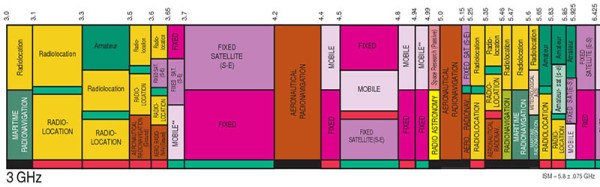
Last week, the FCC unanimously voted to allow the use of spectrum in the 3.5GHz band with the Citizens Broadband Radio Service. This opens up 150 MHz of spectrum from 3550 – 3700MHz for new wireless broadband services. If history repeats itself, you will be connecting to the Internet with the Citizens Broadband Radio Service (CBRS) in a few years.

While the April 17th FCC meeting was the formal creation of the CBRS, this is something that has been in the works for a very long time. The band was originally proposed back in 2012 when portions of spectrum were, like the ISM bands back in the 80s, identified as being underused. Right now, the 3.5GHz band is being used for US military radars and aeronautical navigation, but new advances in frequency management as outlined by commissioner [Clyburn] will allow these to coexist with the CBRS. In the words of Chairman [Wheeler], “computer systems can act like spectrum traffic cops.”

Access to the 3.5GHz spectrum will be divided into three levels. The highest tier, incumbent access, will be reserved for the institutions already using it – military radars and aeronautical radio. The second tier, priority access, will be auctioned and licensed by the FCC for broadband providers via Priority Access Licenses (PALs). The final tier, general authorized access, will be available for you and me, provided the spectrum isn’t already allocated to higher tiers. This is an unprecedented development in spectrum allocation and an experiment to see if this type of spectrum allocation leads to more utilization.

There are, however, unanswered questions. Commissioner [O’Rielly] has said the three-year license with no renewable expectancy could limit commercial uptake of PALs. Some commentors have claimed the protocols necessary for the CBRS to coexist with WiFi devices does not exist.

Still, the drumbeat demanding more and more spectrum marches on, and 2/3rds of the 150MHz made available under this order was previously locked up for the exclusive use of the Defense Department. Sharing spectrum between various users is the future, and in this case has the nice bonus of creating a free citizens band radio service.

You can read the full order here, or watch the stream of the April 17th meeting.