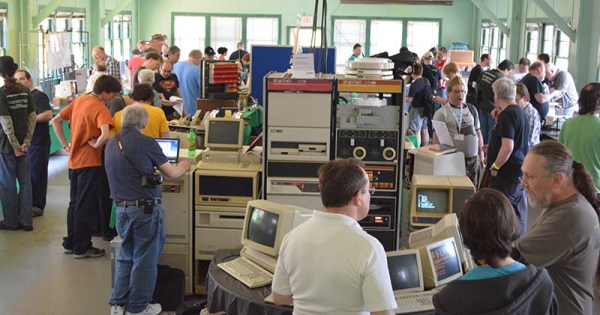
The Vintage Computer Festival East was last weekend, and now it’s time to wrap everything up. We’re going to start this off with a video of the biggest, most intolerable jerk on the planet walking around the boardwalk at Ashbury Park. Thanks to [Fran] for filming it.
That video, despite the wretched casting director, included the reveal of the PDP Straight-8, the 50-year-old minicomputer that was repaired and refurbished by [David Gesswein] just this year. You can see some pictures of that and more below, and a little more on [David]’s website.
Before you attempt to solve a problem, you must first study the problem. If there’s a problem with the environment, you must therefore study the environment at a scale never seen before. For this year’s Hackaday Prize, there are a lot of projects that aim to do just that. Here are a few of them:
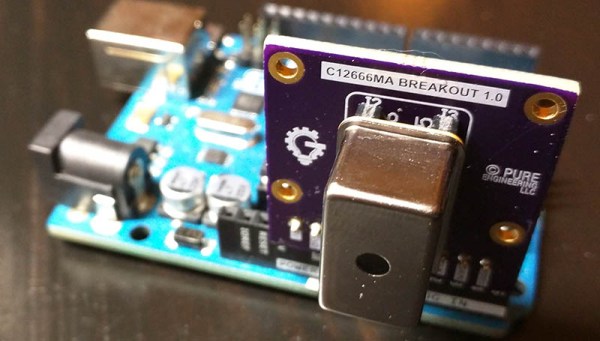
[Pure Engineering]’s C12666 Micro Spectrometer has applications ranging from detecting if fruit is ripe, telling you to put sunscreen on, to detecting oil spills. Like the title says, it’s based on the Hamamatsu C12666MA spectrometer, a very tiny MEMS spectrometer that can sort light by wavelength from 340 to 780nm.
The project is to build a proper breakout board for this spectrometer. The best technologies are enabling technologies, and we can’t wait to see all the cool stuff that’s made with this sensor.
[radu.motisan]’s portable environmental monitor isn’t just one sensor, but an entire suite of them. The design of the project includes toxic and flammable gas sensors, radiation detectors, dust sensors, and radiation detectors packaged together in a neat, convenient package.
[radu] has already seen some success with environmental sensors and The Hackaday Prize; last year, his entry, the uRADMonitor placed in the top fifty for creating a global network of radiation sensors.
The latest and greatest thing makers and IoT solutions is apparently router hacking. While most Hackaday readers lived through this interesting phase where Linksys routers were used to connect sensors and other such digital bits and bobs to the Internet a few years ago, SOCs have improved, and now there are router-based dev boards.
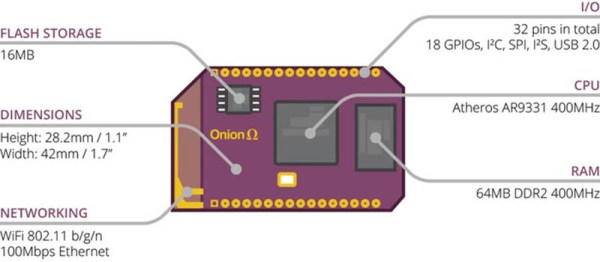
The latest is the Onion Omega, an exceptionally tiny board just under two inches square. Onboard is an Atheros AR9331 chipset – the same found in a number of cheap WiFi routers – attached to 32 pins breaking out GPIOs, SPI, I2C, and USB. With WiFi and Ethernet, this is a board designed to connect sensors, motors, actuators, and devices to the Internet.
This is not the only recent router-based dev board to make it to the crowdfunding sites. A week or so ago, the Domino hit Kickstarter, featuring the same AR9331 chipset found in the Onion Omega. The Onion does have a few things going for it – cloud integration, a web-based console, and an app store that make the Onion vastly more useful for the ‘maker’ market. The Domino has a boatload of pins available, and competition is always good, right?
In 300 years, New York, London, Tokyo, and just about every major city on the planet will be underwater. Sub-Saharan Africa will extend to the equator. Arizona will get hurricanes. These are huge problems, but luckily there are a few very creative people working to terraform the Earth for this year’s Hackaday Prize.
[Danny] is working to stop desertification, and stop blowing drifts of sand from encroaching on valuable farm land. How does his project aim to do this? There are a few techniques that can mitigate or even stop the expanding deserts, including reforestation, proper water management, and using woodlots and windbreaks just like in the 1930s dust bowl.
With the right tools, these techniques are fairly simple to implement. For that, [Danny] is working on a biodegradable lattice framework that will hold soil in place just like plant roots would. It’s an interesting concept, and we can’t wait to see what kind of prototypes [Danny comes up with.
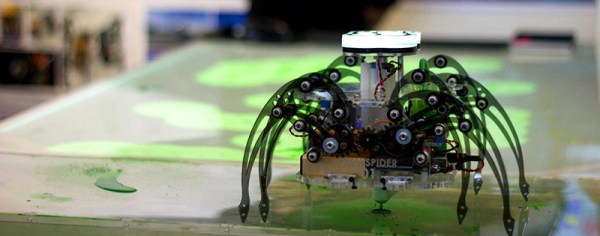
The Terra Spider takes a different tack. In true post-apocalyptic fashion, the Terra Spider will deploy thousands of robots capable of moving and removing biomatter from the environment. Each of the Terra Spiders is able to monitor the local environment, and a few dozen of these bots connected by a wireless network will be able to address a specific site’s needs to make a landscape the way it should be.
The Amiga 1000, the original Amiga, was introduced in 1985, making this the 30th anniversary of the Commodore Amiga. Of course this needed to be represented at the Vintage Computer Festival, and [Bill Winters] and [Anthony Becker] were more than up to the task:
The guys brought with them a representation of nearly every Amiga, and also have a few neat gadgets to plug into these cool little boxes. The Amiga 1200 has been heavily upgraded with a compact flash drive. With the proper adapters and cards, this neat machine can be upgraded with Ethernet, WiFi, or just about every conceivable networking solution.
Attached to the A500 is a Gotek floppy drive emulator, a relatively standard if weird device that turns a PC floppy drive connector into a USB mass storage solution. This floppy emulator did not originally support Amiga disk formats, but with a firmware modification, everything just works. That’s a great story in itself, and something we should probably cover another time.
If you’re wondering what it was like for [Bill] and [Anthony] to dig through their garage for their exhibit, here you go.
Portable Macintoshen
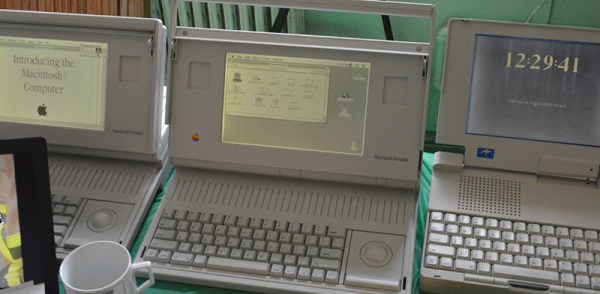
The first Macintosh was released in 1984. Macintosh users wanted a slightly more portable machine, but the first ‘luggable’ Mac wouldn’t be released until late 1989. The market was there to fill the gap, with some bizarre machines exhibited by [Matt Bergeron]:
The Outbound laptop and notebook were unlicensed clones of the Macintosh. Instead of pirating the Apple ROMs, the Outbound computers required buyers to pull the ROM chips from their Macs and install them in the slightly more portable version. This was, of course, inconvenient, and we can imagine there were more than a few ROM chips cloned.
The Dynamac was a different beast, using the entire PCB from a mac SE or SE/30. To this, the creators of the Dynamac added a custom video card and electroluminescent display that was also capable of driving an external monitor. Very cool stuff.
Electric vehicles are the wave of the future, whether it’s from sucking too much oil out of the ground, or because of improved battery technology. Most internal combustion engines are unsustainable, and if you’re thinking about the environment – or working on an entry for The Hackaday Prize – an electric vehicle is the way to go.
Here are a few electric vehicle projects that are competing in The Hackaday Prize that show off the possibilities for the electric vehicles of the future.
An Electric Ninja
Motorcycles are extremely efficient already, but if you want a torquey ride with a lot of acceleration, electric is the way to go. [ErikL] is hard at work transforming a 2005 Ninja 250R into an electric vehicle, both to get away from gas-sipping engines and as a really, really cool ride. Interestingly, the battery technology in this bike isn’t that advanced – it’s a lead acid battery, basically, that reduces the complexity of the build.
And They Have Molds To Make Another
Motorcycles aren’t for everybody, but neither are normal, everyday, electronic conversion cars. [MW Motors] is building a car from scratch. The body, the chassis, and the power train are all hand built.
The amazing part of this build is how they created the body. It’s a fiberglass mold that was pulled off of a model carved out of a huge block of foam. There’s a lot of composite work in here, and a lot of work had to happen before digging into the foam; you actually need to choose your accessories, lights, and other bits and bobs before designing the body panels.
While the suspension and a lot of the mechanical parts were taken from a Mazda Miata, the power and drive system are completely custom. Most of the chassis is filled with LiFeMnPO4 batteries, powering four hub motors in each wheel. It’s going to be an amazing car.
Custom, 3D Printed Electric Motors
If you’re designing an electric car, the biggest decision you’re going to make is what motor you’re going to use. This is a simple process: open up a few catalogs and see what manufacturers are offering. There’s another option: building your own motor. [Solenoid] is working on a piece of software that will calculate the specifications of a motor given specific dimensions. It will also generate files for a 3D printed motor given the desired specs. Yes, you’ll still need to wind a few miles of copper onto these parts, but it’s the beginning of completely custom electronic motors.
The MagSafe adapter in MacBooks and MacBook Pros is probably the greatest single advancement in laptop technology in the last 10 years. Interestingly, the MagSafe port is also a an analog volt meter that can be read by the OS, and it’s not just limited to monitoring battery voltage; with the right software, you can turn a MagSafe port into a terrible and expensive analog sensor, letting scripts on the computer run based on analog values.
[Peter] created a voltmeter application for his mac after realizing the System Management Controller – the chip responsible for charging the battery – was accessible through low-level kernel calls. If you care enough to chop an Apple power adapter in half, the MagSafe port can read other analog inputs.
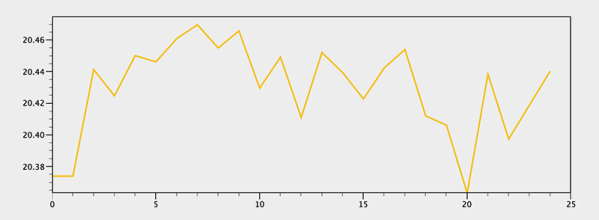
The SMC Voltmeter app [Peter] wrote samples the voltage every second and displays values on a graph. This app also allows you to run scripts. While you won’t be able to do much with an extremely expensive, very slow, one-channel data logger (the battery is going to run down eventually), we’re sure we’ll see something that’s held together with duct tape and prayer that uses this weird tool.