MRRF: Mostly Harmless 3D Printed Arms

The Midwest RepRap Festival isn’t just people hanging out with their 3D printers all weekend; There are also people bringing all the things they made with their 3D printers. There was an R2D2 and half of a B1 Battle Droid, a 3D printed quadcopter and of course 3D printed weaponry. [Ryan] and [Kane] from Mostly Harmless Arms brought a collection of their totally not trademark infringing not-Nerf guns.

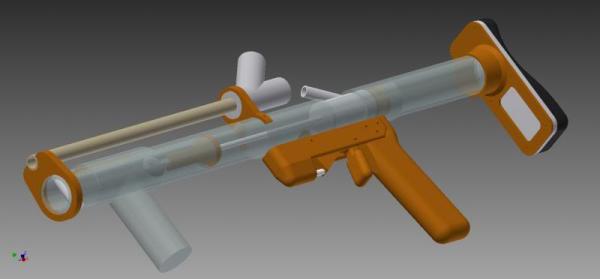
The guys have a few designs for guns that shoot silicone-tipped extruded foam darts much further than a Nerf gun. There’s a bow, a more traditional spring-powered blaster, and a crossbow. All the designs with the exception of a few pipes and tubes and springs are 3D printed, and all the parts are small enough to fit on an 8″ bed. The darts are made with a dome mold for silicon and insulation foam that’s normally wedged in window and door frames. They’re dusted with cornstarch to prevent sticking, although in the video below there were a few jams. That’s to be expected; there was a camera around.


Continue reading “MRRF: Mostly Harmless 3D Printed Arms”

Hackaday Links Column Banner

Hackaday Links: March 22, 2015

[Liam Kennedy] built a wearable space station notifier it’s on Kickstarter, and now the campaign is in its final hours. It’s very cool; doubly so if you don’t have to talk to a crazy lady who doubts the existence of NASA.

[countkillalot] lost a Raspberry Pi. It was in his apartment, and responded to ping, but he couldn’t find it. Turning the Pi into an FM transmitter revealed its location. Relevant bash.org.

If you don’t listen to the Amp Hour podcast, oh man are you in for a treat. This time it’s [Chuck Peddle], father of the 6502, designer of the KIM-1, and someone with at least three hours’ worth of interesting stories.

MakeIt Labs, the Nashua, New Hampshire hackerspace, has done everything right – they have their 501(c)(3), and they’ve been talking to the city about getting a new space. They have the option of moving into a space three times the size as their current one, and it’s cheaper than the current space. They have an indiegogo to raise the renovation funds for the new space. Oh, hackaday.io supports pages for hackerspaces. Just pointing that out.

Speaking of hackerspaces, yours needs this sign.

A 3-DAY DESERT CAMPING AND TECH-FEST WITH BEER. That’s all you need to know about Arduino Day, an event being held next weekend in the Mojave.

Want to hide from the NSA, or whatever governments or corporate interests are listening in on your phone? Stick it in a microwave. [WhiskeyTangoHotel] tested out a Tek RSA306 spectrum analyzer in a microwave, once with the door open, once with the door closed. If you’re exceptionally clever or have access to Wikipedia, you can figure out what frequencies will leak out of a microwave given the size of the holes in the metal mesh.

Here’s a Flintstones toilet paper holder. It would have been a phonograph, but no one could find a cooperative turtle and bird.

It has been brought to our attention that everyone should be aware ucapps.de still exists. If you want something that does everything with MIDI and SID chips, there you go.

BeagleBones At MRRF

[Jason Kridner] – the BeagleBone guy – headed out to the Midwest RepRap Festival this weekend. There are a lot of single board computers out there, but the BeagleBoard and Bone are perfectly suited for controlling printers, and motion control systems thanks to the real-time PRUs on board. It’s not the board for you if you want to play retro video games or build a media center; it’s the board for building stuff.

Of interest at the BeagleBooth were a few capes specifically designed for CNC and 3D printing work. There was the CRAMPS, a clone of the very popular RAMPS 3D printer electronics board made for the Beagle. If you’re trying to control an old mill that is only controllable through a parallel port, here’s the board for you. There are 3D printer boards with absurd layouts that work well as both printer controller boards and the reason why you should never come up with the name of something before you build it.

[Jason]’s trip out to MRRF wasn’t only about extolling the virtues of PRUs; Machinekit, a great motion control software, was also there, running on a few Beagles. The printer at the BeagleBooth was running Machinekit and apart from a few lines of GCode that sent the head crashing into the part, everything was working great.

Continue reading “BeagleBones At MRRF”

The Midwest RepRap Festival – Awesome Stuff In The Middle Of Nowhere

It’s time once again to venture out to Goshen, Indiana for the Midwest RepRap Festival. It is the largest 3D printing con in the entire world where no one is trying to sell you anything. With a qualifier like that, it doesn’t have to be very big, but last year over 1,500 people showed up to the Elkhart county farm show complex and this year many more people are expected.

On the list of attendees is Taulman 3D, makers of fine, odd filament, Lulzbot, [Johnny] of Ultimachine, creator of the RAMBo board, MakerJuice, the FirePick Delta – the most skulled project on hackaday.io, and dozens of other people who make a living with 3D printing.

Of the expected attendees that are not specifically involved with 3D printing, I’m told [Ben Heck] will be there, along with someone from Adafruit and Make. The EFF might have a booth. A local radio station is doing a remote, and the servers at Wings, Etc. — one of the few area pubs — are going to clean up this weekend.

The event officially starts at 4:00pm today, Friday, March 20th. If you won’t be going the entire weekend, I’d suggest showing up on Saturday or Sunday. There will be far too many people there, and I’m slightly agoraphobic. We’ll be posting updates from the MRRF later on.

Hacklet 39: The Kerbal Way Of Doing Things

Kerbal Space Program is a space flight simulator based on an extremely stupid race of green space frogs that have decided to dedicate all their resources towards the exploration of space. It is a great game, a better space simulator than just about anything except for Orbiter, and the game is extremely moddable. For this edition of the Hacklet, we’re going to be taking a look at some of the mods for KSP you can find over on hackaday.io.

1271491420181365398Like most hardware builds for Kerbal Space Program, [lawnmowerlatte] is using a few user-made plugins for KAPCOM, a hardware controller and display for KSP. The Telemachus plugin is used to pull data from the game and display that data on a few screens [lawnmower] had sitting around.
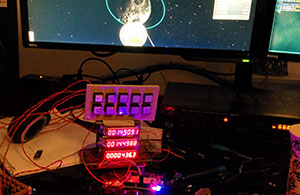
There are a few very cool features planned for this build including seven-segment displays, a throttle handle, and neat enclosure.


IMG_20140419_013717[Gabriel] is working on a similar build for KSP. Like the KAPCOM, this one uses the Telemachus plugin, but this one adds three eight-digit, SPI-controlled, seven-segment displays, relegendable buttons, and a Kerbal-insipired frame made out of Meccano.


[Lukas]’ KSP Control Panel is another complicated control system that breaks immersion slightly less than a keyboard. He’s using a Raspberry Pi to talk to the Telemachus server to control every aspect of the craft. From staging to opening up the solar panels, it’s all right there in [Lukas]’ control panel.


You may have noticed a theme with these builds; all of them use the Telemachus plugin for KSP. Even though it’s fairly simple to create plugins for Unity, there really aren’t that many KSP plugins build for these immersive control panels and space flight simulators. Or rather, Telemachus is ‘good enough’. We’d like to see a fully controllable KSP command pod model, just like those guys with 737 flight simulators in their garage. If you have any idea how that could happen, leave a note in the comments.

Measuring Heart Rate With A Piezo

Look around for heart rate sensors that interface easily to microcontrollers, and you’ll come up with a few projects that use LEDs and other microcontrollers to do the dirty work of filtering out pulses in a wash of light.

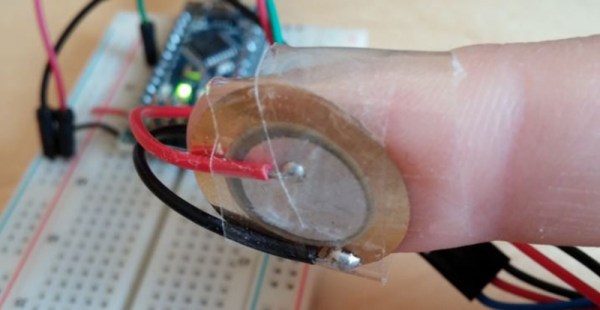
[Thomas] was working on a project that detects if water is flowing through a pipe with a few piezoelectric sensors. Out of curiosity, he taped the sensor to his finger, and to everyone’s surprise, the values his microcontroller were spitting out were an extremely noise-free version of his heart rate.

The piezo in question is a standard, off the shelf module, and adding this to a microcontroller is as easy as putting the piezo on an analog pin. From there, it’s just averaging measurements and extracting a heartbeat from the data.

It’s a much simpler solution to measuring a heart rate, and since two people haven’t heard of this technique, it’s likely a lot more people haven’t heard of this technique either. If you’re looking for an entry to The Hackaday Prize, this would be a great jumping off point for anything in either the fitness or medical domains.

Machining A Yo-Yo With Speed Holes

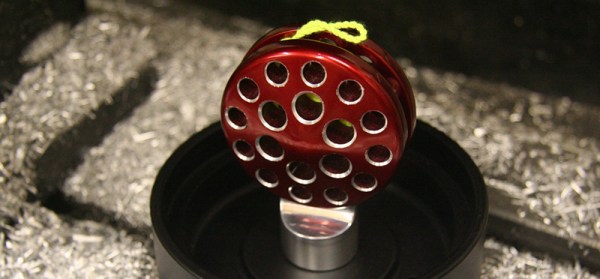
A while ago, [Gord] received a notice from his daughter’s school looking for silent auction donations for a fundraiser. It’s pretty much a bake sale, only [Gord] gets to build something. He has a pretty nice machine shop, and eventually settled on building a pair of beautiful vacillating vertical pendulums. They’re yo-yos, in case you were wondering what that meant.

Each half is cut out of a 2.5″, with both sides of each half faced off and tapped. From there, eighteen speed holes shave off 22 grams of weight. The sides of the yo-yo are shaved down to a thickness of half an inch, a 14° bevel is put on each face, the edges are chamfered at 30°, and everything is polished up.

Sending a bare metal yo-yo to a raffle is apparently a little uncouth, so [Gord] anodized each half of the yo-yos in a bath of sulfuric acid, then applied dye to the surface. With everything assembled, a fancy glass and metal case was constructed and a certificate of authenticity printed out. It’s a brilliant final touch to a great project, we just wish we knew how the yo-yo performed.

Thanks [Chris] for sending this in.