New Part Day: SPI RAM And A Video Controller

Generating video signals with a microcontroller or old CPU is hard if you haven’t noticed. If you’re driving even a simple NTSC or PAL display at one bit per pixel, you’re looking at a minimum of around 64kB of RAM being used as a frame buffer. Most microcontrollers don’t have this much RAM on the chip, and the AVR video builds we’ve seen either have terrible color or relatively low resolution.

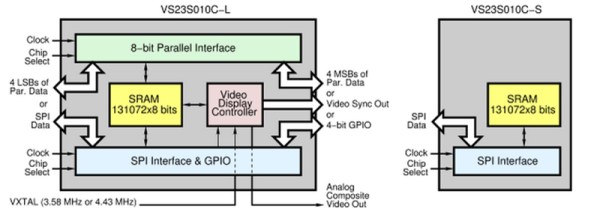
Here’s something interesting that solves the memory problem and also generates analog video signals. Yes, such a chip exists, and apparently this has been in the works for a very long time. It’s the VLSI VS23s010C-L, and it has 131,072 bytes of SRAM and a video display controller that supports NTSC and PAL output.

There are two chips in the family, one being an LQFP48 package, the other a tiny SMD 8-pin package. From what I can tell from the datasheets, the 8-pin version is only an SPI-based SRAM chip. The larger LQFP package is where the action is, with parallel and SPI interfaces to the memory, an input for the colorburst crystal, and composite video and sync out.

After looking at the datasheet (PDF), it looks like generating video with this chip is simply a matter of connecting an RCA jack, throwing a few commands to the chip over SPI, and pushing bits into the SRAM. That’s it. You’re not getting hardware acceleration, you’re going to have to draw everything pixel by pixel, but this looks like the easiest way to generate relatively high-resolution video with a single part.

Thanks [antibyte] for the tip on this one.
Adding Recycling Codes To 3D Prints

Every little plastic bauble you interact with has some sort of recycling code on it somewhere. Now that we’re producing plastic 3D printed parts at home, it would be a good idea to agree on how to recycle all those parts, and [Joshua Pearce]’s lab at Michigan Tech has the answer; since we’re printing these objects, we can just print the recycling code right in the object.

The US system of plastic recycling codes is particularly ill-suited for identifying what kind of plastic the object in question is made of; there are only seven codes, while China’s system of plastic identification uses 140 identification codes. This system for labeling 3D printed parts borrows heavily from the Chinese system, assigning ABS as ‘9’, PLA as ’92’, and HIPS as ‘108’.

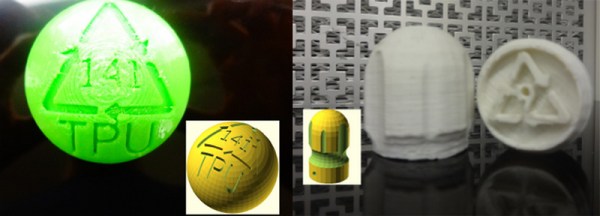
With agreed upon recycling codes, the only thing left to do is to label every print with the correct recycling code. That’s an easy task with a few OpenSCAD scripts – the paper shows off a wrench made out of HIPS labeled with the correct code, and an ABS drill bit handle sporting a number nine. 3D printing opens up a few interesting manufacturing techniques, and the research team shows this off with a PLA vase with a recycle code lithophane embedded in the first few layers.

An Experiment In Shift Registers And Multiplexed LEDs

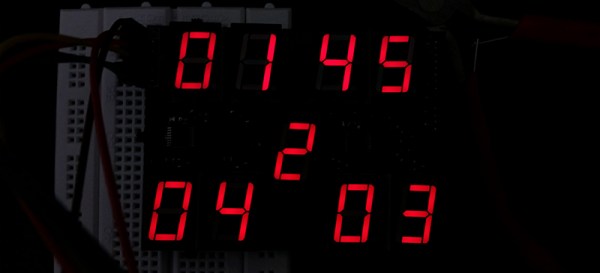
[Kratz] is working on a WiFi controlled scoreboard, but before building the full-scale version, he thought it would be wise to test out the multiplexing technique for the display. The experiment worked, but unless this scoreboard is for a foosball table, he still has a lot of work ahead of him.

The design of this prototype display is pretty simple, with just two ‘595 shift registers feeding bits to the display. Sixteen NPN transistors are being used to sink and source current to the display. It’s a relatively simple circuit, allowing [Kratz] to fit nine seven-segment displays on a small board with only six wires – ground, two V+ for the logic and LEDs, clock, data, and latch – going to the microcontroller.

There were a few snags in the design; the data is clocked in on a rising edge, but an extra falling edge was required before latching. [Kratz] can’t figure out the reason for this, and it might just be a timing issue.

Brains Controlling Labyrinths Without Hands

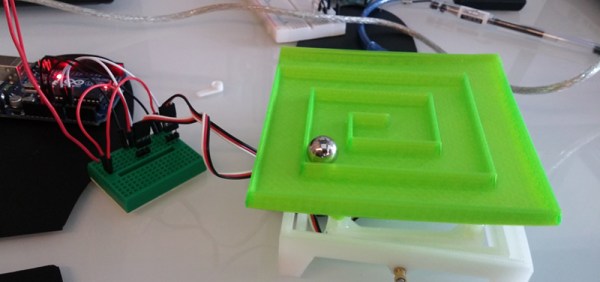
[Daniel], [Gal] and [Maxim] attended a hackathon last weekend – Brainihack 2015 – that focused on neuroscience-themed builds in a day and a half long build off. The trio are communications systems engineering and computer science students with no background in neuroscience whatsoever. You can’t build an FMRI in a day and a half, so they ended up winning the best project in the open source category with a brain-controlled labyrinth game.

The labyrinth itself is entirely 3D printed and much, much simpler than the usual, ‘wooden maze with holes’ that’s generally associated with labyrinth puzzles. It’s really just a plastic spiral for a ball to follow. There’s a reason for this simplicity. The team is using EEG to detect brain waves and move the labyrinth on the X and Y axes.

The team is using OpenBCI for the interface between their brains and a pair of servos. This is actually an interesting piece of tech; unlike a few toys like the NeuroSky MindWave and the Star Wars Force Trainer, the OpenBCI gives you eight input channels that attach to anywhere on the scalp. The team used these inputs to measure Alpha waves and Steady State Visually Evoked Potential to control the pair of servos on the labyrinth frame.

It’s a great build, a wonderful demonstration of a device that outputs real EEG signals, and the team on a prize. What’s not to like?

Microscope Camera For Zeroing CNC Machines

After what we’re sure is several dozen screw-ups or at the very least a lot of wasted hours, [Chris] has gotten around to building a very precise microscope camera mount for zeroing out his CNC machine.

If you need to mill a few bits out of a sheet of metal or plastic, it’s important to know exactly where you’re cutting. A CNC machine can take care of the relative positioning, but if you already have half your holes drilled, you also need absolute positioning. This means placing the work piece exactly where you want to cut, or failing that, zeroing the machine to a predefined point on the piece.

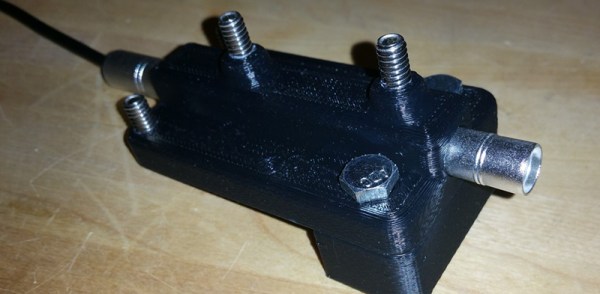
[Chris] is accomplishing this with a pen-shaped USB microscope. With a 3D printed mount and a few magnets, this camera can clip right on to the machine, and with the camera interface in Mach3, it’s pretty easy to zero out the mill to within a thousandth of an inch.

There’s a video demo of the camera in action below, but there’s a lot more CNC mods on [Chris]’ website. There’s custom 3D printed vacuum nozzles, and a lot of work on a small desktop Grizzly mill.

Continue reading “Microscope Camera For Zeroing CNC Machines”

Hard Drive Becomes Hard Drive Activity Light; Stores No Data

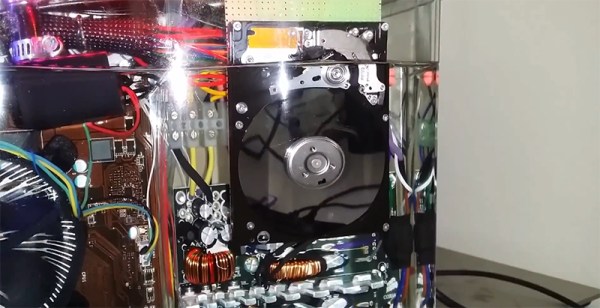
A while ago [Frank Zhao] built a computer in an aquarium. It’s exactly what you would expect – a bunch of parts stuffed into a container filled with mineral oil. Yes, there’s an i7 and a GTX970 in there, but there’s also a bunch of neopixels and a neat little bubbling treasure chest. That wasn’t enough for [Frank], and he wanted to add a HDD activity monitor. What’s the most absurd activity monitor for an SSD? An old platter-based drive, of course.

The build is relatively simple and something [Frank] put together from spare parts in a day. After cracking open an old PATA hard drive, the voice coil for the hard drive arm was connected to the motherboard’s HDD activity signal through a few MOSFETs. The platter motor is controlled by an MTD6501 motor driver, set to spin up when the circuit is on.

It’s a kludge as far as controlling the components of a hard drive go, but that’s not really the point. It’s just a neat project to show when the SSD in the aquarium computer is being accessed. That said, the activity monitor is currently disconnected because the old HDD is so freakin’ loud. It looks really cool, though.

Hackaday Links Column Banner

Hackaday Links: March 15, 2015

[Fran] and [Bil] are back again for the first Dinosaur Den of 2015. Highlights of this edition include a surprisingly young tri-power supply and Nixie display cards from 1965.

The game of Go has been turned into a sequencer. That’s a project from [Kristian Gohlke] and [Michael Hlatky]. It’s an industrial camera placed above a Go board, and some computer vision algorithms to detect stones on the board. There’s a 16×16 section to create drum patterns (black stones) or synth notes (white stones). Below that there’s a 16×3 grid for the bass notes, two 3×8 grids to control filters and effects, and a 3×3 grid to play percussive loops.

HOW TO REMOVE A GPS ANKLE MONITOR. We had to get the SEO right on this one. Here’s how you can ditch your probation officer for a weekend. Great news: his parents used their house for bail, now an entire family is homeless. Lesson learned: use a burner phone and call forwarding until you’re out of the country.

The Computer History Museum is doing a great series of interviews, and this one is with [Bob Dobkin], former director at National Semiconductor, and co-founder of Linear. Analog design isn’t wizardry, you just need a decade of experience.

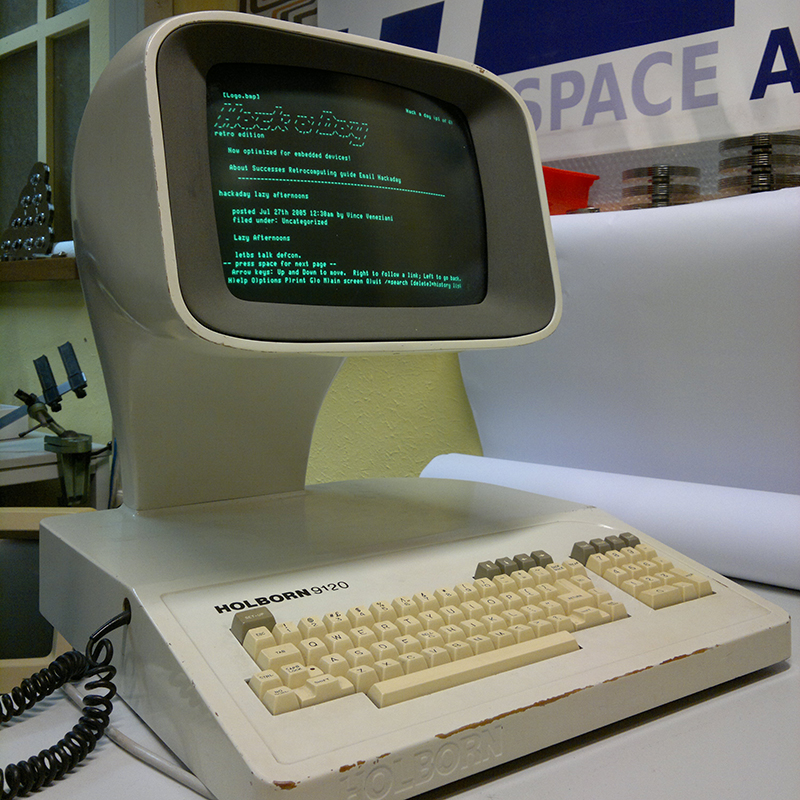
[Simon] over at the Hack42 hackerspace finally found the time to repair their old Holborn 9120 terminal – the most space-age terminal ever built. The keyboard is an old Keytronic unit, and the foam underneath the keys had turned to dust. This was replaced with an Ikea mousepad, foam tape, and the foil from a discarded bag of chips. It worked, and they got their terminal to load our retro edition:

terminal

If you have some old hardware, try to point it at our retro site, take a picture (or post a writeup) and send it on in.