
Repairing A Router Plagued By Capacitors

[psgarcha]’s modem/router comes straight from his internet provider, is on 24/7, and is built with the cheapest components imaginable. Eventually, this will be a problem and for [psgarcha], this problem manifested itself sooner than expected. Fortunately, there was a soldering iron handy.

The problems began with a boot loop – starting the router up, watching the blinking LEDs, and watching these lights follow the same pattern forever. Initially thinking this would be a problem with the firmware, [psgarcha] did the only thing he could do – take it apart. Inside, he found some bulging capacitors. Unsheathing his iron and replacing the obviously faulty components, [psgarcha] plugged the router in and had everything work. Great. Until those caps failed again a few months later.

There was obviously something wrong with the circuit, or wrong with the environment. Figuring it was hot out anyway, [psgarcha] replaced those caps again and added a fan and a small heatsink to the largest chip on the board. This should solve any overheating problems, but the real testing must be done in summer (or putting the router in a well-insulated enclosure). It’s an easy fix, a good reminder of exactly how often caps fail, and a great example of reducing the electronic cruft building up in landfills.

Drawing On Glow In The Dark Surfaces With Lasers

What do you get when you have a computer-controlled laser pointer and a big sheet of glow in the dark material? Something very cool, apparently. [Riley] put together a great build that goes far beyond a simple laser diode and servo build. He’s using stepper motors and a proper motion control software for this one.

The theory behind the device is simple – point a laser at some glow in the dark surface – but [Riley] is doing this project right. Instead of jittery servos, the X and Y axes of the laser pointer are stepper motors. These are controlled by an Arduino Due and TinyG motion control software. This isn’t [Riley]’s first rodeo with TinyG; we saw him at Maker Faire NYC with a pendulum demonstration that was absolutely phenomenal.

Right now, [Riley] is taking SVG images, converting them to Gcode, and putting them up on some glow in the dark vinyl. Since the Hackaday Skull ‘n Wrenches is available in SVG format, that was an easy call to make on what to display in weird phosphorescent green. You can see a video of that along with a few others below.

Continue reading “Drawing On Glow In The Dark Surfaces With Lasers”

The Most Minimal WS2812B Driver

Whether you call them individually controllable RGB LEDs, WS2812, or NeoPixels, there’s no denying they are extremely popular and a staple of every glowey and blinkey project. Fresh off the reel, they’re nearly useless – you need a controller, and that has led to many people coming up with many different solutions to the same problem. Here’s another solution, notable because it’s the most minimal WS2812 driver we’ve ever seen.

The critical component in this build is NXP’s LPC810, an ARM Cortex M0+ in an 8-pin DIP package. Yes, it’s the only ARM in a DIP-8, but still able to run at 30MHz, and hold a 4kB program.

JeeLabs is using the SPI bus on the LPC810 to clock out data at the rate required by the LEDs. The only hardware required is a small LED to drop the voltage from 5V to 3.3V and a decoupling capacitor. Yes, you could easily get away with this as a one-component build.

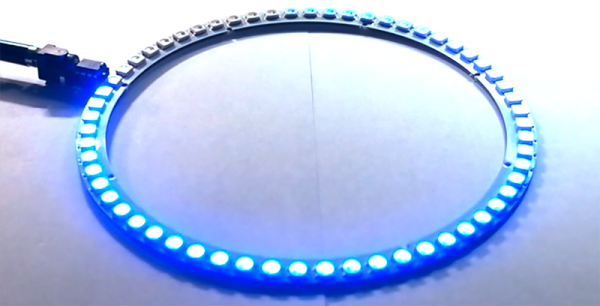
The build consists of a ring of sixty WS2812b RGB LEDs, and the chip dutifully clocking out bits at the correct rate. It’s the perfect start to an LED clock project, an Iron Man arc reactor (are we still doing those?), or just random blinkey LEDs stuffed into a wearable.

Thanks [Martyn] for sending this one in.

ESP Gets FCC And CE

The ESP8266 Internet of Things module is the latest and greatest thing to come out of China. It’s ideal for turning plastic Minecraft blocks into Minecraft servers, making your toilet tweet, or for some bizarre home automation scheme. This WiFi module is not, however, certified by the FCC. The chipset, on the other hand, is.

Having a single module that’s able to run code, act as a UART to WiFi transceiver, peek and poke a few GPIOs, all priced at about $4 is a game changer, and all your favorite silicon companies are freaking out wondering how they’re going to beat the ESP8266. Now the chipset is FCC certified, the first step to turning these modules into products.

This announcement does come with a few caveats: the chipset is certified, not the module. Each version of the module must be certified by itself, and there are versions that will never be certified by the FCC. Right now, we’re looking at the ESP8266-06, -07, -08, and -12 modules – the ones with a metal shield – as being the only ones that could potentially pass an FCC cert. Yes, those modules already have an FCC logo on them, but you’re looking at something sold for under $5 in China, here.

Anyone wanting to build a product with the ESP will, of course, also need to certify it with the FCC. This announcement hasn’t broken down any walls, but it has cracked a window.

Using Lasers For Hair Growth

HowToLou is back with a rather interesting build: One hundred laser diodes for hair growth.

Before you guffaw at the idea of lasers regrowing hair lost to male pattern baldness, there’s a surprising amount of FDA documents covering the use of laser diodes and red LEDs for hair growth and an interesting study covering teeth regrowth with lasers. Yes folks, it’s a real thing, but something that will never get a double-blind study for obvious reasons.

[Lou] is building his hat with 100 laser diodes, most of which were sourced from Amazon. These diodes were implanted in a piece of foam flooring, a rather interesting solution that puts dozens of diodes in a flexible module that’s pretty good for making a wearable device.

The lasers are powered by three AA batteries, stuffed into a four-slot battery holder that was modified to accommodate a power switch. [Lou] has been wearing a nine-diode hat for a month now, and if the pictures are to be believed, he is seeing a little bit of hair growth. At the very least, it’s an interesting pseudo-medical build that seems to be producing results.

Hats like these are commercially available for about $700. [Lou] built his for about $60. We’re calling that a win even if it doesn’t end up working to [Lou]’s satisfaction. Just don’t look at the lasers with your remaining eye.

Continue reading “Using Lasers For Hair Growth”

Home Computers Behind The Iron Curtain

I was born in 1973 in Czechoslovakia. It was a small country in the middle of Europe, unfortunately on the dark side of the Iron Curtain. We had never been a part of Soviet Union (as many think), but we were so-called “Soviet Satellite”, side by side with Poland, Hungary, and East Germany.

My hobbies were electronics and – in the middle of 80s – computers. The history of computers behind the Iron Curtain is very interesting, with a lot of unusual moments. For example – communists at first called cybernetics as “bourgeois’ pseudoscience” (as well as sociology or semiotics), “used to enslave a mankind by machines”. But later on they understood the importance of computers, primarily for science and army. So in 50s the Eastern Bloc started to build its own computers, separately and “in its own way.”

The biggest problem was a lack of modern technologies. There were a lot of skilled and clever people in eastern countries, but they had a lot of problems with the elementary technical things. Manufacturing of electronics parts was divided into diverse countries of Comecon – The Council for Mutual Economic Assistance. In reality, it led to an absurd situation: You could buy the eastern copy of Z80 (made in Eastern Germany as U880D), but you couldn’t buy 74LS00 at the same time. Yes, a lot of manufacturers made it, but “it is out of stock now; try to ask next year”. So “make a computer” meant 50 percent of electronics skills and 50 percent of unofficial social network and knowledge like “I know a guy who knows a guy and his neighbor works in a factory, where they maybe have a material for PCBs” at those times.

Continue reading “Home Computers Behind The Iron Curtain”

Hackaday Links Column Banner

Hackaday Links: December 14, 2014


The Progressive Snapshot is a small device that plugs into the ODB-II port on your car, figures out how terrible of a driver you are, and sends that data to Progressive servers so a discount (or increase) can be applied to your car insurance policy. [Jared] wondered what was inside this little device, so he did a teardown. There’s an Atmel ARM in there along with a SIM card. Anyone else want to have a go at reverse engineering this thing from a few pictures?

[Alex]’s dad received a special gift for his company’s 50th anniversary – a Zippo Ziplight. Basically, its a flashlight stuffed into the metal Zippo lighter we all know and love. The problem is, it’s battery-powered, and Zippo doesn’t make them any more. It also uses AAAA batteries. Yes, four As. No problem, because you can take apart a 9V and get six of them.

‘Tis the season to decorate things, I guess, and here’s a Hackaday snowflake. That’s from [Benjamin Gray], someone who really knows his way around a laser cutter.

HHaviing trouble wiith a debounce ciircut? HHer’s a calculator for just thhat problem. Put iin the logiic hhiigh voltage level, the bounce tiime, and the fiinal voltage, and you get the capaciitor value and resiistor value.

A harmonograph is a device that puts a pen on a pendulum, drawing out complex curves that even a spirograph would find impressive. [Matt] wanted to make some harmonographs, but a CNC and a printing press got in the way. He’s actually making some interesting prints that would be difficult if not impossible to make with a traditional harmonograph – [Matt] can control the depth and width of the cut, making for some interesting patterns.

The Mooltipass, the Developed On Hackaday offline password keeper, has had an interesting crowdfunding campaign and now it’s completely funded. The person who tipped it over was [Shad Van Den Hul]. Go him. There’s still two days left in the campaign, so now’s the time if you want one.