WALL-O-TRON, The Interactive Rock Climbing Wall

Last April, hackerspaces around the country received a gift from RedBull for their creation challenge. The hackerspace teams were charged with creating, ‘something with LEDs’ and let loose in their workshop for a chance to win a trip to NYC and build some cool stuff. Of course, RedBull couldn’t bring all the teams to the big apple and a few incredible projects were left by the wayside in their home hackerspace.

One such project was the WALL-O-TRON from Team Rabbit-Hole and home base for the Tymkrs. It’s a huge wall embedded with LEDs that turn an ordinary rock climbing wall into a game called WallSweeper – climb a path to the illuminated hold, but don’t touch the ‘hot rock’ or your game is over.

The hand holds are illuminated by over 300 of LEDs connected to a Linux PC. The sign above the wall is controlled by RedBull’s TurBULL Encabulator, and the giant ‘WALL-O-TRON’ letters are huge pieces of foam with five meters of RGB LEDs embedded inside.

A great project with the possibility of being upgraded in the future with more games. Perfect for the rock climbing playground it’s situated in.

Continue reading “WALL-O-TRON, The Interactive Rock Climbing Wall”

Thundercats, HO!

sword

[Tony Swatton], blacksmith, armorer, and prop maker, has built hundreds of custom swords for hundreds of movies and TV shows. He’s also the maker behind Man at Arms, the YouTube series where weapons from your favorite shows and movies are recreated, be they improbable weapons from a James Bond movie or a sword from a cartoon. This time, he recreated the Sword of Omens from Thundercats. It’s a work of art in its own right, and amazingly practical for a cartoon sword.

The Sword of Omens is one of [Tony]’s more complex sword making endeavors he’s done. The grip is made of seven different pieces cast in bronze, while the hilt of the sword is over a dozen of different pieces of steel welded together. The jewel in the sword was cut from a piece of glass, carefully ground on a lapidary wheel to a perfect dome.

Of course, this isn’t the only weapon from popular media that [Tony] has crafted. He’s also done Oddjob’s hat from James Bond and Finn’s golden sword of battle from Adventure Time.


The Ondes Martenot; Better Than A Theremin

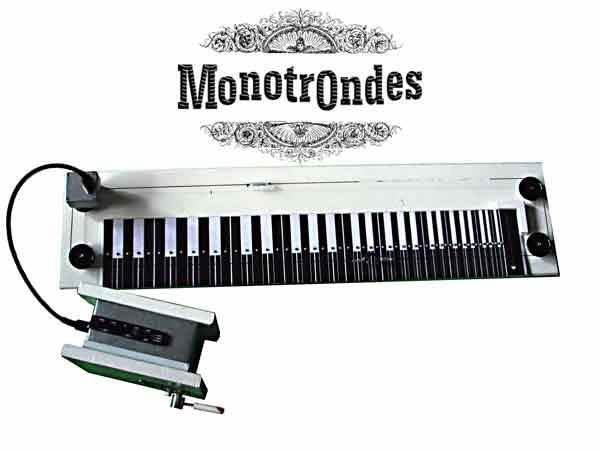
Monotrondes+logo

[Ville] loves the sound of an ondes martenot and decided to build his own. No, it’s not made of vacuum tubes like a 1920s original, this one is made out of a cheap, off-the-shelf analog synth and just a few extra parts.

The ondes martenot is a theremin-like musical instrument; instead of waving your hands around aerials on the theremin, the ondes uses a small ring attached to the player’s finger on a wire loop and a volume lever. The ondes isn’t a common instrument by any means, but Radiohead uses one several in any event.

[Ville] began his build by taking a small, cheap, and new Korg Monotron analog ribbon synth, cracking it open, and reading the schematics. A 100k multiturn pot was wired into the monotron and fastened to a printed paper keyboard with a system of pulleys and a small metal ring. With the multiturn pot wired into the pitch input on the monotron, [Ville] had a semi-accurate and very functional ondes martenot replica.

You can hear [Ville]’s ondes in action after the break. It’s a little rough starting out, but by the time he’s looping multiple phrases it really does sound wonderful.

Continue reading “The Ondes Martenot; Better Than A Theremin”

Tearing Apart An Organ And Making A MIDI Keyboard

pedul

What do you do if you’re in a band and have an old, dead organ lying around? Build a MIDI foot controller, of course.

After dispensing of the old organ guts, [Mark] mounted the pedals in a handsome road case and started working on the electronics. His first inclination was to mount an Arduino Pro Mini on a piece of stripboard, but after that failed decided to learn Eagle and fabricate a PCB. each key of the organ pedals are connected to a switch read by the Arduino which sends data to a Korg Microsampler over MIDI.

The swell pedal from the organ was also reused, but because the old incandescent light in the pedal was toast, this was replaced with an LED. It still works, allowing [Mark] to do volume swells on his new, fancy, MIDI foot controller.

You can check out a video of the controller below.

Continue reading “Tearing Apart An Organ And Making A MIDI Keyboard”

LED Tie Plays Tetris

tetris

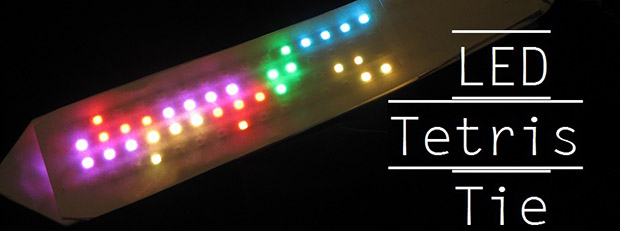
[Bill] has been working with a gaggle of 8th graders this summer at a STEM camp, impressing them with his geeky attire such as an 8-bit and PCB ties, and an LED illuminated lab coat. The adolescent tinkerers asked him what he would be wearing on the last day. Not wanting to let the kids down, he whipped up an LED Tetris tie in an evening.

The Tetris board is a 20 x 4 grid of WS2811 based RGB LED strips, controlled by a Digispark dev board. Structurally, the tie is just two bits of card stock with the electronic bits sandwiched in between. and taped to a cheap clip-on. In the video below, the tie doesn’t have any sort of input to control the movement and rotation of blocks. [Bill] plans to update his tie with some rudimentary AI so it can play itself.

All the code is over on [Bill]’s git. It’s still a work in progress, but from the STEM student’s reaction, there’s a lot of potential in this tie.

Continue reading “LED Tie Plays Tetris”

Signmaking In Glass And Gold

Signmaking today isn’t what it once was. Where today a few vinyl letters stuck to a piece of plate glass is good enough for any storefront, there was a time when the signs in front of businesses were works of art involving many skills and dozens of tradesmen to create. [David Smith] is one of the last remaining old-school signmakers, and his creations are just as beautiful as the finely crafted signs of a century ago.

The techniques [David] uses to create his signs are as varied as the finished products are elegant. He cuts patterned grooves into glass with wheels made of diamond or ceramic and bends shaped glass over forms in a very large kiln.

Aside from cutting, shaping, and grinding glass, [David] also paints his signs – on the back side in reverse, building up his design layer by layer. The very first layer in some of his designs are gold leaf, a difficult material but [David] invented his own leaf applicator that makes the job much easier.

Truly amazing works of art, and certainly much more elegant than whatever plastic nonsense goes as proper signmaking these days.

Continue reading “Signmaking In Glass And Gold”

TI’s CC3000 WiFi Chip Gets A Library

About six months ago, Texas Instruments released a simple, cheap, single-chip WiFi module. At $10 a piece in quantities of 1000, the CC3000 is a much better solution to the problem of an ‘Internet of Things’ than a $50 Arduino Ethernet modules, or even the $30 Electric Imp. All indications, especially the frequent out of stock status for the dev board on TI’s web site, show the CC3000 will be a popular chip, but until now we haven’t seen a CC3000 library for the Arduino or other microcontrollers.

[Chris] just solved that problem for us with a CC3000 WiFi library for the Arduino. He ported TI’s MSP430 CC3000 library to the Arduino, allowing even the bare-bones Arduino Uno to connect to a WiFi network with just a handful of parts. The code itself takes about 12k of Flash and 350 bytes of RAM, giving anyone using the CC3000 enough room left over to do some really interesting stuff. There’s even a slimmed down library that uses somewhere between 2k and 6k of Flash, making an ATtiny-powered web server a reality.

There are a few caveats in using the CC3000 with an Arduino; it’s a 3.3 Volt part, so you’ll need a level shifter or some resistors. Also, the chip draws about 250 mA when it’s being used, so you’ll need a beefy battery if you want your project to last an entire day of use.

Now that the library is out of the way, be on the lookout for a CC3000 breakout board. Here’s one, but expect some more on the market soon.