Programming A Game Boy While Playing Pokemon

We hope our readers are familiar with the vast number of ROM hacks for the original 1st-gen Pokemon games. With certain sequences of button presses, it’s possible to duplicate items in the player’s inventory, get infinite money, or even catch a glimpse of the elusive MissingNo. [bortreb] is familiar with all these hacks, but his efforts to program a Game Boy from inside Pokemon is by far the greatest Pokemon glitch ever created.

This ‘total control’ ROM hack was inspired by [p4wn3r]’s extremely impressive 1 minute and 36 second long speed run for Pokemon Yellow. The technique used in [p4wn3r]’s run relies on the fact the warp points in Pokemon Yellow are right after the item list in the Game Boy’s memory. By corrupting the item list, [p4wn3r] figured out how to make the front door of his house warp directly to the end of the game resulting in the fastest Pokemon speed run ever.

Realizing this ROM hack is able to control the CPU with only the player’s inventory, [bortreb] wanted to see how far he could push this hack. He ended up writing a bootstrapping program by depositing and discarding items from the in-game PC, and was then able to reprogram the Game Boy with a number of button presses on the D-pad, select, start, A and B buttons.

The resulting hack means [bortreb] can actually make Pong, Pacman, a MIDI player, or even a copy of Pokemon Blue. In the video after the break, you can see all of [bortreb]’s speed run along with the finale of playing a MIDI file of the My Little Pony theme song. [bortreb] has a really amazing hack on his hands here that really pushes the definition of what can be done by tinkering around with a Pokemon ROM.

Continue reading “Programming A Game Boy While Playing Pokemon”
Button Automatically Tells People To Bugger Off In Gmail

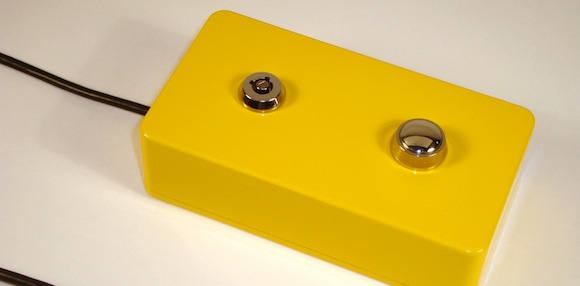
[Kevin]’s friend is a remarkably helpful engineer, and when his friend gets requests to help out on a few projects he always has a hard time saying no. Really, [Kevin]’s friends’ time is much too valuable to take up many more projects, but saying no to someone will drag you down. To  alieve his friend of the torment of saying no, [Kevin] built an automated Gmail assistant that will automatically replay to an annoying email with the words, “Go F*** Yourself!”.

The automated Gmail assistant is built around a Teensy 2.0 microcontroller equipped with a key that serves as a safety, lest an accidental “F*** you” be sent to friends, family, or employers.

If [Kevin]’s friend feels bad for telling so many people off there’s also a handy feature to make sure the engineer friend doesn’t seem too unhelpful: there’s a one percent chance of the Gmail assistant of replying with, “That’s a Great idea, I’ll get right on it!”.

Automated Resistor Sorter Puts Them Into Small Plastic Tubes

This one might be an oldie, but it’s certainly a goodie.

Way back in 2005, [David] and [Charles] needed a project for one of their engineering courses. With so many loose resistors scattered over the lab, they decided to build an automated resistor sorter (PDF warning) to separate these resistors and put resistors of the same value together in the same bin.

The electrical and programming portion of this build is relatively simple – just a PIC microcontroller reading the value of a resistor. The mechanical portion of this build is where it really shines. Resistors are sorted when they pass through small plastic tubes mounted to a wooden frame.

There are several levels of these tubes in [David] and [Charles]’ sorter that move back and forth. The process of actually sorting these resistors is a lot like going down a binary tree; at each level, the tube can go right or left with the help of a solenoid moving that level of the frame back or forth.

[David] and [Charles]’ project wasn’t entirely complete by the end of the class; to do so would require  8 levels and 128 different tubes on the bottom layer. Still, it worked as a proof of concept. We just wish there was a video of this machine in action.

Tip ‘o the hat to [Alexander] for finding this one and sending it in.

Cutting Styrofoam With A CNC Machine And Turning It Into Aluminum

One of the most popular ways of turning an object trapped inside the world of a computer into a real, metal object is the art of lost wax, or lost foam casting. In this process, a full-scale model of the object to be made in metal is crafted in either foam or wax, placed in a pile of sand, and burned away by molten metal.

[ptflea] over at the Bamberg, Germany hackerspace Backspace came up with a very clever build that automatically cuts foam into the desired shape, ready to be taken out to the backyard foundry. The build is based around an old flatbed scanner and a hot wire cutter. The old scanner conveniently had  an equal number of steps per axis, so attaching an Adafruit motor shield and replacing the old control electronics was just an issue of finding the correct resistors.

Software control is provided by a Processing app [ptflea] whipped up and is able to carefully cut very delicate shapes that even the steadiest hand would have trouble with.

Making stuff out of styrofoam is cool and all, but the real goal for this project was setting things on fire and melting old heatsinks. The styrofoam molds were placed in a bucket full of sand, and the furnace – a few ytong bricks, a crucible, and a propane burner – started to melt some aluminum. The molten aluminum was poured onto the mold and after cooling, the makers of Backspace had a few very cool aluminum trinkets.

A nice build that is able to produce some very nice metal objects. We suspect, though, that a higher-density foam (something along the lines of blue or green insulation sheets, if they have those in Germany) could produce an even higher level of detail if you’d like to build your own.

Videos after the break.

Continue reading “Cutting Styrofoam With A CNC Machine And Turning It Into Aluminum”

Tearing Down The Wii U

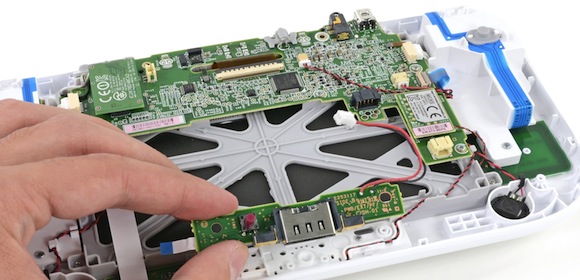
With the release of the Wii U last weekend we knew it wouldn’t be long before we saw those glorious gut shots on the Internet. The folks at iFixit have torn down a Wii U, and the insides look somewhat promising for a potential hack to take control of the Wii U Game Pad.

The components in the Wii U console aren’t terribly surprising; a few wireless controllers, HDMI adapters, Flash memory chips, and the IBM Power CPU make up most of the interesting components. The insides of the GamePad, though, look pretty interesting. It appears the Wii U GamePad is powered by an ARM Cortex microcontroller built by STMicroelectronics, but the part numbers for the major ICs on the GamePad board are impervious to Googling.

Of course there’s still the question of how video is transmitted wirelessly from the Wii U console to the GamePad. iFixit found a Broadcom BCM4319XKUBG Wireless module that operates on normal WiFi frequencies. This module has been used in a few other pieces of video gear, most notably the Boxee Box, so there is some possibility of intercepting the video signal transmitted to the GamePad and figuring out the protocol.

The long and short of iFixit’s teardown, at least from the hacker perspective, is that all the interesting parts use hardware similar to what you’d find on any other eminently hackable device. Here’s to hoping we get an open Wii U GamePad before the year is out.

Optimizing Your Electronics Projects With A Camera

What do you do when you have a microcontroller you’re trying to optimize? One method is using a debugger, but for AVRs and such that’s not a very common technique. For lower-level electronics projects, it’s nearly impossible, even. [Cnlohr] built a small Minecraft server that listens to in-game redstone circuits, but the performance of his real-world to block-world bridge wasn’t what he hoped. He came up with a pretty clever way of figuring out what was slowing his server down without any special gear at all.

[cnlohr]’s Minecraft server is just a simple AVR microcontroller, Ethernet adapter, and SD card affixed to a beautiful glass PCB. The performance of his server wasn’t what he expected; downloading a largish file from the server resulted in a download rate of about 55kbps, much slower than he expected. He wasn’t quite sure what the hangup was, so he took a camera and with a long exposure time took a very blurry picture.

The Minecraft server has a blue LED to show when the SD card was being accessed. In the picture above, [cnlohr] saw that SD card access was taking far too long, and if he wanted to optimize the code this would be the place to start.

Not bad for a dead-simple method of seeing where the code on your microcontroller project is slowing down.

Continue reading “Optimizing Your Electronics Projects With A Camera”

Launch Day Wii U Homebrew Is Very Encouraging

[youtube=http://hackaday.com/?v=5RBQG8As7Rs&w=580]

With the launch of the Wii U yesterday, we were wondering exactly how long it would take for this new console to be broken wide open allowing for the execution of homebrew code. Technically, it only took a day, as [wraggster] shows us, but the results aren’t what you would expect. Right now, he’s using methods meant for the classic Wii to open his system up; probably not the best way to open up the Wii U, but a start nonetheless.

This hack revolves around the Super Smash Bros. Brawl exploit that allows for the execution of unsigned code. It’s called Smash Stack and is one of the more popular ways of getting homebrew code running on the old, last-gen Wii.

Of course [wraggster]’s hack is dependent on the fact the classic Wii has been open for homebrew development for years now, and only works because of the Wii U’s ability to play classic Wii games. This probably isn’t the direction Wii U hackers want to go into, but it does provide a way for anyone to get into the Wii U system without using any new tricks.