Generating Truly Random Sequences

Your brain can’t generate random numbers, and computers can’t either. Most of the ‘random’ numbers we come across in our lives are actually pseudorandom numbers; random enough for their purpose, but ordered enough to throw statistical analyses for a loop. [Giorgio] thought generating random sequences would make for an excellent project, so he whipped up a random sequence generator out of a few Opamps, resistors, and a handful of caps.

[Giorgio] used a Chua Circuit – a circuit that models nonlinear equations – to create a chaotic system. When pairs of points from these systems of equations are plotted on a graph, a fabulous and chaotic ‘double scroll’ pattern (seen above) can be found. After taking oscilloscope probes to different points on his Chua circuit, [Giorgio] watched chaos magically appear on his ‘oscope screen.

The double scroll pattern isn’t exactly random, but since the Z signal of his circuit chaotically varies between positive and negative, the only thing needed to create a random sequence of 1s and 0s is sending the Z signal through a comparator.

After calibrating and sampling his circuit [Giorgio] captured thousands of samples at a rate of 5 samples per second. From a cursory glance, it looks like [Giorgio]’s circuit is at least as good as flipping a coin, but proper tests for randomness require many more samples.

A very, very cool piece of work that is much, much more elegant than getting random bits from a Geiger counter.


USB Business Card Packs An ARM Processor

Over on the Hackaday forums, [Brian] introduced himself by showing off his new business card. Given his expertise is creating unique circuit boards, we can’t imagine a better way to show off his skills than an ARM-powered business card.

[Brian] posted a more detailed write-up on his blog that covers his development process. He decided to use a 48-pin LPC1343 ARM Cortex M3 as a USB Mass Storage Class device. All the heavy lifting for instantiating a USB storage device is handled by the microcontroller, so all [Brian] had to do was wire up a Flash memory chip and access it over an SPI interface.

The finished business card functions just like a USB thumb drive with a whopping 1 Megabyte of storage. That’s not a lot of storage, but it has more than enough room for [Brian]’s resume, a link to his website, and the full source code for his card.

Uncovering Easter Eggs In Old Mac ROMs

The picture you see above is taken from the ROM of a Macintosh SE made in the  late 1980s. This black and white image remained buried inside old Macs until [Adam] and [Trammell] at NYC Resistor reverse engineered these old Mac ROMs and found a few really cool Easter eggs.

[Adam] and [Trammell] have been dumping ROMs from old computers for a while now. Their modus operandi is finding old 27C-series EPROMs on old computers, prying the out of their comfortable home, slapping them in a breadboard, and wiring up an Arduino clone to dump the data to a computer.

Recently, the guys found an old Mac SE lying on the side of a road in Brooklyn and brought it over to NYC Resistor. They had known about images hidden in the SE ROM, but the guys wanted to know how and where these pictures were stored. After carefully inspecting the binary file generated from dumping the ROM, [Adam] was able to recover three images hidden in every Macintosh SE.

The folks at Apple – especially in the heady days of the Apple II and 68k Macs – hid quite a few Easter eggs in the ROMs of their computers. For instance, the Apple IIgs has audio data stored in the ROM, and the Macintosh Classic hid an entire operating system – System 6.0.3 – in the ROM of the machine.

via Make

Volt Meter Clock Also Displays The Temperature

[IronJungle] got around to putting together every tinkerers favorite project: a clock with a strange way of displaying the time. For his clock, [Jungle] took a trio of voltmeters and turned them into a clock that displays the current hour, minute, and second on custom paper dials.

[IronJungle] connected a PIC 14M2 microcontroller to a DS1307 real time clock to keep track of the current time. As for display, [Jungle] took a trio of volt meters and wired them in to the PWM outputs on his PIC. With this, he was able to precisely control the position of the needle in the meter, and thus display the time.

In addition to displaying the time, [IronJungle] added a small temperature sensor to his build. By pressing a button below the seconds display, the clock is able to display the current temperature in Fahrenheit, Celsius, and Kelvin.

After the break you can check out a time-lapse video of [IronJungle]’s voltmeter clock going through the hours.

Continue reading “Volt Meter Clock Also Displays The Temperature”

Playing With DSP And Building A Guitar Pedal

Building guitar pedals has come a long way from hooking up a few transistors and building a simple boost circuit. [Cloudscapes] has been working on a Anti-nautilus auto glitch, auto repeat pedal, and if you’re looking for something that sounds like a spaghetti western soundtrack skipping on a record player, we couldn’t think of anything better.

[Cloudscapes] was already familiar with 8-bit AVRs, but when doing real-time audio sampling, a more powerful microcontroller was in order. He turned to the MikroElektronika MINI-32 board for development purposes. This small board fits a PIC32 microcontroller into an easily breadboardable DIP-40 form factor, perfect for playing around with some very capable hardware.

For the DAC, [Cloudscapes] had some experience with the 16-bit PT8211, but finding a good 16-bit ADC in a convenient package was a bit of a challenge. He eventually settled on the 12-bit MCP3201 ADC, more than enough for a pedal that is supposed to sound lo-fi.

After [Cloudscapes] got a few boards made, he started on his DSP adventure. Unfortunately, the initial code used unsigned 16-bit words to represent each sample, meaning every time the loop repeated it would start at 0 and produce a short pop in the speaker. After a week of debugging, [Cloudscapes] realized signed integers are a much better data format for storing audio data and got rid of the problems plaguing his project.

Now [Cloudscapes] has a wonderful DSP dev board, perfect for making new and strange guitar effects. After the break you can listen to a demo of what the Anti-nautilus pedal actually does, and we’ve got to say it sounds great.

Thanks [Chris] for sending this one in.

Continue reading “Playing With DSP And Building A Guitar Pedal”

Hackaday Retro Edition Roundup

In case you’ve forgotten about it, we still have a retro edition of Hackaday. It’s our simple, hand-coded HTML site featuring a few random hacks from Hackaday’s 8-year history. There’s also a retro successes page where our readers can log on with their old boxxen and claim their prize as a master of retrocomputing. Here’s a few retro successes that came in over the past month or so:

Our second OS/2 Warp submission comes from [Chris]. He got an HP Omnibook 800CT running OS/2 Warp 4 to load up our retro site.

A few of you may be wondering what the upper bound of what we consider a retro computer is. [Witek] used a Wyse thin client from the year 2000 to pull up our retro edition. These terrible computers used a Compact Flash card plugged directly into an IDE port to load up Windows CE. Yeah, it’s technically a SSD. [Witek] put the GRUB bootloader on one and loaded up our retro edition with Debian Squeeze. We have too many bad memories of these thin clients, and we’ve got to commend [Witek] for putting the effort into doing something useful with one.

[leadacid] is on a roll. He gave us our first OS/2 Warp submission and has since moved onto an IBM RS/6000. Previously, he got a Macintosh 8100 and a Quadra 840AV to pull up the retro site. Nice job.

Those are all the retro submissions for now, but if you have an old computer lying around, try pulling up our retro site and send it in.

Sadly, You Can’t Buy This Hoverbike

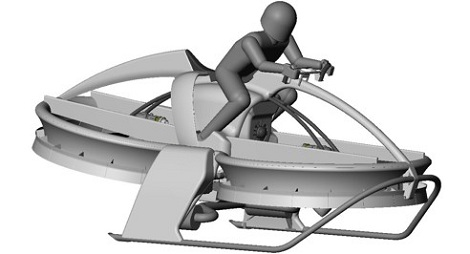
The LA Times posted a story about a company called Aerofex that built a real-life hover bike very reminiscent of the vehicles embedded in the redwoods of the forest moon of Endor.

The bike itself is a pair of ducted fans, with the pilot straddling the craft amidship. Aerofex claims the ducts on their hoverbike prevent the recirculating flow of air that causes dust or snow to completely obscure a helicopter pilot’s vision when landing.

From the Times’ article, Aerofex doesn’t have any plans to make this hoverbike commercially available and is instead meant to be a concept vehicle for future UAVs.

On the Aerofex blog, there’s a ton of videos showing off the capabilities of this bike. From what we can gather, it doesn’t seem like this hoverbike can climb higher than a few inches off the ground, so it’s of questionable utility when not flying around a dry lake bed.

Surprisingly, Aerofex says their bike doesn’t require any artificial stabilization or software; it’s controlled by the pilot leaning front to back and side to side. We’ll take that as an indication this hoverbike may be easy for someone to build in a garage, and we’ll be sure to post the first Aerofex hoverbike clone that shows up on our tip line.

You can check out a video of the hoverbike in action after the break.

Continue reading “Sadly, You Can’t Buy This Hoverbike”