Kitchen Hacks: An Android Bartender

[Nick] just finished up bis barbot build that is named after our favorite bartender. It’s an impressively capable even if it was done on the cheap.

The user chooses a libation for iZac to make via an Android tablet. This drink is interpreted by an Android ADK to have the mechanics of the robot swing into action and start making a drink.

The part of the build that moves the fluid was inspired by the Evil Mad Scientist Labs’ Drink Making Unit 2.0. Instead of pumps pulling the liquid through tubing, [Nick] attached an aquarium air pump to an Erlenmeyer flask. A siphon tube draws liquid out of the flask because of the difference in air pressure. The liquid is controlled by a few laser cut pinch valves that he designed.

Once a user selects a cocktail, the robot swings into action and dispenses liquid into a glass sitting on a load cell. Since the glass is being weighed at all times, iZac knows exactly how much alcohol (and in what proportion) is in the cocktail. [Nick] tested out iZac at the Sydney Hackerspace with soda water and flavoring. iZac proved very popular and we’re wondering if we could build something like this in a liquor cabinet.
Making Aerogel At Home

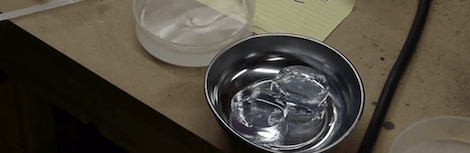
[Ben] outdid himself. He successfully made monoliths of silica aerogel in his garage. Aerogel, the light-weight solid that has been referred to as ‘hard air’ is really freaking expensive especially in non-granulated form.

The techniques behind producing aerogels have been on the Internet for a fairly long time. A few uncommon chemicals and a supercritical drying chamber are required for production, meaning it takes a lot of know-how to make hard air at home. Somehow, [Ben] got ahold of some tetramethoxysilane, the hard to come by ingredient and made a supercritical drying chamber out of pipe fittings and liquid Carbon Dioxide.

In the end, [Ben] was able to make a few small pieces of aerogel. The size of his pieces were constrained by his “mold” (actually a syringe) and the size of his drying chamber. It’s very possible [Ben] could build a larger supercritical drying chamber and make larger pieces of aerogel that would be sold commercially for hundreds of dollars.

Check out the very informative walkthrough of [Ben]’s process after the break. It’s 10 minutes long and makes for a great lunch break video.

Continue reading “Making Aerogel At Home”

Ice On Your Turkey Makes It Tender, Apparently

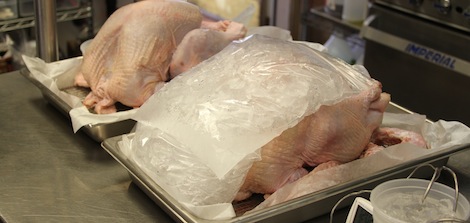
Turkey day is fast approaching and for those of us not cool enough to be rocking the deep-fried turkey this year we’ll have to suffer though a potentially dry oven-roasted bird. Chef [Justin] came up with a great way to prevent dried out white meat on a turkey using ice of all things.

The enemy of moist and tender breast meat is heat. Cooking meat for too long will dry it out. There’s a problem, though: the breast is the thickest part of the bird which means it will take longer than the legs or thighs to reach the necessary 160 degrees. [Justin] figured that if he could cool down the breast with ice, it will take longer to cook and both the white and dark meat will come out perfectly.

[Justin] set up a test with two 15-pound birds. Both turkeys were allowed to come up to room temperature, then ice packs were put on the breast of one bird for 15 minutes. This lowered the temperature of the experimental breast by a few degrees. Both birds were then thrown into the oven.

After coming out of the oven, both birds looked great. The bird treated with ice packs appeared to be more tender and moist. Sounds like the perfect thing to pull out of our bag of tricks next week.

Zero-G Experiments Will Make Some Pretty Pictures

Does a yo-yo work in zero-g? How about a paper airplane? These questions were answered in 1985 on the Space Shuttle Discovery, but reproduction of results is the cornerstone of the scientific method. [Rob] is about to reproduce some of the awesome zero-g pictures by riding on a vomit comet and taking a few pictures of water globes colliding.

For the last few months, [Rob] has had a standby ticket on the G-Force One, a plane that takes passengers on parabolic arcs to simulate microgravity. He was lucky as his standby ticket allowed him to take a few experiments on board, so [Rob] decided there’s just not enough awesome pictures of water colliding in zero-g.

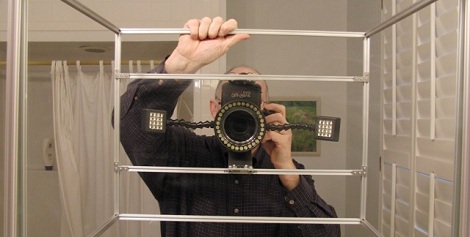
He built a rig out of micro t-slot aluminum. A DSLR is mounted to the frame along with a few ‘test tubes’ containing water. When [Rob] blows through a tube, a small sphere of water will be released to collide with other object. Think of it as the nerd’s version of water splash photography.

Of course, a trip through zero-g wouldn’t be complete without a few more experiments. [Rob] plans on testing a few toys to see if yo-yos ‘sleep’ without gravity (they don’t), and if a grandfather clock works on the moon (there’s a month-long day, so kind of). We can’t wait to see [Rob]’s pictures once he comes back to Earth.

Solder Reflow Toaster Oven

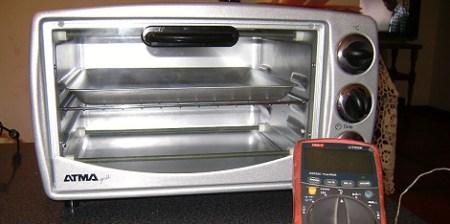
[Sebastian] needed a small solder oven so he bought himself a small toaster oven (Spanish, Google Translate). It’s not the kind of thing we’d make our breakfast in now, but for soldering it’s a very nice oven.

After a little bit of research on Google, [Sebastian] discovered that the best technique when dealing with reflow ovens and solder paste is following a specific temperature curve. Ideally, Tin/Lead solder needs to preheat from room temperature to 150 degrees C, then level off so the flux can activate. After that, a quick jaunt above 183 degrees C makes the solder flow. To get his toaster working optimally, [Sebastian] stuck a thermistor in the toaster and measured the temperature profiles of different ‘modes.’

The correct temperature curve was calculated using different heater elements and [Sebastian] was off to the races. He did have a few problems on his first few boards – solder bridging, mostly – but that’s not the fault of the oven. An LCD display (translate) was added recently so accurate real-time temperature monitoring is available.

Taking GPS Where No Man Has Gone Before

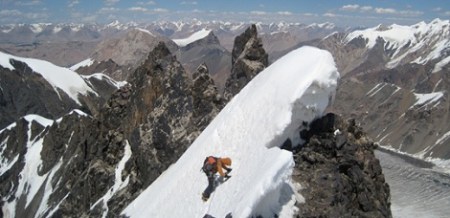
[Willem] has a friend that wanted to take a GPS datalogger up an unclimbed mountain the wilds of Kyrgyzstan. The GPS logger built for the expedition made it to the summit of Eggmendueluek, but it didn’t work the whole way up. Since the logger came back to London, [Willem] was able to do a complete teardown and failure analysis.

The data logger was built around a Jeenode with a GPS unit and MicroSD card reader added on. A few breakout boards were made and two of these bad boys were ensconced in water and dust proof enclosures. Powered by four AA batteries, the data loggers were able to handle the rigorous testing of being thrown down a staircase and also the harsh temperatures of London. Things changed in the wilds of Kyrgyzstan, though.

The data retrieved from the mountaineering expedition wasn’t the greatest – a few wires came loose after being thrown into the back of a Russian truck and jostled around. The AA batteries only powered the data loggers for three days, compared to the 12 day battery life in London. There are a few improvements needed for the next trip – some thermal insulation and not using solid core wire – but not that [Willem] has figured out the bugs he’s ready for his friend’s next expedition.

The International Obfuscated C Code Contest Is Back

The International Obfuscated C Code Contest is back. The stated goals of the IOCCC are to, “Write the most obscure C program, show the importance of programming style (by doing the opposite), stress the preprocessor to the breaking point, and illustrate some subtleties of the C language.” If you think you’re up to the task of abusing your compiler, check out the rules and guidelines for the contest.

There’s nothing quite like having the code for a flight simulator look like a plane, or calculating pi by measuring the area of C code. The submissions to the IOCCC are classic hacks; very clever things that shouldn’t work, but do despite themselves.

There hasn’t been an IOCCC competition since 2006, and no one knows if it will be around next year. We’ve already seen a few potential entries for this year, like piping chars into /dev/audio to generate a song and hyperlinks all the way down. If you’ve got something you’re working on, feel free to send it in.

via /.