Insane Macro Photography Rig

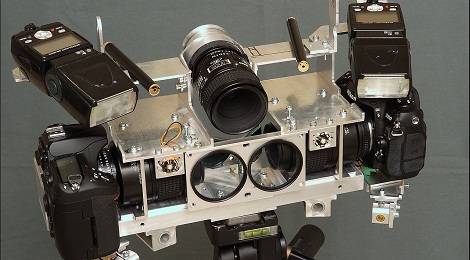
[fotoopa] just put up a Flikr build log of his 3D macro photography rig he uses to take pictures of insects in flight. Outside Hollywood or National Geographic, we’ve never seen a crazier photography rig.

[fotoopa]’s build is based around two cameras – a Nikon D200 and D300. These cameras are pointed towards the subject insect with two mirrors allowing for a nice stereo separation for 3D images. Of course, the trouble is snapping the picture when an insect flies in front of the rig.

For shutter control, [fotoopa] used two IR laser pointers pointed where the two cameras converge. A photodiode in a lens above the rig detects this IR dot and triggers the shutters. To speed up the horribly slow 50ms shutters on the Nikons, a high-speed shutter was added so the image is captured within 3ms.

[fotoopa]’s 2011 rig took things down a notch; this year he’s only working with one camera. Even though he didn’t get any 3D images this year, the skill in making such an awesome rig is impressive.

via (diyphotraphy.net)

Bluetooth Enabled Breathalyzer

[Al] at Open Gadgets just put the finishing touches on his Android breathalyzer. It’s the perfect thing to install on ex-girlfriends’ phones to prevent 2 a.m. drunk dialing.

The project started off as a talking breathalyzer connected to a computer that tweeted your BAC, gave weather and stock readouts, and functioned as a photo booth. Since the first reveal of his project, [Al] moved from the desktop world to the mobile domain.

The breathalyzer itself is contained entirely in an Altoids tin. The build is based on the IOIO board that recently got support for Bluetooth. An alcohol sensor in the project measures the alcohol content of the surrounding atmosphere and reports this back to a phone over Bluetooth. There’s no word if the Android version of [Al]’s breathalyzer has the Twitter and photo booth functions, they would be relatively easy to add.

While a wirelesss, tweeting breathalyzer lends itself to a competition for a high score, [Al]’s project could have a few very good implantation; a DIY auto ignition interlock would be a very useful device for some people. Check out the videos of [Al]’s builds after the break.

Continue reading “Bluetooth Enabled Breathalyzer”

Sous Vide With Racing Stripes

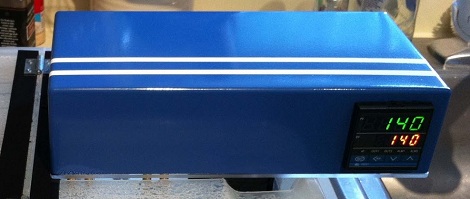
We’re not going to question the logic that went into putting racing stripes on a slow cooker, but [Evan]’s sous vide machine is the most professional one we’ve seen.

After [Evan] found a cooking book that went into the physics and chemistry of making a meal, he wanted to make some really good meals. Sous vide spoke out to him and [Evan] committed himself to building an immersion cooker.

After trolling around on the Internet, [Evan] came across a little gem on Make. The Make build was cheap – it was built around an off-the-shelf PID controller and thermocouples. [Evan] though about building his own PID controller, but time is money and he couldn’t beat the commercial version in features.

The enclosure was the most time-consuming part of [Evan]’s build. It’s a 1/8″ sheet of aluminum cut and bent to the correct size. The sharp edges were filed down and joined with epoxy; definitely not the ‘normal’ way of building an enclosure. The color scheme is borrowed from this Renault – French cooking inspired by a French car.

As for [Evan]’s results, he cooked a 5oz filet marinated in garlic, thyme, olive oil, salt and pepper. This dish was flanked with some roasted Yukon Gold potatoes and sautéed broccoli. Our mouth is watering just looking at the picture, so we’re betting [Evan] did an excellent job.

Rebuilding A Bridgeport Mill

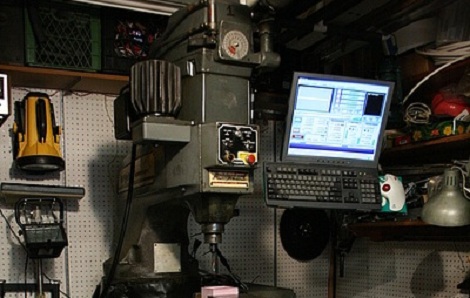
It looks like the Internet’s resident steampunker is moving up a century or two. [Jake Von Slatt] rebuilt the CNC portion of a Bridgeport Series II mill so it can interface with a computer. It’s a feat even more impressive than moving the mill into [Jake]’s garage.

The first step of the build was tearing out the BOSS 5 industrial microcomputer and replacing it with a Win XP laptop running ArtSoft’s Mach 3. This allows G-code to be displayed directly on the screen. The old power supply for the mill did give [Jake] a few problems. The Gecko stepper drivers that replace the old electronics couldn’t handle the voltage of the old power supply. That can be dealt with by opening the transformer and removing a few turns of wire.

[Jake] has been sending in a few of his hacks as of late, so it’s good to see Hack a Day has another fan, especially one of [Mr. Von Slatt]’s caliber. There is a problem with the mill modifications though – [Jake] hasn’t figured out how to program it. If any HaD readers would like to chime in on the best way to program G-code for the mill, feel free to leave a message in the comments.

Dad Hacks Cerebral Palsy, Upgrades Son’s Lifestyle

[Jorge]’s son was born in 2004 after a troubling time in the womb. The son, [Ivo], wasn’t getting enough oxygen and unfortunately developed cerebral palsy. [Jorge] took it upon himself to improve his son’s life, so he got busy building some machinery for physical therapy. Today, [Ivo] is able to walk very well without the need for braces or other aids.

[Ivo] has a form of CP called Spastic quadriplegia. With [Ivo]’s disorder, his skeletal muscles are always tight meaning he’s nearly unable to walk. This can be treated with muscle relaxants such as Botox (yes, that Botox), but [Jorge] wanted to help out with his son’s physical therapy.

[Jorge] began preparing for [Ivo]’s physical therapy by building a “tripod” for him. This allows [Ivo] to stand while taking part in physical activities like ping-pong and golf. The second phase of the training was a modification to a cross-country skiing/elliptical trainer that allowed [Ivo] to practice walking. Today, [Ivo] is happily walking very well, a testament to his dad’s wishes that he has somewhat normal life. Some aluminum tubing helped, but we’re pinning this one on his dad.

Hackaday Links: November 10, 2011

Experimentations with haptics

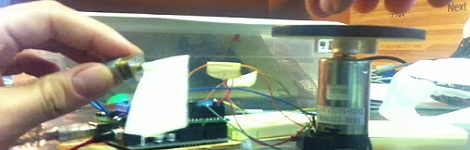
[Chris] sent in two videos (1, 2) documenting his experiments with haptic feedback. He’s recording the position of a DC motor and can either play it back or send it to another motor. It’s very similar to the kissing robot we saw earlier this year, but we’re not making any judgments.

Mobile Emergency Repeater go bag

[Nick], a.k.a. [KF5JAK] sent in a few pics of his emergency/disaster relief amateur radio go bag. With a 3G connection via a cell phone, the MER can be used with EchoLink.

Launchpad MIDI booster pack

Earlier this month we lamented the dearth of add-ons for the TI Launchpad. The folks on the 43oh forums just came out with a MIDI booster pack. Time to dust off that old Radio Shack keyboard, we guess.

Macro photography with OH GOD WHARGARBL

You know camera lenses work both ways, right? [Karl] has been experimenting with this very idea by mounting a camera lens backwards and running a few wires so it’s electrically connected as well. Check out an example shot.

Keeping tabs on your kids’ homework

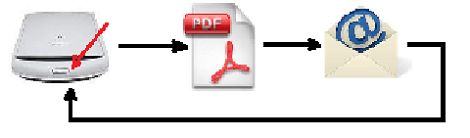
[Janis] doesn’t live with his kids but he wanted to keep track of their homework. He set up a document scanner that sends those worksheets straight to his email inbox. All he has to do is annotate them and send them back. This guy’s doing it right.

RFID Reading And Spoofing

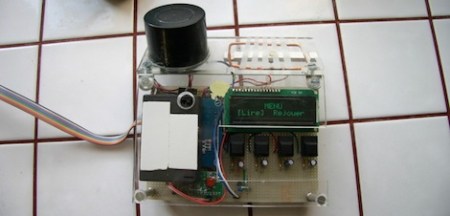
Locks are always temporary hindrances. After deciding to open the RFID-secured lock in his department, [Tixlegeek] built a device to read and spoof RFID tags (French, Google translate here).

The system is built around an ATMega32 microcontroller with a 16×2 LCD display. A commercial RFID reader module takes care of all the sniffing/cloning duties, and a small modulation circuit handles pumping those bits over to a lock. Right now, the spoofer can only handle reading and spoofing 125kHz RFID tags with no encryption or authorization. A tag that’s more complex than the duct tape RFID tag doesn’t work.

[Tixlegeek]’s little project does open up a few interesting avenues of exploring stuff that’s most certainly illegal. A smaller version of the project could be emplaced near a door or other RFID reader and left to crack a lock with a 32+62 bit password at 125 kilohertz. It wouldn’t be the fastest safecracker in the business, but it would work automatically as long as there is power.

If you’ve got any other ideas on what [Tixlegeek]’s RFID spoofer could do, leave a note in the comments.