Trippy Tripteron Kinematics Brainteaser

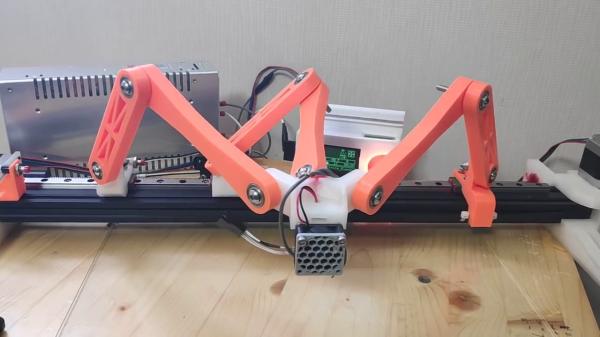
[JK Lee] has been experimenting with a monorail tripteron motion control system (video, embedded below) and trying to improve performance with varying tweaks to the design and with varying degrees of success. But [JK] is enjoying this project — he was inspired by an idea that maker [Nicholas Seward] proposed — building a tripteron on two rails (video), or even building one on a single rail (video). He is making good progress, most recently working on solving a vertical bounce issue. He is focusing on the middle arm, as this arm carries most of the weight. You can see a brief video explanation of the kinematics of the monorail tripteron that [JK] made (he warns us that English is not his native language, so focus on the equations and diagrams and not the grammar).

If you’re not familiar with the tripteron, it was conceived, along with the quadrupteron, at the Robotics Laboratory at Université Laval in Canada and patented by their researchers back in 2004. We wrote about an early implementation of a tripteron by [Apsu] back in 2016. These recent experiments, reducing the mechanism down to a single or double rail, are interesting.

Other than cool projects for makers like [Nicholas] and [JK] who enjoy tinkering, are there any applications of tripterons and/or quatrupterons in the real world? Let us know in the comments below. Thanks to [Littlejohn] for sending in the tip.
Continue reading “Trippy Tripteron Kinematics Brainteaser”

Handheld Multimeter Converted For Bench Top Use

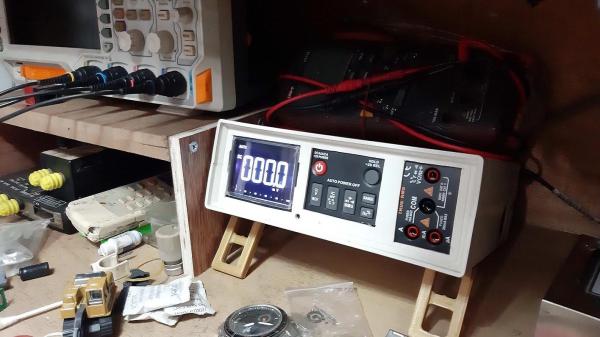
A few years ago [Mechatrommer] got one of the low-cost Aneng Q1 multimeters and has converted it into a bench top meter. He first tried and failed to do an LCD modification and set it aside. It remained in a storage box until he needed another meter to repair his rubidium frequency standard. Finding that off-the-shelf bench multimeters were literally off-the-shelf — they were too deep for his bench — he decided to take matters into his own hands.

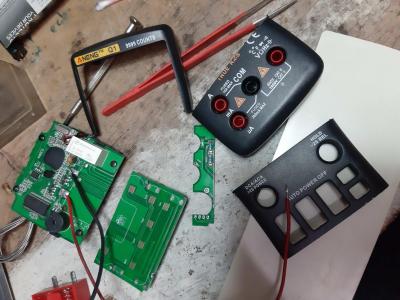
He dug out the dismantled an Aneng Q1 and undertook a more drastic modification than before, slicing the multimeter into three pieces and mounting each piece in a new enclosure. The power-draining back-lit display of the Q1, problematic in a battery-powered handheld meter, isn’t an issue in a bench top design. [Mechatrommer] replaced the battery pack with a mains powered supply. Next he reconnected all the signals which had been interrupted by the bandsaw, and now the meter lives again.

The resulting meter is pleasing enough (ignore the sideways input jacks) and looks like a typical piece of home-brew test gear. The enclosure has a lot of empty space, which he uses to stow test leads and sandwiches (we saw a similar storage compartment in [Dave Jones]’s recent teardown of a portable Fluke 37 multimeter). Kudos to [Mechatrommer] for coming up with this unusual conversion project.

We’ve written about the differences between these low-cost and more professional multimeters before if you want to learn more.

Thanks to [Adrian] for the tip.

Smartphone App For Leftover Vaccinations

South Korea’s Disease Control and Prevention Agency launched a pilot program yesterday to minimize vaccination waste using a nationwide smartphone app. People who are over 30 years of age can search for leftover doses on their smartphones. If any are available, they can book an appointment immediately within the app, and then get to the medical center within hours to receive the injection. One can tag up to five nearby inoculation centers to receive an instant message when a dose becomes available.

These leftover doses arise from people who have missed their appointment, but also just as you would expect when considering the short shelf life of the opened vaccine, the number of doses per vial, and modulo arithmetic. Within hours of the program rolling out, people began complaining about server problems and the lack of available doses. But this is a pilot program, after all, so some glitches are to be expected.

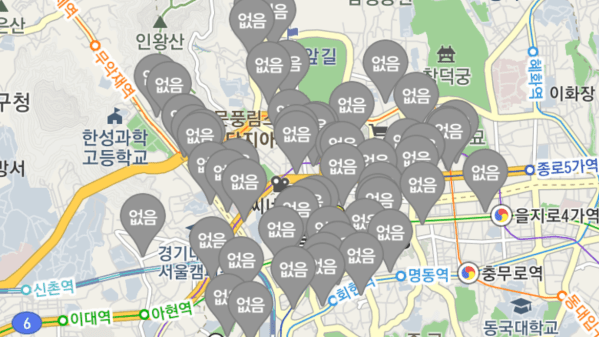
The full program is supposed to begin on June 9th, although it isn’t clear how it will be different from the pilot project, other than presumably having fewer bugs. The lead picture above shows the availability of leftover vaccines in central Seoul this morning — zero (the symbol 없음 means “none”). But the system does indeed work and people received vaccinations yesterday utilizing this program.

Technically speaking, this isn’t a new app, but rather, it is integrated into the two most popular South Korean portal sites. Anyone already using KakaoTalk or the Naver portal on their smartphone can use this leftover vaccination service with just the press of a few icons. Are the health authorities in your region utilizing smartphone apps or online reservations sites to distribute these leftover doses, doses that would otherwise be discarded? Let us know in the comments below.

Continue reading “Smartphone App For Leftover Vaccinations”

World’s First RP2040 QWERTY Computer

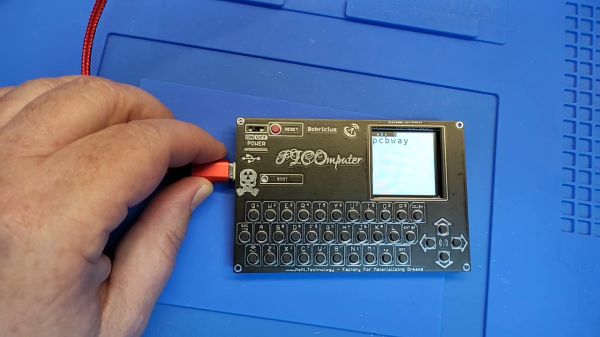
Independent hardware developer [bobricius] is at it again, making what he claims is the world’s first Pico RP2040 QWERTY + IPS development kit — the PICOmputer. This is a palm-sized computer of sorts. It integrates a keyboard made from tactile push button switches, a TFT IPS display, and a RP2040 Pico computer module. At 100 x 65 mm size, it is slightly bigger than your typical ISO-7810-ID-1-sized credit card, and slightly smaller than an A7 piece of paper.

One of [Bobricius]’s goals for this project was to minimize the number of external components, thus maximizing the use of the RP2040’s internal features. And if you peruse the schematic posted on his GitHub repository, you can agree he’s met this goal for sure. There’s a filter capacitor for the optional LoRa module, and two MOSFETs and three resistors to drive a speaker and the TFT backlight. Aside from connectors, the switches, and the submodules themselves, that’s all of the external circuitry.

The arrangement of two USB connectors, type C for power and micro-USB for data, is an interesting aspect of the connector / module placement. He plans to add an Ethernet module in the future, and issue some more revisions to fix small errors and to make the front panel fit more sizes of displays. We wonder if a battery module add-on is in the works, as well.

If you recognize [bobricius], that’s because his previous ARMACHAT handheld LoRa messenger project was among the Hackaday Prize Community Vote (Bootstrap) winners last year. We think tiny keyboards may be an obsession for him — indeed, he freely admits to being blinded by his own enthusiasm. Check out his mini (Pi)QWERTY USB keyboard from 2018, for example. Thanks to [Itay] for bringing this project to our attention via the Hackaday tip line.

Continue reading “World’s First RP2040 QWERTY Computer”

History Of Closed Captions: Entering The Digital Era

When you want to read what is being said on a television program, movie, or video you turn on the captions. Looking under the hood to see how this text is delivered is a fascinating story that stared with a technology called Closed Captions, and extended into another called Subtitles (which is arguably the older technology).

I covered the difference between the two, and their backstory, in my previous article on the analog era of closed captions. Today I want to jump into another fascinating chapter of the story: what happened to closed captions as the digital age took over? From peculiar implementations on disc media to esoteric decoding hardware and a baffling quirk of HDMI, it’s a fantastic story.

There were some great questions in the comments section from last time, hopefully I have answered most of these here. Let’s start with some of the off-label uses of closed captioning and Vertical Blanking Interval (VBI) data.

Continue reading “History Of Closed Captions: Entering The Digital Era”

Yet Another Rigol DS1054Z Viewer

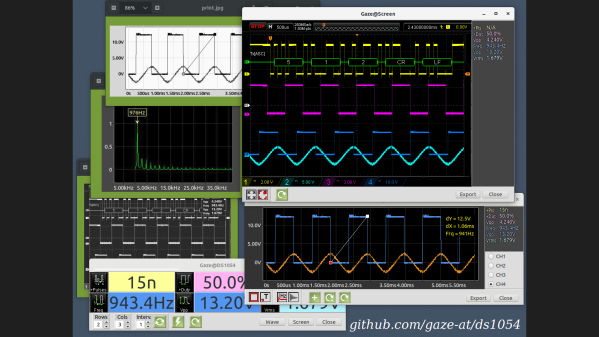
Tired of squinting at the small numbers on the oscilloscope display, [Alfred] aka [Gaze@] decided to take matters into his own hands and wrote yet another tool to remotely view images from a Rigol DS1054Z. At least that was the initial idea. But, it grew unexpectedly — as [Alfred] says, “the more the project turned out to be fun, the more it got out of hand”. We know the feeling well.

In addition to being able to simply view and export the screen, the program implements waveform measurements (we’re not sure if it is using the measurement ability of the ‘scope, or actually performing measurements in the program). And as you can see in the animated GIF of the program in operation over on the GitHub repository, the numbers are certainly clear and legible. His problem of squinting at the small screen has indeed been solved.

This is coded in Pascal (FPC Lazarus), but we weren’t able to browse the program because [Alfred] hasn’t posted the source code yet. It is written only for Linux, and he has tested it on Ubuntu, Debian, Fedora, and Manjaro. The project relies on Python, PyVisa, and gtk2, and talks to your DS1054Z over USB or LAN. The installation instructions are well documented, but as [Alfred] himself warns, if you encounter trouble arising from subtle dependency version conflicts, you may need to be a nerd and/or a pensioner with unlimited time on your hands to solve them. There is no users guide nor extensive help according to [Alfred]. However, simple hints might be found in hover text or by pressing F1. Disclaimers aside, this looks like an interesting project to try out.

As [Alfred] notes, there are many other tools available to fetch data and images from your Rigol oscilloscope. [Jenny List] wrote a two-part series on using Python to control your test instruments, and here’s an example of a simple Python script that does a screen grab. Do you have a favorite way to remotely operate your oscilloscope? Let us know in the comments below.

DIY Insulating Nuts And Bolts

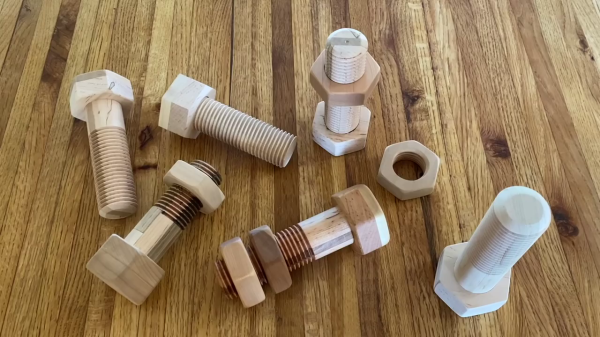
[Rudi Schoenmackers] has devised a clever set of custom 3D-printed jigs that makes it easy to build your own wooden hex nuts and bolts. Well, easy if you have access to a woodworking shop with a router, bandsaw and belt sander.

You won’t be using these to mount your PCBs, however. They are pretty big — UNC 1½-6 threads (the closest metric thread would probably be M36-4). [Rudi] points out that these jigs can be readily adapted to generate different sizes and pitches of threads, even left-handed ones, but we suspect making a #4-40 or M3-0.5 is out of the question. There are commercial jigs for making threads, but as [Rudi] points out, those are quite expensive. The price of [Rudi]’s jigs is quite low, assuming you have a 3D printer.

We’re not sure how to best take advantage of these nuts and bolts in ordinary hacking projects, but [Rudi] enjoys giving them away as cool toys or making large clamps and vises out of them. Let us know if you have any applications where wooden threaded fasteners could come in handy. If wooden threads interest you, then check out this project we covered a few years ago on making simple taps.

Continue reading “DIY Insulating Nuts And Bolts”