A PCB Diary

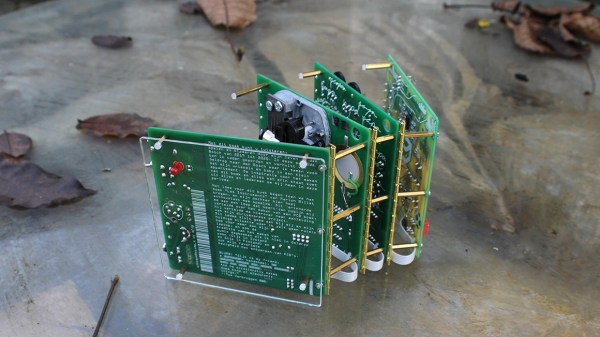
[Gijs Gieskes] has made another eye-catching PCB wonder, this time a diary built from several circuit boards which are assembled into a book, not unlike a PC/104 system. But with [Gijs]’s system you can easily open the stack-up to access single boards without disassembling the whole thing. We don’t see brass piano hinges on PCB assemblies very often, but [Gijs]’s PCB designs are anything but conventional. Hint: if you wanted to recreate this technique using more ordinary hardware, you can find hinged PCB standoffs from various suppliers.
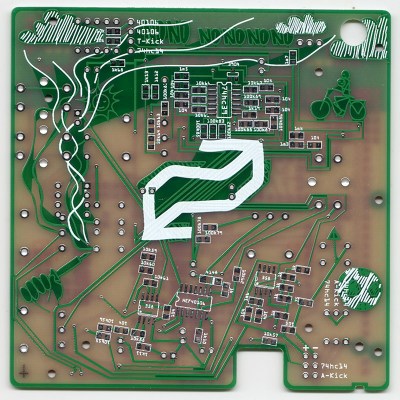
Bicycle, soccer ball, smoke on the “No no no no no…” PCB

Apparently it’s more than a passive piece of art.  Each board has several circuits, some of which (all?) are functioning is ways not clearly described, which seems to be intentional. According to his build log, different things happen when you mix and match the inter-board ribbon cables in various ways. We are told in the instructions “to just try and see what happens”. No schematics are posted, but there is a partial description of the circuits in the manual and parts on the two-layer boards are well-labeled. Although after spot checking a few circuits board photos, we’d guess that no small number of traces, and perhaps some parts, are wild goose chases.

The project claims to be a diary for the years 2018 and 2019, but we will leave it as an exercise for the reader to interpret the messages that [Gijs] has embedded into this fascinating piece. We have written about several of his projects over the years, such as this crazy bent Casio SK-1 from all the way back in 2005. And before dismissing this “book” style of circuit board stack-up as only for artists, check out this teardown of a Soyuz clock we covered back in January.

Printed Circuits, 1940s Style

A presentation this month by the Antique Wireless Museum brought British engineer and inventor John Sargrove (1906-1974) to our attention. If you’ve ever peeked inside old electronics from days gone by, you’ve no doubt seen point-to-point wiring and turret board construction. In the 60s and 70s these techniques eventually made way for printed circuit boards which we still use today. But Mr Sargrove was way ahead of his time, having already invented a process in the 1930s to print circuits, not just boards, onto Bakelite. After being interrupted by the war, he formed a company Electronic Circuit Making Equipment (ECME) and was building broadcast radio receivers on an impressive automatic production line.

Mr. Sargrove’s passion was making radios affordable for everyone. But to achieve this goal, he had to make large advances manufacturing technology. His technique of embedding not only circuit traces, but basic circuit elements like resistors, capacitors, and inductors directly into the substrate foresaw techniques being applied decades later in integrated circuit design.  He also developed a compact vacuum tube which could be used in all circuits of a radio, called an “All-stage Valve“. Equally important was his futuristic automatic factory, which significantly reduced the number of factory workers needed to make radios from 1500 to 50. Having completed the radio design, he was also developing a television receiver using the same concepts. Unfortunately, ECME was forced into liquidation when a large order from India was cancelled upon declaration of independence in 1947.

You really must watch the video below. There are many bits and pieces of modern factory automation which we still use today, yet their implementation using 1940s techniques and technology is fascinating. Further reading links after the video. Thanks to [Mark Erdle] for the tip.

Continue reading “Printed Circuits, 1940s Style”

Smart Screen Heal Thyself

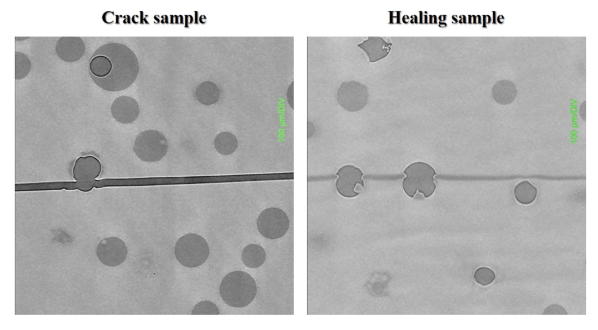
The Korea Institute of Science and Technology (KIST) have announced a transparent, self-healing polyimide material designed for smart phone screens. A KIST team from the Composite Materials Applications Research Center led by Dr Yong-chae Jung and a team at Yonsei University’s Electronics Materials Lab led by Dr Hak-soo Han collaborated on this project. While the goal was to improve the material used in folding smart phone screens, the results seem applicable to all glass screens that are prone to cracks and scratches.

This new material can heal itself in 12 hours at room temperature, even faster under UV light. As we understand it, many micro-balloons of flaxseed oil are impregnated on the surface and break open if the material is damaged. Thus liberated, the oil is now free to flow into and fill up the cracks. We imagine it’s like repairing windshield cracks, but on a much smaller scale.

The idea is to eliminate the need for user-added screen protection films and increase the life of your phone screen. But cynical people might wonder if smart phone manufacturers will embrace this new technology with much enthusiasm — after all, if people use their phones longer it might cut into sales. Those with access to academic journals can read the report here.

C64 Runs On STM32F429 Discovery

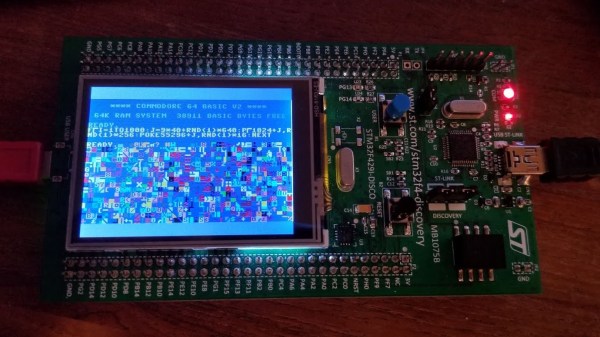
There have been various reincarnations of the Commodore C64 over the years, and [Dave Van Wagner] has created one that can run on an STM32F429ZI Discovery development board. These dev boards have been around quite a few years and feature a 2.4 inch color TFT LCD in addition to the typical I/O circuitry, and are a pretty good value — [Dave] says they currently sell for under $30 through distribution.

The project began earlier this year when [Dave] set out to write a command line program in C# that emulated C64 Basic. He had written a 6502 emulator many years earlier, but had not tested it. [Dave] went on a programming binge in March and got it up and running over a very long weekend. He subsequently decided to add support for VIC-20, TED, and PET as well.

Even though [Dave] says C# is a beautiful language, he subsequently ported the program into C (an ugly language?) in order to run on the Discovery board, swapping the command line terminal interface for real LCD video and a USB keyboard. There’s also an Arduino version (terminal interface only). It runs about 15% slower than a real C64, and there are some limitations still like no SID. But overall, this is a great project and a low-cost way to emulate a C64 in an embedded format. If you want to explore further, here is the Mbed project for the STM32F429, and you can find the Arduino and C# versions on his GitHub page. You may remember [Dave] from the C128 video hack we wrote about last year.

Larry Berg And The Purple Open Passion Project

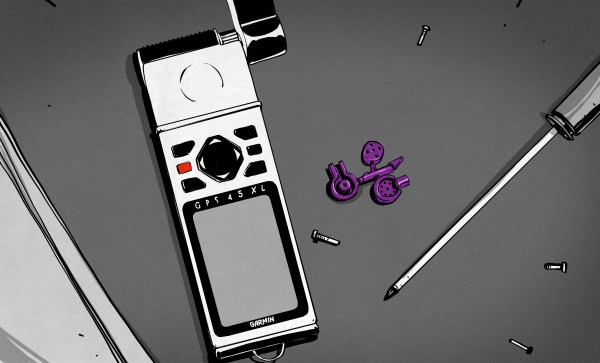
It all started with an 88-ton Arburg RP300 injection molding machine in the basement, and a bit of inattention. Larry Berg wanted a couple custom plastic plugs for his Garmin GPS, so he milled out a mold and ran a few. But he got distracted, and came back an hour later to find that his machine had made 400. Instead of throwing them away, he mailed them away for free, but then he found that people started throwing money at him to make more. People all over the world.

This is how the Purple Open Project turned into an global network of GPS geeks, selling molded alternatives to the oddball Garmin plugs for pledges to pay an unspecified amount, and ended up producing over 350,000 plugs over 16 years before he passed away in 2012. This is the story of a hacker’s hacker, who wanted to be able to connect his GPS to his computer and use it the way he wanted, and accidentally created an international business.

Continue reading “Larry Berg And The Purple Open Passion Project”

Celebrating The 4004’s 0x31st Anniversary

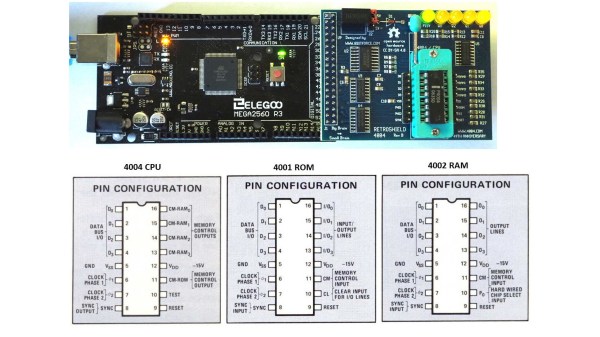
This weekend marked the 49th anniversary of the legendary Intel 4004 microprocessor, and to celebrate [Erturk Kocalar] combined the old and new in this intriguing Retroshield 4004 / Busicom 141-PF calculator project. We have reported on his Arduino shield project before, which lets you connect a variety of old microprocessors to an Arduino so you can experiment with these old chips with a minimum of fuss.

[Erturk] decided to use the Arduino to simulate the hardware of the Busicom 141-PF, a calculator famous for bringing us the microprocessor. In addition to the calculator, the Arduino has to simulate the Intel 4004 CPU’s supporting chips, which include ROM, RAM, and shift registers. If you want to build one of these yourself, all the design files are open source, or you can get an assembled shield from his Tindie store. In either case, you will have to provide your own 4004, which are surprisingly still available. (Tindie and Hackaday share the same parent company, Supplyframe. We’ve got nothing to do with Intel.)

We really appreciate the detailed explanation that [Erturk] provides about the inner workings of the calculator. Interfacing the emulator to the original ROM code running on the 4004 is non-trivial — take a look at the explanation of the spinning drum printer, for example. We enjoyed perusing the annotated ROM listing, as well as reading the story of the efforts which have been undertaken to prevent these historical documents from being lost forever. Be sure to check out the history of the 4004 and its inventor Federico Faggin if you’d like to delve deeper.


Vectron Adds Basic And Christmas Tree Control

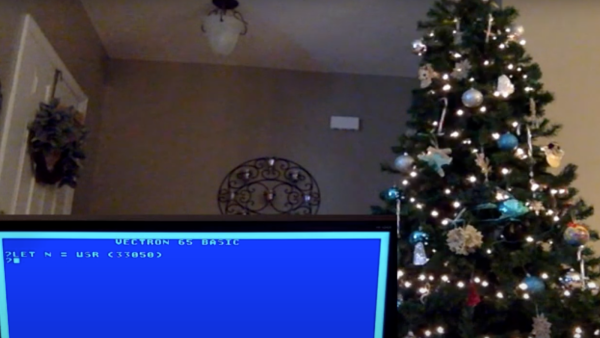
Not content to leave things alone, [Nick Bild] has updated his nearly practical breadboard 6502 Vectron project once again by adding Tiny Basic and home tree automation. Instead of using an LCD module like last time, or his custom-built VGA output using 7400-series logic, [Nick] chose to go modern this time and implemented a VGA output using a TinyFPGA BX.

Tiny Basic was one of the first versions of Basic released after Bill Gates famous open letter to hobbyists in 1976. While Altair Basic was selling for $150, Tom Pittman wrote Tiny Basic for the 6800 and sold it for only $5 (don’t worry, Tom has since made it free to use). We got a kick out of browsing the Tiny Basic manual and learning that our serial number can be found on the paper tape leader, and that a Teletype will generally receive one more character, at least, after getting the X-OFF control signal.

In the video, you can see [Nick] running a short Basic program and operating his Christmas tree lights from the Vectron, although it’s only on-off control. He suggests that a PCB version is in the works, but he’s having trouble deciding when to quit adding features.  That’s a conundrum we know all too well.

Continue reading “Vectron Adds Basic And Christmas Tree Control”