Someone Get This Minimalist Wooden PC A Martini

It’s interesting to imagine what computers may have looked like throughout different time periods that precede their portability or even their existence altogether. In the 1950s and ’60s, computers still filled entire rooms, but if the age of the PC had arrived earlier one is left to wonder what might a minimalist mid-century PC might look like.

Well, if we were lucky, it would have looked something like [xmorneau]’s cubical computing creation. This DIY beauty is made of scrap oak and a sexy set of hairpin legs. As hot as it looks, [xmorneau] shouldn’t have to worry about overheating — the bottom is completely open except for an intake fan, there’s another fan at the top that exhausts hot air through a mesh grille, and those lovely little legs elevate it four inches off the desk. Our favorite part (after the legs) has to be the secret lid that blends in beautifully.

The cube measures 32cm³ (~12.6in³), so [xmorneau] went with a mini-ATX motherboard, but was able to fit in a full-size graphics card. Everything is mounted internally to wood except for the mobo, which is mounted on a panel of sheet metal that makes up the back wall.

We love the way this looks and are glad to see that this build changed [xmorneau]’s opinion of RGB a little bit, because we can’t help but like it both ways.

Too sophisticated for your taste? Check out this LEGO-Minecraft mashup.

Field Guide To Shipping Containers

In the 1950s, trucking magnate Malcom McLean changed the world when he got frustrated enough with the speed of trucking and traffic to start a commercial shipping company in order to move goods up and down the eastern seaboard a little faster. Within ten years, containers were standardized, and the first international container ship set sail in 1966. The cargo? Whisky for the U.S. and guns for Europe. What was once a slow and unreliable method of moving all kinds of whatever in barrels, bags, and boxes became a streamlined operation — one that now moves millions of identical containers full of unfathomable miscellany each year.

When I started writing this, there was a container ship stuck in the Suez canal that had been blocking it for days. Just like that, a vital passage became completely clogged, halting the shipping schedule of everything from oil and weapons to ESP8266 boards and high-waist jeans. The incident really highlights the fragility of the whole intermodal system and makes us wonder if anything will change.

A rainbow of dry storage containers. Image via xChange

Setting the Standard

We are all used to seeing the standard shipping container that’s either a 10′, 20′, or 40′ long box made of steel or aluminum with doors on one end. These are by far the most common type, and are probably what come to mind whenever shipping containers are mentioned.

These are called dry storage containers, and per ISO container standards, they are all 8′ wide and 8′ 6″ tall. There are also ‘high cube’ containers that are a foot taller, but otherwise share the same dimensions. Many of these containers end up as some type of housing, either as stylish studios, post-disaster survivalist shelters, or construction site offices. As the pandemic wears on, they have become so much in demand that prices have surged in the last few months.

Although Malcom McLean did not invent container shipping, the strict containerization standards that followed in his wake prevent issues during stacking, shipping, and storing, and allow any container to be handled safely at any port in the world, or load onto any rail car with ease. Every bit of the container is standardized, from the dimensions to the way the container’s information is displayed on the end. At most, the difference between any two otherwise identical containers is the number, the paint job, and maybe a few millimeters in one dimension.

Standard as they may be, these containers don’t work for every type of cargo. There are quite a few more types of shipping containers out there that serve different needs. Let’s take a look at some of them, shall we?

Continue reading “Field Guide To Shipping Containers”

Soviet Axe Restoration: Replace Or Repair?

What do you do with a cool-looking misfit guitar that has non-working built-in effects and some iffy design aspects? Do you try to fix it and keep it original, or do you gut it and strut your stuff with new bits from around the shop? This is the conundrum that [Tim Sway] finds himself in with this late 70s/early 80s Formanta Solo II straight out of the USSR. (Video, embedded below.)

[Tim] likes a lot of things about it (and we do, too), especially the acid green pick guard, the sparkly pickups, and the beefy bridge that lets him set the string spacing individually, on the fly. It even has a built-in phaser and distortion, but those aren’t working and may never have worked that well at all.

The non-working effects guts.

As you can see in the video below, [Tim] has already spent a few hours making it playable and a little more palatable in order to figure out what to do with it electronics-wise. He started by making the 9 V compartment big enough to actually fit a battery inside, and drilled out bigger holes for new tuners.

Interestingly, these guitars had a 5-pin DIN receptacle instead of a 1/4″ jack. [Tim] bought an adapter just in case, but once someone dug up a schematic and sent it over, he decided to rewire it with a 1/4″.

For all of its plus sides, [Tim] doesn’t like the headstock on this thing at all and found the neck to be too chunky for the modern guitarist, so he cut down the headstock, shaved down the neck a bit, and stained it dark. He also made a new nut out of what looks like rosewood. Then it was on to the more standard stuff — file down the frets and polish them, oil the fretboard, and clean up the body.

The point of this exercise is to make a usable guitar for the modern musician. As [Tim] says, this is not a particularly valuable guitar, nor is it rare, and it wasn’t built that well to begin with. One of the issues is the switches — they’re kind of light and cheesy feeling, and one of them is directly in the strum path. Will [Tim] change those out but fix the original effects, or will he make the thing completely his own? We wait with bated breath.

Want to mess around with cheap old guitars, but don’t know where to start? Our own [Sven Gregori] has your back with Axe Hacks.

Via adafruit

Raspberry Pi Spigot Puts Digits Of Pi On Tap

What did you do for Pi Day? Play with your Raspberry Pi 400? Eat some pizza or other typically round objects and recite all nine digits you’ve got memorized? That’s about where we were at this year. But not [bornach], no. [bornach] went all out and built a spigot that spews digits of Pi well past the first nine decimal places.

This clever spigot sculpture implements the spigot algorithm for generating digits of Pi one-by-one in a stream on to a chain of 8×8 matrices, and does so using a Raspberry Pi (of course). The point of the spigot algorithm is to store as few numbers as possible at any given time by reusing variables. We love the way the digits materialize on the matrix, almost as if they are ink being activated by water. Be sure to check out the build and demo video after the break.

That 10k pot on the top really does control the spigot — since the Pi has no ADC, [bornach] is using the potentiometer to charge a capacitor and using the time it takes to reach the threshold to decide whether the faucet is open or closed. There are a couple of hacks at play here, including the Popsicle-stick LED matrix bracing and the HAT [bornach] fashioned so the daisy-chained 8×8 LED modules could interface with the Pi.

We love Raspberry Pis of all eras around here, especially the darling new Pico. Diminutive as it may be, the Pico can be sliced even smaller with a hacksaw if you don’t mind losing a few GPIO pins.

Continue reading “Raspberry Pi Spigot Puts Digits Of Pi On Tap”

Totally Useless Coffee Dispenser Is Anything But

Good coffee is nice to have, sure, but frankly, caffeine is caffeine and we’ll take it any way we can get it. That includes freeze-dried, if that’s all you’ve got. We won’t judge anyone for their taste in caffeinated beverages, and to call this coffee dispenser ‘totally useless’ is just patently untrue. It clearly has a use, and even if you don’t like freeze-dried coffee, you could sacrifice one jar worth of Nescafe and fill it with Skittles or anything else that will fit in the little collector basket.

In this machine, the cup is the trigger — the 3D-printed plate underneath activates a micro switch embedded in the scrap wood base, and this triggers a micro:bit around back to actuate the stepper motor that twirls the collector basket around. Although [smogdog] has provided all the files, you’d have to come up with your own connector to suspend the thing over the cup and carve your own base.

We love it when we can see what a machine is doing, so not only is it useful, it’s beautiful. And it worked, at least for a little while. For some reason, it keeps burning out stepper motors. Check it out in proof-of-concept action after the break.

We’ve seen the Micro:bit do a lot, and this pinball machine is among the most fun.

Continue reading “Totally Useless Coffee Dispenser Is Anything But”

Color-Changing Sutures Detect Infection

If you’ve ever had surgery, you know firsthand how important it is to keep the wound from getting infected. There are special conductive sutures that sense changes in wound status via electrical signal and relay the information to a computer or smart phone. As awesome as those sound, they’re a first-world solution that is far too pricey for places that need it most — developing countries. And surgical wounds in developing countries are about four times more likely to get infected than those in the US.

Iowa high-school student [Dasia Taylor] found a much simpler solution that could drive down the infection rate. She used beets to develop color-changing sutures that turn from bright red to purple within five minutes if an infection is present.

Beets, and other fruits and vegetables like blackberries, plums, and blueberries are natural indicators of pH. They have a compound called anthocyanin that gives them both their pigment and this cool property. Beets are perfect because they change color at a pH of nine — the same pH level of infected human skin, which is normally around five.

[Dasia] experimented with several types of suture thread to see which ones would absorb the beet juice in the first place. She settled on a cotton-polyester blend that is braided. While it probably helps absorb the beet juice, it would also give bacteria several places to hide. Another problem is that many surgeries involve cutting muscle, too, and by the time a deeper infection would show up on the sutures, it would be pretty late in the game. But if these color-changing sutures can be made to be cost-effective, safe for skin, and of course, keep wounds together, this solution is way better than nothing at all and definitely worth producing. You can see [Dasia] talk about her project in the video below.

Want to know more about natural pH indicators? Sure you do.

Continue reading “Color-Changing Sutures Detect Infection”

Ford And HP Teamed Up To Drive Down Plastic Waste

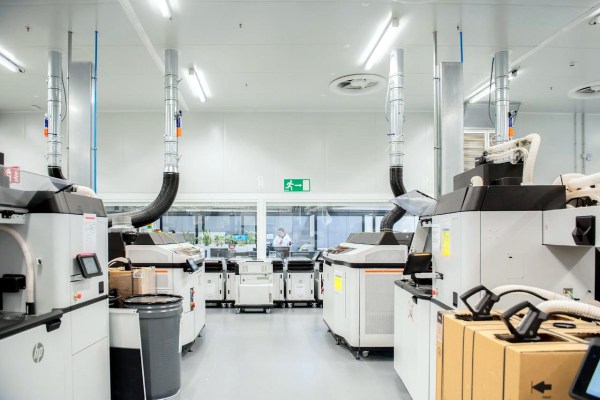
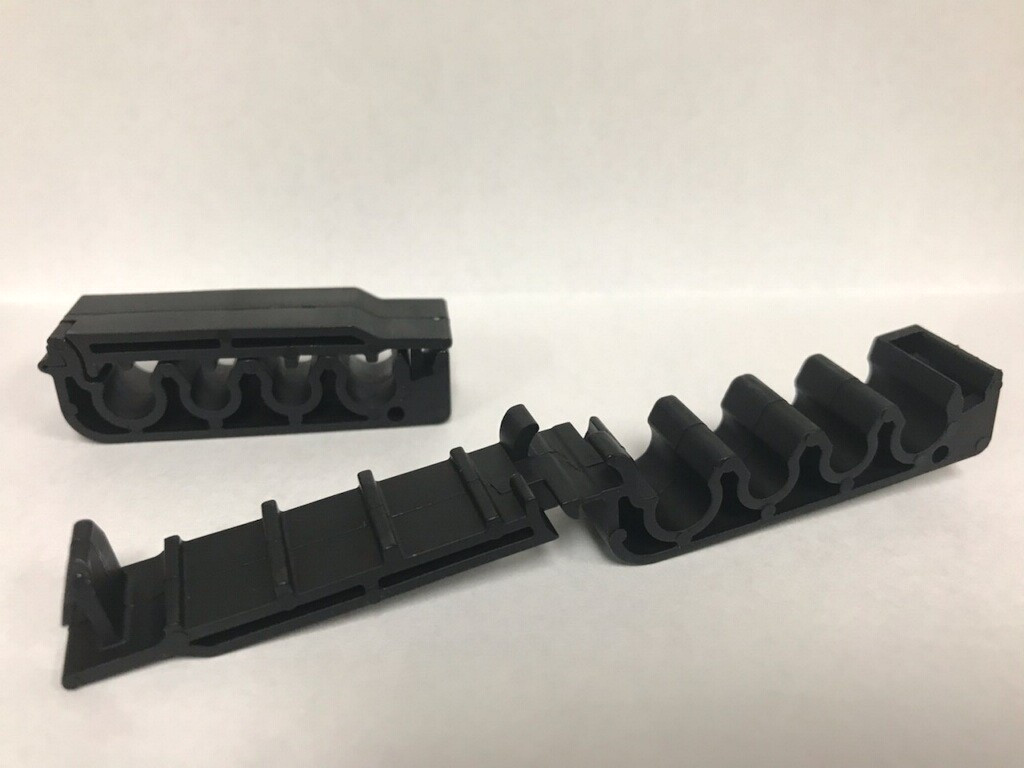
This mass manufacturer movement towards electric cars is one thing, but what about sustainability on the plastic part production line? Ford and HP have teamed up to turn used 3D printed parts and powders into pellets that will be fodder for injection-molded parts — specifically the fuel-line clips for Super Duty F250 trucks.

Two of the sustainably-made fuel clips.

According to Ford’s press release, their goal is to reach 100% sustainable materials in all their vehicles, not just the diesel-drinking Super Duty. Their research team found ten other Fords whose existing fuel-line clips could instead be made sustainably, and the company plans to implement the recycled plastic clips on all future models.

There are all sorts of positives at play here: the recycled clips cost 10% less to make and end up weighing 7% less than traditionally-made clips, all the while managing to be more chemical and moisture resistant.

And so much plastic will be kept out of landfills, especially once this idea takes off and more manufacturers get involved with HP or form other partnerships. One of the sources of Ford’s plastic is Smile Direct Club, which has 60 printers cranking out over 40,000 dental aligners every day.

There’s more than one way to combine 3D printing and sustainability. Did someone say fungal sound absorbers?

[Images via Ford]