Grawler: Painless Cleaning For Glass Roofs

Part of [Gelstronic]’s house has a glass roof. While he enjoys the natural light and warmth, he doesn’t like getting up on a ladder to clean it every time a bird makes a deposit or the rainwater stains build up. He’s tried to make a cleaning robot in the past, but the 25% slope of the roof complicates things a bit. Now, with the addition of stepper motors and grippy tank treads, [Gelstronic] can tell this version of GRawler exactly how far to go, or to stay in one place to clean a spot that’s extra dirty.

GRawler is designed to clean on its way up the roof, and squeegee on the way back down. It’s driven by an Arduino Pro Micro and built from lightweight aluminium and many parts printed in PLA. GRawler also uses commonly-available things, which is always a bonus: the brush is the kind used to clean behind appliances, and the squeegee blade is from a truck-sized wiper. [Gelstronic] can control GRawler’s motors, the brush’s spin, and raise/lower the wiper blade over Bluetooth using an app called Joystick BT Commander. Squeak past the break to see it in action.

As far as we can tell, [Gelstronic] will still have to break out the ladder to place GRawler and move him between panels. Maybe the next version could be tethered, like Scrobby the solar panel-cleaning robot.

Continue reading “Grawler: Painless Cleaning For Glass Roofs”

Alexa And Particle Modernize Coffee Machine By One Iota

When [Steve Parker]’s girlfriend got a tea kettle that takes voice commands, he suddenly saw his fancy bean-to-cup coffee machine as a technological dinosaur. It may make good coffee, but getting the DeLonghi going is inconvenient, because it runs a self-cleaning cycle each time it’s turned on or off.

Thus began [Steve]’s adventure in trying to turn the thing on with Alexa via Particle Photon. Because of the way the machine is designed, simply adding a relay wouldn’t do—the machine would just turn off and back on, only to start the self-clean again. Once inside, he found it’s controlled by a PIC18LF2520. Further research indicated that it is powered by an off-line switcher that combines a power MOSFET with a power supply controller. [Steve] figured out that the buttons are read via square wave and interpreted by a multiplexer.

The project went into the weeds a bit when [Steve] tried to read the signals with a knock-off Saleae. As soon as he plugged it in, the control board fried because the DeLonghi evidently has no reference to Earth ground. While waiting for a replacement board to arrive, he tried replacing the mux and shift register chips, which actually fixed the board. Then it was more or less a matter of using the DeLonghi’s status LEDs to determine the machine’s state, and then to interface with the Photon and Alexa. Cycle past the break for a ristretto-sized demonstration.

[Steve] didn’t do all this to actually make coffee, just turn the machine on with a voice command. The Photon is totally capable of making coffee, though, as we saw with this closed-loop espresso machine.

Continue reading “Alexa And Particle Modernize Coffee Machine By One Iota”

It’s Not Morning Until Green O’clock

[JohnathonT] has a two-year-old who can’t reliably tell time just yet. Every morning, he gets up before the rooster crows and barges into his parents’ room, ready to face the day.

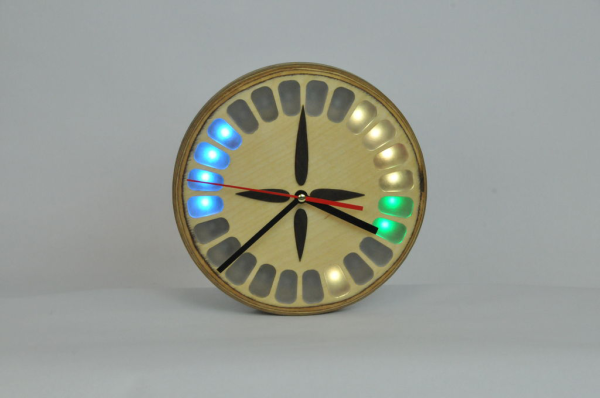
In an effort to catch a few more Zs, [JohnathonT] built a simple but sanity-saving clock that tells time in a visual, kid-friendly way. Sure, this is a simple build. But if a toddler is part of your reality, who has time to make one from logic gates? The hardware is what you’d expect to see: Arduino Nano, a DS1307 RTC, plus the LEDs and resistors. We think an RGB LED would be a nice way to mix up the standard stoplight hues a bit.

At a glance, little Mr. Rise and Shine can see if it’s time to spread cheer, or if he has to stay in his room and play a bit longer. At 6:00AM, the light powers on and glows red. At 6:50, it turns yellow for 10 minutes. At the first reasonable hour of the day, 7:00AM, it finally turns green. In reading the code, we noticed that it also goes red at 8:00PM for 45 minutes, which tells us it also functions as a go-to-sleep indicator.

When his son is a little older, maybe [JohnathonT] could build him  a clock that associates colors with activities.

Automatic MtG Card Sorter Separates Rags From Riches

Like many of us, [Michael Portera] was an avid trading card collector as a kid. Also like many of us, life got in the way, and the collections sat ignored in boxes until our mothers threatened to get rid of them (or skipped the threat altogether and sold them at a garage sale for next to nothing).

[Michael] was recently reunited with his collection of Magic cards, which vary in value as much as baseball or any other kind of collectible card. Now that his Friday nights are otherwise occupied, he decided to sell them off. But first, he had to know how much they’re worth.

Manually sorting and pricing hundreds of cards would take longer than he’d like, so he built a sorter to automate the process. It takes a stack of MtG cards and uses servos and little tires to move them, one by one, into position. A short Python script runs the servos, tells a Raspi 3 camera take a picture of each one, and uploads it to Amazon AWS. Once the pictures are there, [Michael] uses a second script to grab the card title text from the picture and fetch the value through TCGPlayer’s pricing API.

This machine probably isn’t for purists or people with a bunch of originals and re-issues of the same card. We probably should have mentioned that he took out all the Black Lotuses and other obviously valuable cards first. Someone still has to assess the condition of each card, but at two seconds per card, it’s quite the time twister saver. Time Walk past the break to see it in action.

Tired of using dice or scratch paper for your life counter? Summon some Nixie tubes and make a cooler one.

Continue reading “Automatic MtG Card Sorter Separates Rags From Riches”

Flood Fault Circuit Interrupter Could Save Lives

What if you didn’t have to risk your life to disconnect the power during a catastrophic storm? That’s a question many people in Houston were asking themselves as they watched water from Hurricane Harvey and other storms surge through the streets, swell in the gutters, and flood their homes.

Among these Houstonians were engineering students [Jon] and [Cyrus Jyan]. They watched as homeowners fought to safely disconnect their homes from the power grid and said, it shouldn’t have to be this way. They designed the Flood Fault Circuit Interrupter to monitor target areas and disconnect the power automatically when a credible threat is detected.

The FFCI is built on top of existing protection schemes like GFCIs and Arc Fault Circuit Interrupters. It isn’t meant to replace them, but instead tie them together and turn them off based on input from float switches.

As floodwaters rise, an EEPROM does a lookup and compare to decide if the threat is enough to shut it down. If so, an alarm signal to a shunt trip breaker can either throw the whole system to OFF, or else switch over to an alternate power source. The system is built around a standard security panel and keypad interface that supports 12 V alarm output. We particularly like the float switch enclosures that allow water to enter while keeping out debris.

Tiny Pinball Emulator Is Hugely Impressive

We were wondering what [Circuitbeard] has been up to lately. Turns out he’s been building a mini pinball cabinet to add to his arcade of self-built games.

[Circuitbeard] was forced to break out of his Raspi comfort zone this time. We’re glad he did because this is one impressive build. Finding the pinball emulation community lacking for Linux, he turned to the LattePanda, a tiny Windows 10 SBC with a built-in Arduino Leonardo. This was really the perfect board because he needed to support multiple displays with a minimum of fuss. That Leonardo comes in handy for converting button presses to key presses inside the Visual Pinball emulator.

The 3mm laser-cut plywood cabinet was designed entirely in Inkscape and sized around the two screens: a genuine 7″ LattePanda display for the playfield, and a 5″ HDMI for the back glass. The main box holds the Lattepanda, two Pimoroni mini speakers, and a fan to keep the board cool.

There’s a lot to like about this little cabinet thanks to [Circuitbeard]’s fantastic attention to detail, which you can see for yourself in the slew of pictures. Look closer at the coin drop—it’s really an illuminated button with a custom graphic. If you want to have a go at emulating this emulator, all the code is up on GitHub. Tilt past the break to watch some modern pinball wizardry in action, and then check out his mini Outrun machine.

If pinball emulators don’t score any points with you, here’s one that’s all wood and rubber bands.

Continue reading “Tiny Pinball Emulator Is Hugely Impressive”

ESP Cookbook Goes Beyond Chips And DIPs

Are you putting ESP8266s in all your projects these days, whether they need one or not? We don’t blame you. These boards are cheap, tiny, oh and they have WiFi.

If you want to spend less time writing code and more time blinking RGB LEDs over Wi-Fi, then check out this ESP cookbook over on IO. [Turo Heikkinen] and team are writing a soup-to-nuts guide to these darlings of IoT. The cookbook leads off with pinouts and networking (of course) before moving into more intricate recipes involving popular sensors and displays.

This cookbook is funny, it’s helpful, and it’s really well-organized. We love that they used the details section to create a linked table of contents. The links all drive to a specific Instructions page where each group of code snippets and explanations can be found. It’s still a work in progress, so you might want to follow it for updates. We have a feeling they’re going to expand the dessert section next.

Love the ESP8266, but hate programming them in that wonky form factor? Here’s a handy programming jig you can build.