Tote Boards: The Impressive Engineering Of Horse Gambling

Horse racing has been around since the time of the ancient Greeks. Often called the sport of kings, it was an early platform for making friendly wagers. Over time, private bets among friends gave way to bookmaking, and the odds of winning skewed in favor of a new concept called the “house”.

During the late 1860s, an entrepreneur in Paris named Joseph Oller invented a new form of betting he called pari-mutuel. In this method, bettors wager among themselves instead of against the house. Bets are pooled together and the winnings divided among the bettors. Pari-mutuel betting creates more organic odds than ones given by a profit-driven bookmaker.

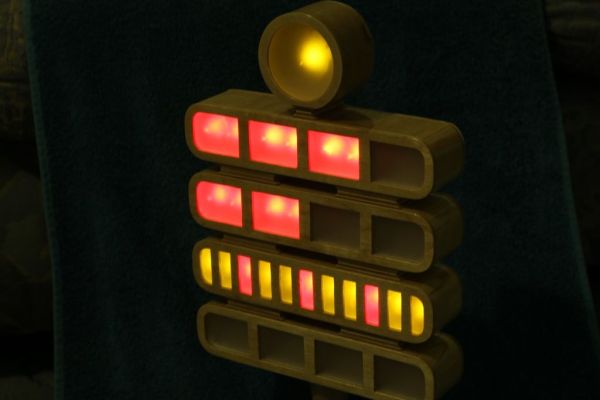
Oller’s method caught on quite well. It brought fairness and transparency to betting, which made it even more attractive. It takes a lot of quick calculations to show real-time bet totals and changing odds, and human adding machines presented a bottleneck. In the early 1900s, a man named George Julius would change pari-mutuel technology forever by making an automatic vote-counting machine in his garage.

Continue reading “Tote Boards: The Impressive Engineering Of Horse Gambling”

PIR Jack-o-Lantern Sees Them Coming

Planning to make that carved a pumpkin last past Halloween night? Forget the tealight or LED candle—here’s an easy, no-solder project that will make it extra special. By default, this jack-o-lantern looks like it has a flickering flame, but get close enough to it and it goes crazy with color.

All you need is an LED matrix, a Rainbowduino to drive it, a PIR motion sensor to trigger the random colors, and a power source. [Alpha Charlie] kept the electronics from becoming pumpkin-flavored with some plastic bags. Since he used the PIR as the jack-o-lantern’s nose, there is a bit of plastic behind it to keep moisture from interfering.

[Alpha Charlie]’s build instructions are quite detailed, which makes this project even simpler if you’ve never used a PIR before. There are lots of ways you could build on this project to make it your own, like using trick-or-treater motion to trigger screams or spooky sounds, or add more sensors to make it more interactive. Watch it react after the break.

If you have nothing else at all to do between now and trick-or-treat time, you could bust out the soldering iron and recreate this 70-LED matrix jack-o-lantern. Blinkenlights too safe for your tastes? Fire-breather it is, then.

Continue reading “PIR Jack-o-Lantern Sees Them Coming”

This Animatronic Hand Is So Metal

According to his Instructables profile, [bwebby] wants to make cool stuff in the special effects industry. We think he has a pretty good chance at it based on the animatronic hand he built.

The finger segments are made from copper pipe. They are connected to each other and to the sheet metal palm with tiny hinges and superglue. That stuff inside the finger segments is epoxy putty. It keeps the ends of the tendons made from bicycle gearing cable firmly attached to the fingertip segments, and provides a channel through the rest of the fingers. These cables run through 50mm aluminium tubes that are set in a sheet metal forearm, and they connect to high-torque servos mounted on a piece of MDF. [bwebby] used a Pololu Mini Maestro to control the servos using the board’s native USB interface and control software.

Watch [bwebby] run through some movements and try out the grip after the break. If you want to make an animatronic hand but aren’t ready for this type of undertaking, you could start with an approach closer to puppetry.

Continue reading “This Animatronic Hand Is So Metal”

Nomograms: Complex Analog Calculators Simple For Everyone

In the late 1800s, a railway engineer named Philbert Maurice d’Ocagne was part of a group of men faced with the task of expanding the French rail system. Before a single rail could be laid, the intended path had to be laid out and the terrain made level. This type of engineering involves a lot of cut and fill calculations, which determine where dirt must be added or removed. The goal of earthwork is to create a gentle grade and to minimize the work needed to create embankments.

In the course of the project, d’Ocagne came up with an elegant, reusable solution to quickly  solve these critical calculations. Most impressively, he did it with little more than a pen, some paper, and a straightedge. By developing and using a method which he called nomography, d’Ocagne was able to perform all the necessary calculations that made the gentle curves and slopes of the French railway possible.

Continue reading “Nomograms: Complex Analog Calculators Simple For Everyone”

Toy Television’s Dreams Come True

A couple of years ago, [Alec]’s boss brought him a souvenir from Mexico City—a small mid-century console television made of scrap wood and cardboard. It’s probably meant to be a picture frame, but [Alec] was determined to give it a better life.

As it turns out, the screen of [Alec]’s old Samsung I9000 was a perfect fit for the cabinet with room to spare. It was on its way to becoming a real (YouTube) TV once [Alec] could find a way to control it remotely. A giant new-old stock remote that’s almost bigger than the TV was just the thing. There’s enough room inside the remote for a non-LE Bluefruit module, which is what the I9000 will accept as input without complaint.

Trouble is, Bluefruit doesn’t support matrix keypads, so [Alec] used a bare ATMega328 running on the internal clock. Since the Bluefruit board provides voltage regulation, the remote was able to keep its native 9V power. [Alec] is happy with the results, though he plans to refine his button choices and maybe make a new overlay for the remote. Stay tuned for a tiny TV tour.

Continue reading “Toy Television’s Dreams Come True”

See Who’s Calling With Caller Pi-D

One of the hardest things in life is watching your parents grow old. As their senses fail, the simplest things become difficult or even impossible for them to do.

[kjepper]’s mom is slowly losing her sight. As a result, it’s hard for her to see things like the readout on the caller ID. Sure, there are plenty of units and phones she could get that have text-to-speech capabilities, but the audio on those things is usually pretty garbled. And yes, a smartphone can natively display a picture of the person calling, but [kjepper]’s mom isn’t technologically savvy and doesn’t need everything else that comes with a smartphone. What she needs is a really simple interface which makes it clear who’s calling.

Initially, [kjepper] tried to capture the caller ID data using only a USB modem. But for whatever reason, it didn’t work until he added an FSKDTMF converter between the modem and the Pi. He wrote some Node.js in order to communicate with the Pi and send the information to the screen, which can display up to four calls at once.  To make a mom-friendly interface, he stripped an old optical mouse down to the scroll wheel and encased it in wood. Mom can spin the wheel to wake the system up from standby, and click it to mark the calls as read. Now whenever Aunt Judy calls the landline, it’s immediately obvious that it’s her and not some telemarketer.

[via r/DIY]

How Analog Tide Predictors Changed Human History

If you’re completely landlocked like I am, you may dream of ocean waves lapping at the shore, but you probably don’t think much about the tides. The movement of the ocean tides is actually quite important to many groups of people, from fishermen to surfers to coastal zone engineers. The behavior of the tides over time is helpful data for those who study world climate change.

Early tide prediction was based on observed changes in relation to the phases of the Moon. These days, tide-predicting is done quickly and with digital computers. But the first purpose-built machines were slow yet accurate analog computation devices that, as they were developed, could account for increasing numbers of tidal constituents, which represent the changes in the positions of tide-generating astronomical bodies. One of these calculating marvels even saved the Allies’ invasion of Normandy—or D-Day— in World War II.

Continue reading “How Analog Tide Predictors Changed Human History”