Retrotechtacular: The Omega Navigational System

In 1971, the United States Navy launched the Omega navigational system for submarines and surface ships. The system used radio frequencies and phase difference calculations to determine global position. A network of eight (VLF) transmitter sites spread around the globe made up the system, which required the cooperation of six other nations.

Omega’s fix accuracy was somewhere between one and two nautical miles. Her eight transmitter stations were positioned around the Earth such that any single point on the planet could receive a usable signal from at least five stations. All of the transmitters were synchronized to a Cesium clock and emitted signals on a time-shared schedule.

LOP-thumbA ship’s receiving equipment performed navigation by comparing the phase difference between detected signals. This calculation was based around “lanes” that served to divvy up the distance between stations into equal divisions. A grid of these lanes formed by eight stations’ worth of overlapping signals provides intersecting lines of position (LOP) that give the sailor his fix.

In order for the lane numbers to have meaning, the sailor has to dial in his starting lane number in port based on the maps. He would then select the pair of stations nearest him, which were designated with the letters A to H. He would consult the skywave correction tables and make small adjustments for atmospheric conditions and other variances. Finally, he would set his lane number manually and set sail.

Continue reading “Retrotechtacular: The Omega Navigational System”

Legit Hack Creates TEA Laser Power By Mr. Wimshurst

It’s a bit scary what you can make with stuff found in the average household, provided you know what you’re doing. How about a TEA laser? Don’t have a high-voltage power supply to run it? Do what [Steven] of rimstar.org did, and power it with a homemade Wimshurst machine.

TEA lasers give off ultraviolet light. In order to see the beam, [Steven] aims it through a glass of water tinted with highlighting-marker juice and onto a sheet of white paper. [Steven] originally used his homemade 30kV DC power supply to light up his TEA laser. He made the laser itself from aluminium foil, angled aluminium, transparency sheets, some basic hardware components, and a 100kΩ resistor.

Although the components are simple, adjusting them so that the laser actually works is quite a feat. [Steven] says he burned holes through several transparencies and pieces of foil before getting it right. Using a Wimshurst machine to power the TEA laser takes another level of patience. It takes about 25 cranks of the static electricity-producing machine to build up enough energy to attempt lasing.

Want to make your own TEA laser, perhaps in a different configuration? [Steven]’s design was based on one of [sparkbangbuzz]’s lasers, which we covered several years ago.

Continue reading “Legit Hack Creates TEA Laser Power By Mr. Wimshurst”

Maker Faire Kansas City: That’s A Wrap

The 5th annual Kansas City Maker Faire was as fun as ever, but it definitely felt different from previous years. There seemed to be an unofficial emphasis on crafts this year, and I mean this in the broadest sense of the word. There was more exposure for the event in the local media, and this attracted a wider variety of faire-goers. But the exposure also brought more corporate sponsorship. This wasn’t an exclusively bad thing, though. For instance, several people from Kansas City-based construction firm JE Dunn were guiding mini makers through a birdhouse build.

Many of the this year’s booths were focused on a particular handicraft.  A local music shop that makes custom brass and woodwind instruments had material from various stages of the building process on display. Several tables away, a man sat making chainmaille bags. At one booth, a girl was teaching people how to fold origami cranes. Several makers had various geek culture accessories for sale, like a shoulder bag made from a vintage Voltron sweatshirt. The guys from SeeMeCNC made the 12-hour drive with the Part Daddy, their 17-foot tall delta printer. They printed up a cool one-piece chair on Saturday, then made a child-sized version of it on Sunday.

The entire lower level of the venue was devoted to a series of exhibits related to the film and television industry. Collectively, they covered the entire production process from the casting call to the red carpet. Several local prop and costume makers were showing off their fantastic creations, including [Steven] of SKS Props. He started making video game props for fun a few years ago. These days, his work adorns the offices of some of those same game companies.

Of course, there was plenty to see and do outside, too. All the kids playing human foosball were having a blast. LARPers larped next to lowriders and food trucks, power wheels raced, and a good time was had by all.

Getting Mixed Up With Home Stir Welding

Most processes designed to join two pieces of what-have-you together are consumptive of something, whether it’s some material acting as a third party to work piece and the tool, or the tool itself. In the wonderful world of friction stir welding, the material of the two pieces under union gets swirled together through friction as the tool traverses the join path. There are, of course, professional machines that perform this with relative ease, but with a large amount of beer on the line, [skookum_choocher] was determined to make his own.

In the first video, he machines a friction welding tool by shaping a tungsten carbide button from a drill bit using a diamond grinder. Once he has a rough shoulder and protuberance going, it’s time to let her rip.  Despite issues with clamping and the geometry of his tool, the weld is ultimately successful at the tail end.

Undeterred, he has another go at it after making some adjustments to the tool shoulder, changing the belt on his poor old Bridgeport, and increasing the clamping strength by a factor of four. You clamp sixteen tons, and whaddya get? A slightly better butt weld than the first time, it turns out. Fearing this weld is insufficient to win the bet, he goes for the lap weld with the work pieces stacked together in a sandwich. We prefer pizza with beer, but nevertheless congratulate him.

Continue reading “Getting Mixed Up With Home Stir Welding”

Retrotechtacular: Building Hammond Organ Tones

Here’s a short film made by the Hammond Organ Company with the intent to educate and persuade potential consumers. Right away we are assured that Hammond organs are the cream of the crop for two simple reasons: the tone generator that gives them that unique Hammond sound, and the great care taken at every step of their construction.

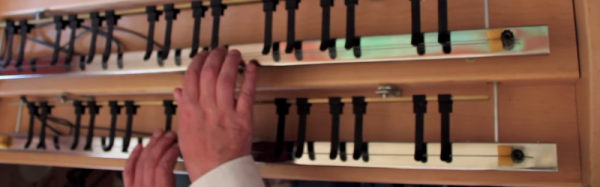
Hammond organs have ninety-one individual electromagnetic tone wheel assemblies. Each of these generate a specific frequency based on the waviness of a spinning disk’s edge and the speed at which it is rotated in front of an electromagnet. By using the drawbars to stack up harmonics, an organist can build lush walls of sound.

No cost is spared in Hammond’s tireless pursuit of excellence. All transformers are wound in-house and then sealed in wax to make them impervious to moisture. Each tone wheel is cut to exacting tolerances, cross-checked, and verified by an audio specialist. The assembly and fine tuning of the tone generators is so carefully performed that Hammond alleges they’ll never need tuning again.

This level of attention isn’t limited to the guts of the instrument. No, the cabinetry department is just as meticulous. Only the highest-quality lumber is carefully dried, cut, sanded, and lacquered by hand, then rubbed to a high shine. Before it leaves the shop, every Hammond organ is subject to rigorous inspection and a performance test in a soundproofed room.

Continue reading “Retrotechtacular: Building Hammond Organ Tones”

Maker Faire Kansas City: Entrepreneurial Spirit Taking Shape

One of the great things about an event like the Kansas City Maker Faire is that there are so many reasons that makers sign up to show their things. Some makers come to teach a skill, and others to sell their handmade creations. Those with an entrepreneurial streak looking to launch a product might rent a booth to get a lot of eyes on their idea. That’s just what [Ted Brull] of Creation Hardware was after this weekend–exposure for Kevo, his small-scale vacuum former.

kevo-mt-dewKevo is a simple and affordable solution for makers of all stripes. It can be used to make molds, blister packaging for items, or even electronics enclosures. [Ted]’s Kickstarter campaign for Kevo has already been successfully funded, but there’s still plenty of time to get a Kevo kit for yourself. The basic reward includes the vacuum-forming chamber and two sizes of adapters that cover most vacuums. It also ships with an aluminium frame to hold polystyrene sheets during the heating and molding processes, and starter pack of pre-cut pieces in black, white, and clear plastic.

Creation Hardware had many vacuum-formed molds on display and were constantly making more from 3D-printed objects, toys, and other things. Our favorite mold was a 20oz bottle of Mountain Dew, which shows how far the small sheets of plastic can stretch.

Maker Faire Kansas City: Coming To Grips With The Mechanics Of Dexterity

There is always a great variety of things to see and experience at the Kansas City Maker Faire. This is the fifth year for the event which is held at historic Union Station, a beautiful art deco train depot from a bygone era. With a multitude of booths and exhibits across two floors and a vast outdoor area, there is something for pretty much everyone. Often times, the interesting things are mobile conversation-starting creations. When we saw [Dan] walking around with a giant wooden contraption on his arm, we knew we must find out more about it.

The impetus for [Dan]’s project was his desire to pick up a soda can using a mechanical grip. He now believes this to have been a lofty goal, given the weight of a full can of the stuff. This prosthetic hand is made from wooden finger segments that are connected by small, continuous hinges. Each of [Dan]’s gloved fingers curls around a metal ring to control that digit’s large wooden analog. On the inside of the hand, sections of paracord run underneath strategically placed eye bolts on each finger segment and are tied off at the fingertips. A second set of eye bolts on the back of the hand anchor the network of rubber bands that provide resistance. Although he made it look easy to open and close the hand, [Dan] said that it’s pretty heavy to lug around and somewhat strenuous to use. Next time, he’ll probably go with foam or 3D-printed pieces.