It’s Time You Built A Smart Pocket Watch

There’s just something about a pocket watch that screams class compared to the barbaric act of bending your arm, or the no-fun way of looking at your phone.

But smartwatches are dumb, analog things that mostly look pretty. Or are they? [JGJMatt] proves otherwise with their stunning DIY smart pocket watch. It is essentially a cheap smart watch from Amazon stuffed into the shell of an old pocket watch, but you know it’s not quite that simple.

On the easier side of things, [JGJMatt] had to come up with a 3D-printed bracket to hold the smart watch’s guts. On the harder end of the spectrum, he ended up building the charging port into the crown, where the latch used to be.

This is a beautiful build for sure, and a great way to reuse something that might otherwise end up thrown away or melted down.

Looking for a cool alternative pocket watch that’s a little easier to build? Check out [JGJMatt]’s pocket sundial.

You’ve Got Mail: Automatic For The People

When we last left the post office, I told you all about various kinds of machinery the USPS uses to move mail around. Today I’m going to tell you about the time they thought they could automate nearly every function inside the standard post office — and no, it wasn’t anytime recently.

By 1953, the post office badly needed modernization. When Postmaster General Arthur Summerfield was appointed that year, he found the system essentially in shambles. Throughout the 1930s and 40s, the USPS had done absolutely no spending beyond the necessary, with little to no investment in the future. But Summerfield was an ideas man, and he had the notion to build a totally automated post office. One of them would be located in Providence, Rhode Island and be known as Project Turnkey — as in a turnkey operation. The other would be located in Oakland, California, and serve as a gateway to the Pacific.

Continue reading “You’ve Got Mail: Automatic For The People”

This Keyboard Doesn’t Work Without Game Boy Cartridges

Just when we though we’d seen it all when it comes to custom keyboards (or most of it, anyway), along comes [Stu] with the TypeBoy and TypePak. Like the title implies, TypeBoy and TypePak are inseparable.

Let’s talk about TypePak first. Somehow, some way, [Stu] managed to fit the following into an aftermarket Game Boy Advance cartridge: a XIAO BLE microcontroller, a Sharp Memory Display, a shift register, and a LiPo battery. It’s all there in [Stu]’s incredibly detailed blog post linked above.

Amazing, no? And although [Stu] claims that the TypePak is mostly for aesthetics (boy howdy), it will make swapping microcontrollers much easier in the future.

If this looks sort of familiar, you may remember a likely render of [mujimaniac]’s board called the GIGA40 that also employed a cartridge system. Allegedly there is now a working prototype of the GIGA40.

Would you like to give the TypeBoy and TypePak a go? Files are available on GitHub, but this doesn’t seem like a project for the faint of heart.

Speaking of stuffing things in to Game Boy cartridges, check out this SNES cartridge turned hard drive enclosure.

Via KBD

Grannophone Helps You Stay In Touch

Whether it’s distance, pandemics, or both that separate you from your elderly loved ones, what’s the best idea for communicating with them so they don’t suffer from loneliness on top of issues like dementia? We’d say it’s probably something like [Stefan Baur]’s Grannophone.

Back in late 2020, a Twitter user named [Nitek] asked the Internet what could be done in the way of a grandma-friendly video-conferencing solution, provided Grandma has a TV and a broadband internet connection. At first, [Stefan] was like, just get her an old iPad and FaceTime with her. But the question got him thinking. And prototyping.

Grannophones are essentially Linux machines with a video-capable SIP client connected over a VPN for privacy reasons. In simple mode, picking up the handset of one Grannophone will call the other, but more complicated configurations are possible. We particularly like that replacing the handset automatically obscures the camera. That’s a nice touch.

At this point, the Grannophone is a work in progress. The idea is that they be extremely easy to build at the kitchen table, like on the order of disposable Swedish furniture. If you can contribute to the project, please do. Be sure to check out the demonstration video after the break.

On the other hand, if Granny is 1337, you could always video-conference in terminal.

Continue reading “Grannophone Helps You Stay In Touch”

Open Deck Is Your Window To Shortcuts

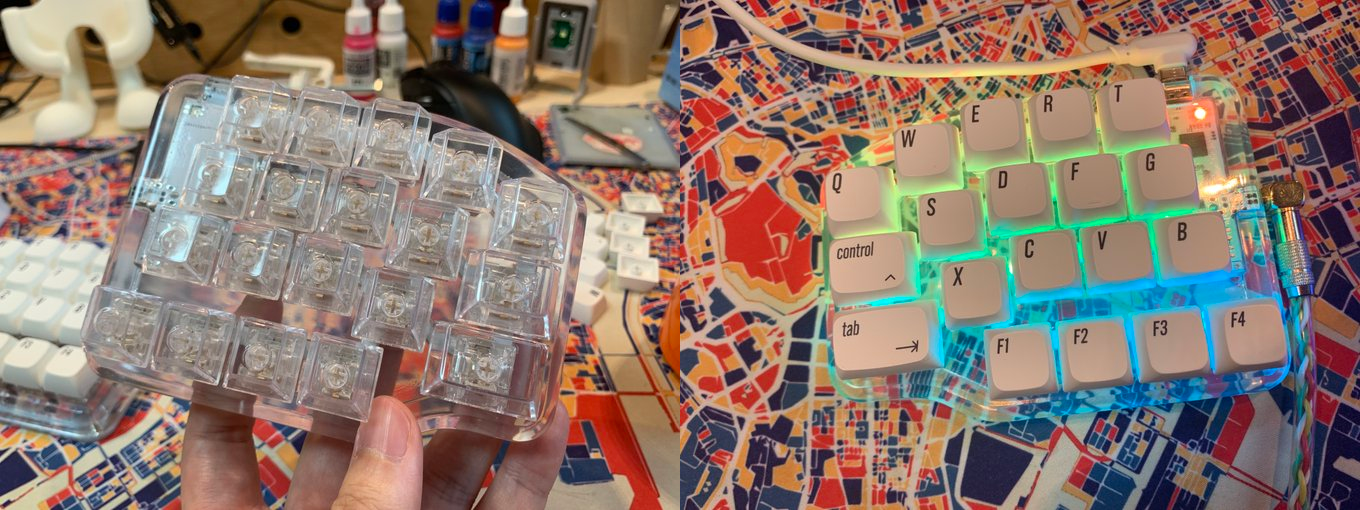
Once in a while, we see projects that could easily pass for commercial products. This is one of those projects: a (surprisingly) low-cost DIY macro pad from [Josh R] that was designed to be a cheaper alternative to the various stream decks out there. Between the carbon fiber top plate and the crystal-clear acrylic keycaps, this is quite the elegant solution.

This lovely little macro pad is built around the ESP8266, specifically the WEMOS D1 Mini V4. However, the most vital part to get right is the screen, which must be a 128 x 160 TFT display in order to line up with the 3D printed frame that divides it into fourths. Custom parts like the acrylic keycaps and the carbon fiber top plate are available on Tindie if you don’t have access to a CNC.

Operationally, Open Deck has a nice-looking GUI. Once programmed, each shortcut is capable of having three beneath it, with the fourth button reserved for Home. Be sure to check out the extremely satisfying build video after the break.

Want a stream deck, but don’t want to build it? Just dig up an old phone or tablet.

Continue reading “Open Deck Is Your Window To Shortcuts”

Raspi-Powered Typewriter Is A Real MUSE

Thanks to parenting and life in general, [Brendan] had fallen out of the habit of writing and wasn’t happy about it. If you write anything ever, you already know there are endless distractions when it comes to doing so on a computer. Sure, there always typewriters, but it’s difficult to do anything with the fruits of a typewriter other than scan it in or make copies, and it’s basically un-editable except by hand.

Instead of just sitting down and writing, [Brendan] did what any of us would do — took the time to create an elegant solution. The Most Unusual Sentence Extractor, or MUSE, is a Raspberry Pi-based typewriter with the best of both worlds. It’s essentially a word processor, but it can save to the cloud.

[Brendan] found beautiful inspiration in the Olympia Traveller de Luxe typewriter, a delightfully boxy affair made in the 1960s and 70s with lovely keys. Starting with a 68Keys.io board, [Brendan] set about re-creating the lines of the Traveller de Luxe in Tinkercad.

Since it doesn’t really need a platen, this was the perfect place to mount a screen using black PVC. At first, [Brendan] was going to use an e-ink screen, but a mishap led to a better solution — an LCD touchscreen that makes document navigation a breeze.

We absolutely love the look of this machine, which was obviously a labor of love. And yeah, it does the trick:[Brendan] is writing again. Though it maybe be inconvenient, we agree that it really is nice to have a dedicated workstation for certain things.

Looking for the complete opposite of this project? How about a Chat GPT-assisted daisywheel typewriter?

Spooky Noise Box Has Post-Halloween Potential

There’s more than one way to scare people on Halloween. Sure, there’s always the low-brow jump scare, but that will generally just annoy the person and possibly cause a heart attack. No, what you need is a sustained soundscape of hellish audio. And where does one find hellish audio? Well, you make your own with a spooky-sounds noise box.

And no, we’re not talking about a soundboard that goes ‘boo’ and ‘ooo-OOO-oooh’ and whatnot. This is a full-on DIY instrument that has potential beyond Halloween. Essentially, the wooden box takes input vibrations from various doodads, and these vibrations are picked up by a piezo disk or two glued to the underside of the lid. The piezos are wired up to a 3.5 mm jack, which runs out to the PC and [SvartalfarQc]’s favorite Digital Audio Workstation (DAW). From there, it’s just a matter of playing around with the sounds — looping them, running them through various instrument voices, adding effects, and so on.

We love the the things that [SvartalfarQc] came up with, including a wind-up walking heart thing, a retractable badge holder, and that noise box mainstay, a sproingy doorstop.

We all know piezos are awesome, but have you ever considered that they can be used to digitize old wax cylinder recordings?