WhisperFrame Depicts The Art Of Conversation

At this point, you gotta figure that you’re at least being listened to almost everywhere you go, whether it be a home assistant or your very own phone. So why not roll with the punches and turn lemons into something like a still life of lemons that’s a bit wonky? What we mean is, why not take our conversations and use AI to turn them into art? That’s the idea behind this next-generation digital photo frame created by [TheMorehavoc].
Essentially, it uses a Raspberry Pi and a Respeaker four-mic array to listen to conversations in the room. It listens and records 15-20 seconds of audio, and sends that to the OpenWhisper API to generate a transcript.
This repeats until five minutes of audio is collected, then the entire transcript is sent through GPT-4 to extract an image prompt from a single topic in the conversation. Then, that prompt is shipped off to Stable Diffusion to get an image to be displayed on the screen. As you can imagine, the images generated run the gamut from really weird to really awesome.

The natural lulls in conversation presented a bit of a problem in that the transcription was still generating during silences, presumably because of ambient noise. The answer was in voice activity detection software that gives a probability that a voice is present.

Naturally, people were curious about the prompts for the images, so [TheMorehavoc] made a little gallery sign with a MagTag that uses Adafruit.io as the MQTT broker. Build video is up after the break, and you can check out the images here (warning, some are NSFW).

Continue reading “WhisperFrame Depicts The Art Of Conversation”

The Loveliest Electronics Desk You’ll See Today

Does your electronics desk have a lap drawer? And is it filled with random, disorganized detritus? Well, [Handy Bear] is here to show you that you can put so much more in every drawer you’ve got if you do it right. And boy, it sure looks like [Handy Bear] did it right.

Hidden inside this beautiful antique desk is plastic storage compartment after plastic storage compartment, all situated inside custom dividers made painstakingly from 3mm MDF. The first iteration, a cubbyhole arrangement, was not modular and looked crappy by [Handy Bear]’s standards.

Back to the drawing board and the scroll saw. [Handy Bear] came up with a new scheme that mimics the dividers in the plastic storage boxes they’re using for components and more. In addition to the slotted parts are open-top boxes for things like the multimeter, helping hands, and the ever-important label maker.

[Handy Bear] used hot glue and simple joinery for everything, sealing all the seams with a mixture of glue and water to keep it from turning to dust. We especially like the caliper holder for the lap drawer. You’ll notice that not quite everything fits inside the desk, so [Handy Bear] put the bigger stuff on a couple of IKEA carts. Be sure to check out the short build video and take the desk tour after the break.

Don’t have room for a whole desk worth of stuff? Build an electronics lab in a box!

Continue reading “The Loveliest Electronics Desk You’ll See Today”

Illustrated Kristina with an IBM Model M keyboard floating between her hands.

Keebin’ With Kristina: The One With The Busy Box Macro Pad

Well, I must admit that Google Translate completely failed me here, and thus I have no real idea what the trick is to this beautiful, stunning transparent split keyboard by [illness072]. Allegedly, the older tweets (exes?) hold the key to this magic, but again, Google Translate.

Based on top picture, I assume that the answer lies in something like thin white PCB fingers bent to accommodate the row stagger and hiding cleverly behind the keys.

Anyone who can read what I assume is Japanese, please advise what is going on in the comments below.

Continue reading “Keebin’ With Kristina: The One With The Busy Box Macro Pad”

Ballistic BMW Blocks Both Bullets And Booms

Maybe you like to live dangerously. Like, James Bond dangerously. Well, we won’t judge, but we will pass this along — BMW has created the ultimate driving machine for shootouts and war zones.

Rather than having aftermarket anti-ballistic bits and bobs attached at a later date, this BMW 7 Series is born anti-ballistic and explosion-resistant, built from the ground up with armor steel. They call this the BMW Protection Core.

By building it this way, there are many advantages like more cabin space, lower curb weight, and better handling, which is exactly what you’d want if you were under these types of attacks.

For starters, the car has chunkier A-pillars and door/window frames meant to withstand the damage pictured here. The car has special armoring in the roof and undercarriage to withstand explosions. And the fuel tank is self-sealing, so you have a chance at getting out of there if the thing takes a bullet.

Can’t afford this ballistic-grade beast? You could always roll your own armored vehicle.

Spooky Noise Box Plays War Drums

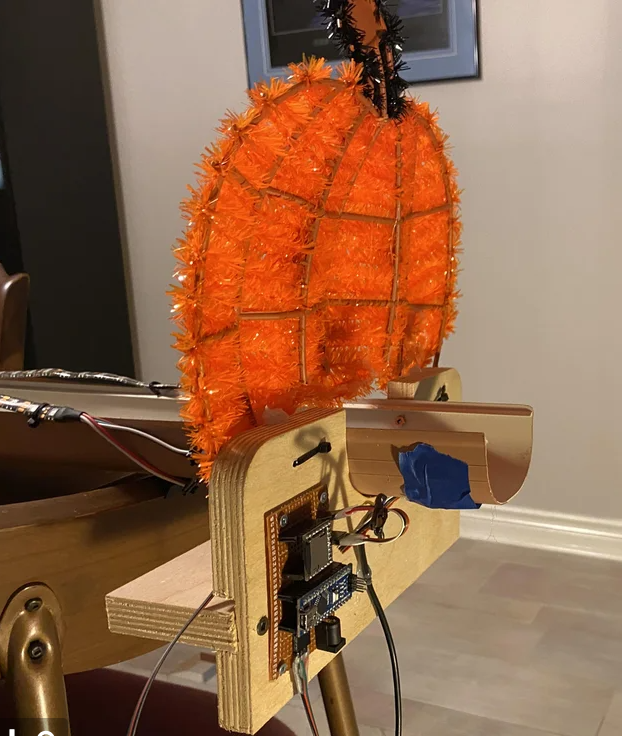
What do you have cooked up to scare trick-or-treaters this Halloween? We humbly suggest adding in some type of noise box, especially one like this offering from [Paisley Computer] that uses reverb and other effects to achieve chilling, thrilling sounds.

As you can see, this instrument is essentially a bunch of doodads affixed to and through a cigar box. And as you’ll hear in the first video after the break, the various rubber bands make great drum sounds. The springs are nice, too, but our personal favorite has to be the head massager thing. Shhhing!

Inside the box you’ll find a guitar jack and some piezos glued to the underside of the top surface, but you’ll also find springs mounted across the inside that add to the resonance of the cigar box.

You can use either an interface and DAW or an effects pedal chain to really make things freaky, and [Paisley Computer] does a showdown between Focusrite interface versus various stomp pedals in the second video. In the third video, we learn how to make one of our own.

Do you like the idea of a spring reverb? How about a really big one that sounds sort of Satanic?

Continue reading “Spooky Noise Box Plays War Drums”

Salad Spinner Busts Some New Moves

Can you believe that [Tom Tilley]’s wife was just going to pawn off this perfectly good salad spinner on the thrift store when it’s so ripe for hacking? We couldn’t, either. Fortunately, he caught it just in time, right before dinner.

One of the coolest things a person can do that also tends to aid gameplay is to make a custom controller. [Tom] decided to make one for Bust-A-Move, a simple game where one shoots balls at bubbles in order to pop them. It looks like quite the fun little stress reducer. Anyway, a simple game deserves a simple controller, no? Yes.

As you’ll see in the build/demo video below, [Tom] started with a standard wireless mouse and hot-glued a cardboard origami creation to it. This goes upside-down inside the salad spinner and gets connected to the spinner part so that the entire origami moves in a circle. [Tom] then extended the left mouse button to a switch, which he affixed to the outside.

This controller re-uses a slightly modified mouse that [Tom] used in a previous Bust-A-Move controller. He is using a FreePIE script and vJoy in order to map mouse movements to the joystick inputs expected by the game. Watch [Tom] bust some moves after the break.

Continue reading “Salad Spinner Busts Some New Moves”

You’ve Got Mail: Reading Addresses With OCR

Last time I delivered on this column, I told you about the USPS’ attempts to fully automate a post office. Of course, that’s a bit of a misnomer, since it took 1,500 employees to actually operate the place on a daily basis. Although Project Turnkey in Rhode Island and Project Gateway in California were proving grounds for all kinds of mail sorting and processing equipment, the act of actually reading addresses and routing mail to its final destination still required human intervention and hand coding.

Today, the post office processes hundreds of millions of mail pieces each day using various pieces of equipment. One of those important pieces of equipment is the OCR address reader, which manages to make sense of all kinds of chicken scratch.

Continue reading “You’ve Got Mail: Reading Addresses With OCR”