Solar Powered Weeding Tractor Uses Manual Labour

You might not have realised this, but there’s a group of hackers out there without whom you wouldn’t be able to put food on the table. They hack under the blazing sun and pouring rain, and have been doing it for thousands of years. Known more commonly as farmers, their creative problem solving skills with whatever is lying around can be absolutely jaw dropping. [Andrew Mans] is one such individual. He built a solar powered weeding tractor that uses human labour to do the actual weeding.

We’ll be honest, this made us go “Wait, what?” for a few seconds, until the ingenuity of it all sank in. Crawling at a snails pace across the onion fields at Mans Organics, the contraption allows 3 workers to lie comfortably on their stomachs in a shaded tent, while pulling weeds that grow too close to the crop for conventional mechanised weeding methods. While this might seem like a slightly crappy job at first glance, there are definitely worse jobs a farm (or in an office) and actually looks quite relaxing. While the picking could of course be automated, this is no small task, especially when your business is food production, not robotics.

Power is provided from four 250 W solar panels on the roof, which charge a bank of deep cycle batteries and the drive train. A pure sine wave converter provides power to a 240 V motor driver which turns it back into DC to run the drive motor. [Andrew] admits this back and forth voltage conversion is overcomplicated and inefficient but it’s the sort of thing that quickly happens when you hack a hacked design. The axle and 5-speed gearbox was salvaged from an old 3 ton truck and is mounted vertically to save space. The hydraulic steering is controlled by one of the human weed pickers, who just makes small course corrections as required.

We love the weird combo of old and new in this hack. Check out the machine in action and detailed walk-around after the break. Continue reading “Solar Powered Weeding Tractor Uses Manual Labour”

Military Gliders Are Making A Comeback, This Time In Unmanned Form

Sun Tzu said, “The line between disorder and order lies in logistics.” This is as true in the modern world as it was 2500 years ago, and logistics have helped win and lose many wars and battles over the centuries. To this end, Logistical Gliders Inc. is developing one-time use, unmanned delivery gliders, for the US Military.

Reminiscent of the military gliders used in WW2, the gliders are designed to be dropped from a variety of aircraft, glide for up to 70 miles and deliver supplies to troops in the field. Specifically intended to be cheap enough to be abandoned after use, the gliders are constructed from plywood, a few aluminum parts for reinforcement and injection molded wing panels. There are two versions of the glider, both with huge payloads. The LG-1K, with a payload capacity of 700 lbs/320 kg and the larger LG-2K, with a payload capacity of 1,600 lbs/725 kg. Wings are folded parallel to the fuselage during transport and then open after release with the help of gas springs. The glider can either do a belly landing in an open area or deploy a parachute from the tail at low altitude to land on the crushable nose.

Gliders like these could be used to deliver supplies after natural disasters, or to remote locations where road travel is difficult or impossible while reducing the flight time required for conventional aircraft. Powered UAVs could even be used to carry/tow a glider to the required release point and then return much lighter and smaller, reducing the required fuel or batteries.

Drones are already used to deliver medical supplies in Rwanda and Ghana, and it’s possible to build your own autonomous unmanned glider. Check out the video after the break to see the big boys in action. Continue reading “Military Gliders Are Making A Comeback, This Time In Unmanned Form”

Soaring With The Sun: 4 Years Of Solar RC Planes

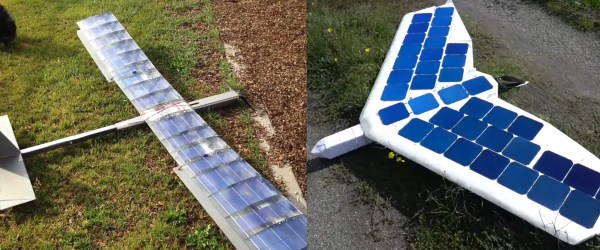
Many of us have projects that end up spanning multiple years and multiple iterations, and gets revisited every time inspiration strikes and you’ve forgotten just how much work and frustration the previous round was. For [Daniel Riley] AKA [rctestflight] that project is a solar powered RC plane which to date spans 4 years, 4 versions and 13 videos. It is a treasure trove of information collected through hard experience, covering carbon fibre construction techniques, solar power management and the challenges of testing in the real world, among others.

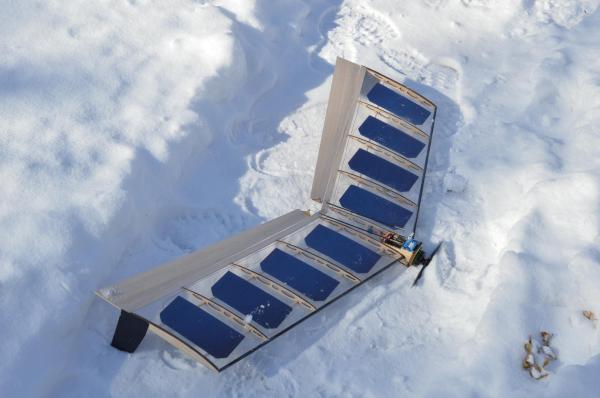
Solar Plane V1 had a 9.5 ft / 2.9 m carbon fibre skeleton wing, covered with transparent film, with the fragile monocrystaline solar cells mounted inside the wing. V1 experienced multiple crashes which shattered all the solar cells, until [Daniel] discovered that the wing flexed under aileron input. It also did not have any form of solar charge control. V2 added a second wing spar to a slightly longer 9.83 ft / 3 m wing, which allowed for more solar cells.

Solar Plane V3 was upgraded to use a single hexagonal spar to save weight while still keeping stiff, and the solar cells were more durable and efficient. [Daniel] did a lot of testing to find an optimal solar charging set-up and found that using the solar array to charge the batteries directly in a well-balanced system actually works equally well or better than an MPPT charge controller.

V4 is a departure from the complicated carbon fibre design, and uses a simple foam board flying wing with a stepped KF airfoil instead. The craft is much smaller with only a 6 ft / 1.83 m wingspan. It performed exceptionally well, keeping the battery fully charged during the entire flight, which unfortunately ended in a crash after adjusting the autopilot. [Daniel] suspects the main reasons for the improved performance are higher quality solar panels and the fact that there is no longer film covering the cells.

We look forward to seeing where this project goes! Check out Solar Plane V4 after the break.

Continue reading “Soaring With The Sun: 4 Years Of Solar RC Planes”

Tacking Against The Sun: Flying A Batteryless Solar RC Plane Is Almost Like Sailing

Flying on the power of the sun is definitely not a new idea, but it usually involves a battery between the solar panels and the propulsion system. [ukanduit] decided to lose the battery completely and control the speed of the motor with the output of the solar panels. This leads to some interesting flying characteristics, almost akin to sailing.

When a load tries to draw more current than a solar panel can provide, its output falls dramatically, so [ukanduit] had to take this into account. Using a ATTiny85, he built a MPPT (Maximum Power Point Tracker) unit that connects between the RC receiver and the motor speed controller. It monitors the output of the panels and modulates the speed of the motor accordingly, while ensuring that there is always enough power to run the servos and receiver. The airframe (named the Solar Bear) is a small lightweight flying wing, with a balsa and carbon fibre frame covered with clear film, with the solar cells housed inside the wing. Since the thrust of the motor is directly proportional to how much sunlight hits the top of wings, it requires the pilot to “tack” against the sun and use momentum to quickly get through turns before orienting into the sun again.

If you want to build your own controller, the schematics and software is up on RC Groups. Check out the Solar Bear in action, flown here by [AJWoods].

Continue reading “Tacking Against The Sun: Flying A Batteryless Solar RC Plane Is Almost Like Sailing”

Tiny Robots That Grow Taller (And Wider)

Sometimes one just needs an extra hand or six  around the workbench. Since you’re a hacker that should take the form of a tiny robot swarm that can physically display your sensor data, protect you against a dangerously hot caffeine fix and clean up once you’re done. [Ryo Suzuki] and [Clement Zheng] from the University of Colorado Boulder’s ATLAS Institute developed ShapeBots, small shape-shifting swarm robots that aim to do exactly that and more.

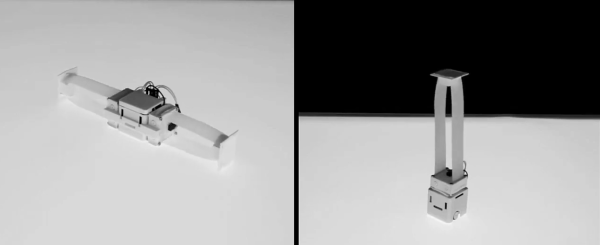
The robots each consist of a cube shaped body with 2 small drive wheels, onto which 1-4 linear actuator modules can attach in various positions. For control the robots’ relative positions are tracked using an overhead camera and is shown performing the tasks mentioned above and more.

To us the actuators are the interesting part, consisting of two spools of tape that can extend and retract like a tape measure. This does does lead us to wonder: why we haven’t seen any hacks using an old tape measure as a linear actuator? While you likely won’t be using it for high force applications, it’s possible to get some impressive long reach from a small from factor. This is exactly what the engineers behind the Lightsail 2 satellite used to deploy it’s massive space sail. Space the two coils some distance apart and you can even achieve full 2-axis motion.

You can also control your swarm using your favourite wifi chip or have them skitter around using vibration or 3D print some linear actuators.

Thanks for the tip [Qes]!

Modular Fixture Plates Perfect For Small Production Runs

If you’ve ever done any small production runs of anything that needs a bit of assembly, you know that jigs and fixtures are a huge time saver. However, these usually need to be mounted, which means you end up drilling holes in your workbench or making one-off mounting plates. [Jim Smith] is no stranger to this problem, and created the Pact Plate, an affordable modular fixture plate and is running a Kickstarter campaign to get it produced.

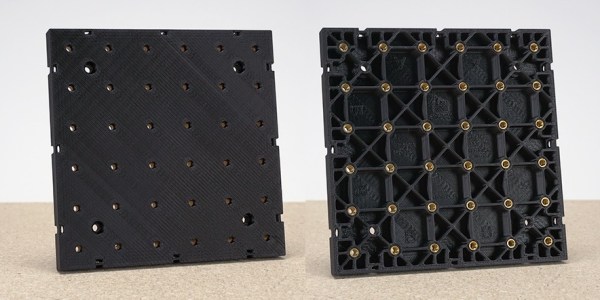
Each plate 150 mm × 150 mm in size with a 25 × 25 mm grid of holes with M4 threaded inserts. This allows quickly and easily mounted to and removed from the plate without the need to drill additional holes. Plates can be bolted together to form larger plates. The demo video shows him using a variety of 3D printed jigs, toggle clamps, PCB and part holders (available for download) and even a robot to quickly set up small assembly stations. This could also save a lot of time during the prototyping and development phases to hold parts in place.

[Jim]’s prototypes are all 3D printed, but want’s to get tooling made to produce the plates using injection moulding. He doesn’t say what material he intends to use, but it’s likely some type of fibre reinforced plastic. He claims the rigidity is close to that of die-cast aluminium. One addition we would like to see is some plugs for the unused hole to prevent small components from falling into them.

Continue reading “Modular Fixture Plates Perfect For Small Production Runs”

Bend Some Bars With A Flywheel

The ability to look at a pile of trash, and see the for treasure is a skill we hold in high regard around here. [Meanwhile in the Garage] apparently has this skill in spades and built himself a metal bar bending machine using an old flywheel and starter pinion gear.

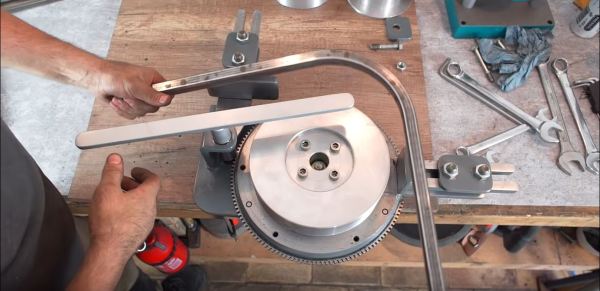
To bend metal using muscle power alone requires some sort of mechanical advantage. Usually this involves a bending tool with a long lever, but [Meanwhile in the Garage] decided to make use of the large gear ratio between a car’s starter motor and the flywheel it drives. This does away with the need for a long lever and allows bending to almost 270° with a larger radius. Lathe and milling work features quite prominently, including to make the bend formers, drive shaft and bushings and to modify the flywheel to include a clamp. The belt sander that is used to finish a number of the parts is also his creation. While the machine tools definitely helped, a large amount of creativity and thinking outside the box made this project possible and worth the watch.

We’ve featured a number of scrap-built tools including a milling machine, sheet metal hole punch and a hydraulic bench vice. Keep them coming!