Build Your Own Core Rope Memory Module?

[Luizão] wanted to create some hardware to honour the memory of the technology used to put man on the moon and chose the literal core of the project, that of the hardware used to store the software that provided the guidance. We’re talking about the magnetic core rope memory used in the Colossus and Luminary guidance computers. [Luizão] didn’t go totally all out and make a direct copy but instead produced a scaled-down but supersized demo board with just eight cores, each with twelve addressable lines, producing a memory with 96 bits.

The components chosen are all big honking through-hole parts, reminiscent of those available at the time, nicely laid out in an educational context. You could easily show someone how to re-code the memory with only a screwdriver to hand; no microscope is required for this memory. The board was designed in EasyEDA, and is about as simple as possible. Being an AC system, this operates in a continuous wave fashion rather than a pulsed operation mode, as a practical memory would. A clock input drives a large buffer transistor, which pushes current through one of the address wires via a 12-way rotary switch. The cores then act as transformers. If the address wire passes through the core, the signal is passed to the secondary coil, which feeds a simple rectifying amplifier and lights the corresponding LED. Eight such circuits operate in parallel, one per bit. Extending this would be easy.

Continue reading “Build Your Own Core Rope Memory Module?”

Tired With Your Robot? Why Not Eat It?

Have you ever tired of playing with your latest robot invention and wished you could just eat it? Well, that’s exactly what a team of researchers is investigating. There is a fully funded research initiative (not an April Fools’ joke, as far as we know) delving into the possibilities of edible electronics and mechanical systems used in robotics. The team, led by EPFL in Switzerland, combines food process engineering, printed and molecular electronics, and soft robotics to create fully functional and practical robots that can be consumed at the end of their lifespan. While the concept of food-based robots may seem unusual, the potential applications in medicine and reducing waste during food delivery are significant driving factors behind this idea.
The Robofood project (some articles are paywalled!) has clearly made some inroads into the many components needed. Take, for example, batteries. Normally, ingesting a battery would result in a trip to the emergency room, but an edible battery can be made from an anode of riboflavin (found in almonds and egg whites) and a cathode of quercetin, as we covered a while ago. The team proposed another battery using activated charcoal (AC) electrodes on a gelatin substrate. Water is split into its constituent oxygen and hydrogen by applying a voltage to the structure. These gasses adsorb into the AC surface and later recombine back into the water, providing a usable one-volt output for ten minutes with a similar charge time. This simple structure is reusable and, once expired, dissolves harmlessly in (simulated) gastric fluid in twenty minutes. Such a device could potentially power a GI-tract exploratory robot or other sensor devices.
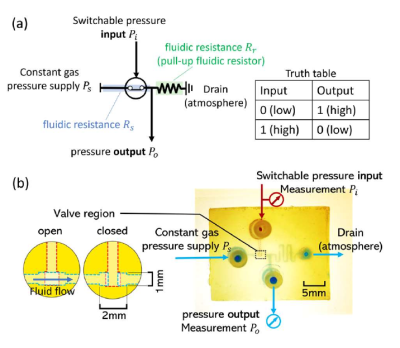
But what use is power without control? (as some car tyre advert once said) Microfluidic control circuits can be created using a stack of edible materials, primarily oleogels, like ethyl cellulose, mixed with an organic oil such as olive oil. A microfluidic NOT gate combines a pressure-controlled switch with a fluid resistor as the ‘pull-up’. The switch has a horizontal flow channel with a blockage that is cleared when a control pressure is applied. As every electronic engineer knows, once you have a controlled switch and a resistor, you can build NOT gates and all the other logic functions, flip-flops, and memories. Although they are very slow, the control components are importantly edible.

Edible electronics don’t feature here often, but we did dig up this simple edible chocolate bunny that screams when you bite it. Who wouldn’t want one of those?

Tiny Tapeout 4: A PWM Clone Of Covox Speech Thing

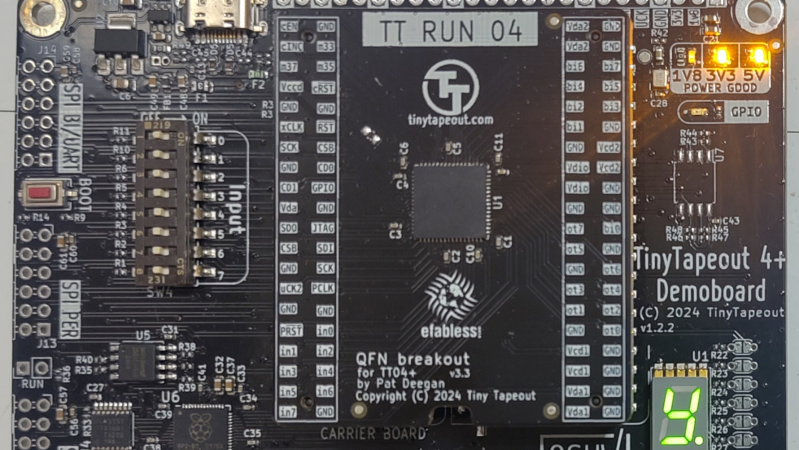
Tiny Tapout is an interesting project, leveraging the power of cloud computing and collaborative purchasing to make the mysterious art of IC design more accessible for hardware hackers. [Yeo Kheng Meng] is one such hacker, and they have produced their very first custom IC for use with their retrocomputing efforts. As they lament, they left it a little late for the shuttle run submission deadline, so they came up with a very simple project with the equivalent behaviour of the Covox Speech Thing, which is just a basic R-2R ladder DAC hanging from a PC parallel port.

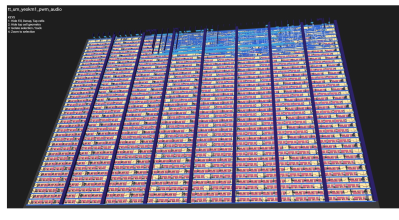
The computed gate-level routing of the ASIC layout

The plan was to capture an 8-bit input bus and compare it against a free-running counter. If the input value is larger than the counter, the output goes high; otherwise, it goes low. This produces a PWM waveform representing the input value. Following the digital output with an RC low-pass filter will generate an analogue representation. It’s all very simple stuff. A few details to contend with are specific to Tiny Tapout, such as taking note of the enable and global resets. These are passed down from the chip-level wrapper to indicate when your design has control of the physical IOs and is selected for operation. [Yeo] noticed that the GitHub post-synthesis simulation failed due to not taking note of the reset condition and initialising those pesky flip-flops.

After throwing the design down onto a Mimas A7 Artix 7 FPGA board for a quick test, data sent from a parallel port-connected PC popped out as a PWM waveform as expected, and some test audio could be played. Whilst it may be true that you don’t have to prototype on an FPGA, and some would argue that it’s a lot of extra effort for many cases, without a good quality graphical simulation and robust testbench, you’re practically working blind. And that’s not how working chips get made.

If you want to read into Tiny Tapeout some more, then we’ve a quick guide for that. Or, perhaps hear it direct from the team instead?

Continue reading “Tiny Tapeout 4: A PWM Clone Of Covox Speech Thing”

2024 Business Card Challenge: Integrated Game Card

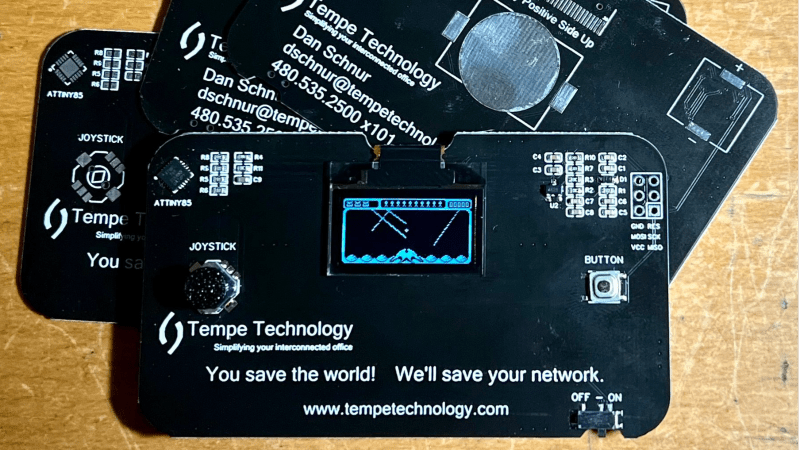
[Dan Schnur] has a simple strategy to ensure their business card stays on the client’s desk and doesn’t just get lobbed in a drawer: make it into a simple gaming platform. This entry into the 2024 Business Card Challenge is based around the tinyjoypad project, integrating an SSD1306 OLED display, joypad, and push button.

Powered by the superstar ATTiny85, the electronics are really not all that much, just a sprinkling of passives to support the display and the six switch inputs from the joystick and push button. Or at least, that’s how much we can glean from the PCB images, as the PCB design files are not provided in the project GitHub.

Leaving the heavy lifting of the software to the tinyjoypad project, the designer can concentrate on the actual job at hand and the reason the business card exists to stay at the forefront of the client’s mind. In the meantime, the card can be a useful distraction for those idle moments. A few such distractions include a tiny version of Missile Command (as shown above), tiny tris, and a very cut-down Q-bert.  Sadly, that last game isn’t quite the same without that distinctive sound.

A Simple Laser Harp MIDI Instrument

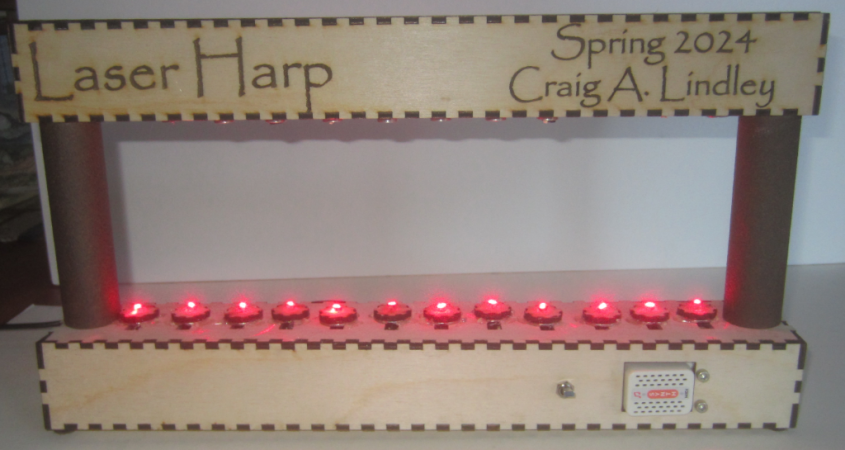
Craig Lindley is a technical author and a prolific maker of things. This simple project was his first attempt to create a laser harp MIDI device. While on vacation, Craig saw a laser harp with only three strings and decided to improve upon it by expanding it to twelve strings. The principle of operation is straightforward: twelve cheap diode laser modules aim a beam towards an LDR, which changes resistance if the light level changes when the beam is interrupted.

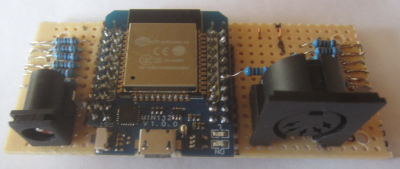
The controller is a simple piece of perf board, with a Wemos D1 mini ESP32 module flanked by some passives, a barrel socket for power, and the usual DIN connector for connecting the MIDI instrument. Using the ESP32 is a smart choice, removing all the need for configuration and user indication from the physical domain and pushing it onto a rarely-needed webpage. After a false start, attempting to use a triangular frame arrangement, [Craig] settled upon a simple linear arrangement of beams held within a laser-cut wooden box frame. Since these laser modules are quite small, some aluminium rod was machined to make some simple housings to push them into, making them easier to mount in the frame and keeping them nicely aligned with their corresponding LDR.

Sadly, the magnetic attachment method [Craig] used to keep the LDRs in place and aligned with the laser didn’t work as expected, so it was necessary to reach for the hot glue. We’ve all done that!

An interesting addition was using an M5 stack Unit-Synth module for those times when a proper MIDI synthesiser was unavailable. Making this luggable was smart, as people are always fascinated with laser harps. That simple internal synth makes travelling to shows and events a little easier.

Laser harps are nothing new here; we have covered plenty over the years. Like this nice build, which is more a piece of art than an instrument, one which looks just like a real harp and sounds like one, too, due to the use of the Karplus-Strong algorithm to mimic string vibrations.

2024 Business Card Challenge: PCB Business Cards For Everybody

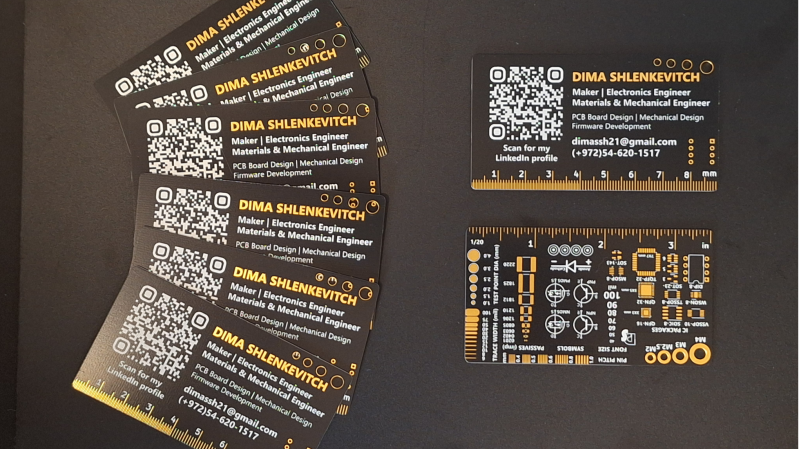
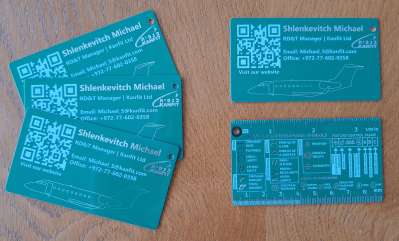
PCB business cards for electronics engineers might be very much old news in our circles, but they are still cool, not seen too much in the wild, and frankly inaccessible to those in other industries. For their entry into the 2024 Business Card Challenge, [Dima Shlenkevitch] is helping a little to alleviate this by providing a set of design examples and worked costs with suppliers.

Original green is still the cheapest option.

[Dima] lists key features every PCB business card should include, such as the expected thickness, restrictions for placing NFC components, and some aesthetics tips. Make sure to choose a supplier that allows you to remove their order number from the manufactured PCB, or it will look out of place.

Ordering PCBs with these specifications to keep costs reasonable requires effort, so [Dima] offers some example designs along with the results. If you want to have pretty gold lettering and graphics, you will need ENiG plating, increasing the price. Non-standard solder mask colors can also raise the price.

Will this help with the practical aspects of driving the PCB design software and actually placing the order? Obviously not, but the information provided gives you a leg up on some of the decisions so you don’t go down an expensive rabbit hole.

2024 Business Card Challenge: BAUDI/O For The Audio Hacker

[Simon B] enters our 2024 Business Card Challenge with BAUDI/O, a genuinely useful audio output device. The device is based around the PCM2706 DAC, which handles all the USB interfacing and audio stack for you, needing only a reference crystal and the usual sprinkling of passives. This isn’t just a DAC board, though; it’s more of an audio experimentation tool with two microcontrollers to play with.

The first ATTiny AT1614 is hooked up to a simple LED vu-meter, and the second is connected to the onboard AD5252 digipot, which together allows one to custom program the response to the digital inputs to suit the user. The power supply is taken from the USB connection. A pair of ganged LM2663 charge-pump inverters allow inversion of the 5V rail to provide the necessary -5 V for the output amplifiers.  This is then fed to the LM4562-based CMoy-type headphone amplifier.  This design has a few extra stages, so with a bit of soldering, you can adjust the output filtering to suit. An LM1117 derives 3.3 V from the USB input to provide another power rail,  mostly for the DAC.

There’s not much more to say other than this is a nice, clean audio design, with everything broken out so you can tinker with it and get exactly the audio experience you want.