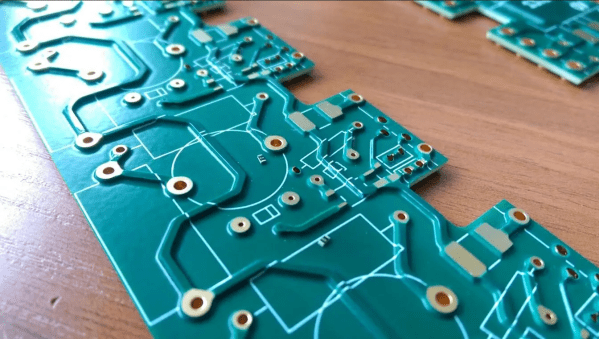
Heavy-Copper PCB Hack Chat

Join us on Wednesday, November 10 at noon Pacific for the Heavy Copper PCBs Hack Chat with Mark Hughes and Greg Ziraldo!

For as useful as printed circuit boards are, they do seem a little flimsy at times. With nothing but a thin layer — or six — of metal on the board, and ultra-fine traces that have to fit between a dense forest of pads and vias, the current carrying capacity of the copper on most PCBs is somewhat limited. That’s OK in most cases, especially where logic-level and small-signal currents are concerned. But what happens when you really need to turn up the juice on a PCB?

Enter the world of heavy-copper PCBs, where the copper is sometimes as thick as the board substrate itself. Traces that are as physically chunky as these come with all sorts of challenges, from thermal and electrical considerations to potential manufacturing problems. To help us sort through all these issues, Mark and Greg will stop by the Hack Chat. They both work at quick-turn PCB assembly company Advanced Assembly, Mark as Research Director and Greg as Senior Director of Operations. They know the ins and outs of heavy-copper PCB designs, and they’ll share the wealth with us.

join-hack-chatOur Hack Chats are live community events in the Hackaday.io Hack Chat group messaging. This week we’ll be sitting down on Wednesday, November 10 at 12:00 PM Pacific time. If time zones have you tied up, we have a handy time zone converter.


Hackaday Links Column Banner

Hackaday Links: November 7, 2021

More trouble for Hubble this week as the space observatory’s scientific instruments package entered safe mode again. The problems started back on October 25, when the Scientific Instrument Command and Data Handling Unit, or SI C&DH, detect a lack of synchronization messages from the scientific instruments — basically, the cameras and spectrometers that sit at the focus of the telescope. The issue appears to be different from the “payload computer glitch” that was so widely reported back in the summer, but does seem to involve hardware on the SI C&DH. Mission controller took an interesting approach to diagnosing the problem: the dusted off the NICMOS, or Near Infrared Camera and Multi-Object Spectrometer, an instrument that hasn’t been used since 1998. Putting NICMOS back into the loop allowed them to test for loss of synchronization messages without risking the other active instruments. In true hacker fashion, it looks like the fix will be to change the software to deal with the loss of sync messages. We’ll keep you posted.

What happened to the good old days, when truck hijackings were for things like cigarettes and booze? Now it’s graphics cards, at least according to a forum post that announced the theft of a shipment of EVGA GeForce RTX 30-series graphics cards from a delivery truck. The truck was moving the cards from San Francisco to the company’s southern California distribution center. No word as to the modus operandi of the thieves, so it’s not clear if the whole truck was stolen or if the cards “fell off the back.” Either way, EVGA took pains to note that receiving stolen goods is a crime under California law, and that warranties for the stolen cards will not be honored. Given the purpose these cards will likely be used for, we doubt that either of these facts matters much to the thieves.

Remember “Jet Pack Man”? We sure do, from a series of reports by pilots approaching Los Angeles International airport stretching back into 2020 and popping up occasionally. The reports were all similar — an object approximately the size and shape of a human, floating aloft near LAX. Sightings persisted, investigations were launched, but nobody appeared to know where Jet Pack Man came from or what he was flying. But now it appears that the Los Angeles Police may have identified the culprit: one Jack Skellington, whose street name is the Pumpkin King. Or at least a helium balloon version of the gangly creature, which is sure what an LAPD helicopter seems to have captured on video. But color us skeptical here; after all, they spotted the Halloween-themed balloon around the holiday, and it’s pretty easy to imagine that the hapless hero of Halloween Town floated away from someone’s front porch. More to the point, video that was captured at the end of 2020 doesn’t look anything like a Skellington balloon. So much for “case closed.”

Speaking of balloons, here’s perhaps a more productive use for them — lifting a solar observatory up above most of the atmosphere. The Sunrise Solar Observatory is designed to be lifted to about 37 km by a balloon, far enough above the Earth’s ozone layer to allow detailed observation of the Sun’s corona and lower atmosphere down into the UV range of the spectrum. Sunrise has already flown two successful missions in 2009 and 2013 which have netted over 100 scientific papers. The telescope has a one-meter aperture and automatic alignment and stabilization systems to keep it pointed the right way. Sunrise III is scheduled to launch in June 2022, and aims to study the flow of material in the solar atmosphere with an eye to understanding the nature of the Sun’s magnetic field.

And finally, what a difference a few feet can make. Some future Starlink customers are fuming after updating the location on their request for service, only to find the estimated delivery date pushed back a couple of years. Signing up for Starlink satellite service entails dropping a pin on a map to indicate your intended service location, but when Starlink put a new, more precise mapping app on the site, some eager pre-order customers updated their location to more accurately reflect where the dish will be installed. It’s not clear if the actual location of the dish is causing the change in the delivery date, or if just the act of updating an order places you at the bottom of the queue. But the lesson here may be that with geolocation, close enough is close enough.

Turn signal monitor

Annoy Yourself Into Better Driving With This Turn Signal Monitor

Something like 99% of the people on the road at any given moment will consider themselves an above-average driver, something that’s as statistically impossible as it is easily disproven by casual observation. Drivers make all kinds of mistakes, but perhaps none as annoying and avoidable as failure to use their turn signal. This turn signal monitor aims to fix that, through the judicious use of negative feedback.

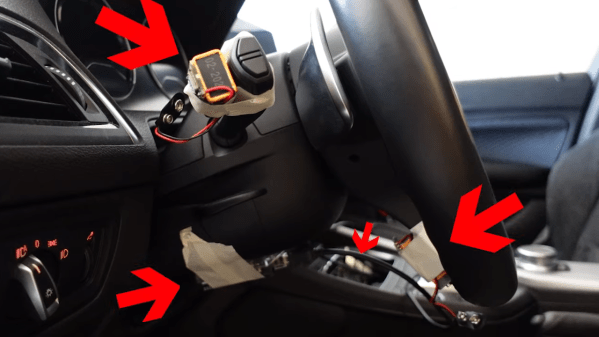
Apparently, [Mark Radinovic] feels that he has a predisposition against using his turn signal due to the fact that he drives a BMW. To break him of that habit, one that cost him his first BMW, he attached Arduino Nano 33 BLEs to the steering wheel and the turn signal stalk. The IMUs sense the position of each and send that over Bluetooth to an Arduino Uno WiFi. That in turn talks over USB to a Raspberry Pi, which connects to the car’s stereo via Bluetooth to blare an alarm when the steering wheel is turned but the turn signal remains untouched. The video below shows it in use; while it clearly works, there are a lot of situations where it triggers even though a turn signal isn’t really called for — going around a roundabout, for example, or navigating a sinuous approach to a drive-through window.

While [Mark] clearly built this tongue firmly planted in cheek, we can’t help but think there’s a better way — sniffing the car’s CANbus to determine steering angle and turn signal status comes to mind. This great workshop on CANbus sniffing from last year’s Remoticon would be a great place to start if you’d like a more streamlined solution than [Mark]’s.

Continue reading “Annoy Yourself Into Better Driving With This Turn Signal Monitor”

30 Days Of Terror: The Logistics Of Launching The James Webb Space Telescope

Back during the 2019 Superconference in Pasadena, I had the chance to go to Northrop Grumman’s Redondo Beach campus to get a look at the James Webb Space Telescope. There is the high-bay class 10,000+ cleanroom in building M8, my wife and I along with fellow space nerd Tom Nardi got a chance to look upon what is likely the most expensive single object ever made. The $10 billion dollar space observatory was undergoing what we thought were its final tests before being packaged up and sent on its way to its forever home at the L2 Lagrange point.

Sadly, thanks to technical difficulties and the COVID-19 pandemic, it would be another two years before JWST was actually ready to ship — not a new story for the project, Mike Szczys toured the same facility back in 2015. But the good news is that it finally has shipped, taking the very, very slow first steps on its journey to space.

Both the terrestrial leg of the trip and the trip through 1.5 million kilometers of space are fraught with peril, of a different kind, of course, but still with plenty of chances for mission-impacting events. Here’s a look at what the priceless and long-awaited observatory will face along the way, and how its minders will endure the “30 days of terror” that lie ahead.

Continue reading “30 Days Of Terror: The Logistics Of Launching The James Webb Space Telescope”

core memory

Retro Memory Hack Chat

Join us on Wednesday, November 3 at noon Pacific for the Retro Memory Hack Chat with Andy Geppert!

With how cheap and easy-to-integrate modern memory chips have become, it’s easy to lose track of the fact that it wasn’t too long ago that memory was the limiting factor in most computer designs. Before the advent of silicon memory, engineers had to make do with all sorts of weird and wonderful technologies just to provide a few precious bytes of memory. Things like intricate webs of wires spangled with ferrite cores, strange acoustic delay lines, and even magnetic bubbles were all tried at one time or another. They worked, at least well enough to get us to the Moon, but none would prove viable in the face of advancements in silicon memory.

That doesn’t mean that retro memory technology doesn’t have a place anymore. Some hobbyists, like Andy Geppert, are keeping the retro memory flame alive. His Core 64 project puts a core memory module in the palm of your hand, and even lets you “draw” directly to memory with a magnet. Andy learned a few tricks along the way to that accomplishment, and wants us all to appreciate the anachronistic charm of retro memory technologies. Stop by the Hack Chat to talk about your memories of memory, or to just learn what it used to take to store a little bit of data.

join-hack-chatOur Hack Chats are live community events in the Hackaday.io Hack Chat group messaging. This week we’ll be sitting down on Wednesday, November 3 at 12:00 PM Pacific time. If time zones have you tied up, we have a handy time zone converter.

Hackaday Links Column Banner

Hackaday Links: October 31, 2021

Global supply chain issues are beginning to hit closer to home for the hacker community, as Raspberry Pi has announced their first-ever price increase on their flagship Pi 4. The move essentially undoes the price drop on the 2GB version of the Pi 4 that was announced in February, and sets the price back up from $35 to $45. Also rolled back is the discontinuation of the 1GB version, which will now be available at the $35 price point. The announcements come from Eben Upton himself, who insists the price increase is only temporary. We applaud his optimism, but take it with a grain of salt since he also said that 2021 production across the board will stay at the seven million-unit level, which is what they produced in 2020. That seems to speak to deeper issues within the supply chain, but more immediately, it’s likely that the supply of Pi products will be pinched enough that you’ll end up paying above sticker price just to get the boards you need. Hope everyone is stocked up.

On the topic of supply chain issues and their threat to Christmas gift-giving, here’s one product we hope is stranded in a container off Long Beach or better still, bobbing along in the Strait of Juan De Fuca: a toddler’s toy telephone that actually makes and receives calls. Anyone born in the last 60 years probably had one of the Fisher-Price Chatter telephone, a toy that in its original form looked like a desk telephone on wheels that was dragged behind the child, popping along and providing endless hours of clicky amusement as kids twisted the dial and lifted the receiver. Come to think of it, the Chatter telephone may be as close to a dial phone as anyone born since 1990 may have come. Anyway, some genius stuck a Bluetooth module into the classic phone to let it hook up to an app on an actual phone, allowing kids (or more likely their nostalgia-soaked parents) to make and receive calls. It’s actually priced at a reasonable $60, so there might be some hacking potential here.

Also tangential to supply chains, we stumbled across a video guide to buying steel that might interest readers. Anyone who has seen the displays of steel and other metals at the usual big-box retailers might wonder what the fuss is, but buying steel that way or ordering online is a great way to bust a project’s budget. Fabricator and artist Doug Boyd insists that finding a local steel supplier is the best bang for your buck, and has a bunch of helpful tips for not sounding like a casual when you’re ordering. It’s all good advice, and would have helped us from looking foolish a time or two at the metal yard; just knowing that pipe is measured by inside diameter while tubing is measured by outside dimensions is worth the price of admission alone.

With all the money you save on steel and by not buying Raspberry Pis, perhaps you’ll have a couple of hundred thousand Euros lying around to bid on this authentic 1957 Sputnik I satellite. The full-scale model of Earth’s first artificial satellite — manhole covers excluded — was a non-flown test article, but externally faithful to the flown hardware that kicked off the first Space Race. The prospectus says that it has a transmitter and a “modern power supply”; it’s not clear if the transmitter was originally part of the test article or added later. The opening bid is €85,000 and is expected to climb considerably.

And finally, there’s something fascinating about “spy radios,” especially those from the Cold War era and before, when being caught with one in your possession was probably going to turn out to be a very bad day. One such radio is the Radio Orange “Acorn” receiver, which is in the collection of the Crypto Museum. The radio was used by the Dutch government to transmit news and information into the occupied Netherlands from their exile in London. Built to pass for a jewelry box, the case for the radio was made from an old cigar box and is a marvel of 1940s miniaturization. The radio used three acorn-style vacuum tubes and was powered by mains current; another version of the Radio Orange receiver was powered by a bike dynamo or even a water-powered turbine, which could be run from a tap or garden hose. The video below shows the water-powered version in action, but the racket it made must have been problematic for its users, especially given the stakes.

Continue reading “Hackaday Links: October 31, 2021”

A Fascinating Plot Twist As Researchers Recreate Classic “Primordial Soup” Experiment

Science is built on reproducibility; if someone else can replicate your results, chances are pretty good that you’re looking at the truth. And there’s no statute of limitations on reproducibility; even experiments from 70 years ago are fair game for a fresh look. A great example is this recent reboot of the 1952 Miller-Urey “primordial soup” experiment which ended up with some fascinating results.

At the heart of the Miller-Urey experiment was a classic chicken-and-the-egg paradox: complex organic molecules like amino acids and nucleic acids are the necessary building blocks of life, but how did they arise on Earth before there was life? To answer that, Stanley Miller, who in 1952 was a graduate student of Harold Urey,  devised an experiment to see if complex molecules could be formed from simpler substances under conditions assumed to have been present early in the planet’s life. Miller assembled a complicated glass apparatus, filled it with water vapor and gasses such as ammonia, hydrogen, and methane, and zapped it with an electric arc to simulate lightning. He found that a rich broth of amino acids accumulated in the reaction vessel; when analyzed, the sludge was found to contain five of the 20 amino acids.

The Miller-Urey experiment has been repeated over and over again with similar results, but a recent reboot took a different tack and looked at how the laboratory apparatus itself may have influenced the results. Joaquin Criado-Reyes and colleagues found that when run in a Teflon flask, the experiment produced far fewer organic compounds. Interestingly, adding chips of borosilicate glass to the Teflon reaction chamber restored the richness of the resulting broth, suggesting that the silicates in the glassware may have played a catalytic role in creating the organic soup. They also hypothesize that the highly alkaline reaction conditions could create microscopic pits in the walls of the glassware, which would serve as reaction centers to speed up the formation of organics.

This is a great example of a finding that seems to knock a hole in a theory but actually ends up supporting it. On the face of it, one could argue that Miller and Urey were wrong since they only produced organics thanks to contamination from their glassware. And it appears to be true that silicates are necessary for the abiotic generation of organic molecules. But if there was one thing that the early Earth was rich in, it was silicates, in the form of clay, silt, sand, rocks, and dust. So this experiment lends support to the abiotic origin of organic molecules on Earth, and perhaps on other rocky worlds as well.

[Featured image credit: Roger Ressmeyer/CORBIS, via Science History Institute]