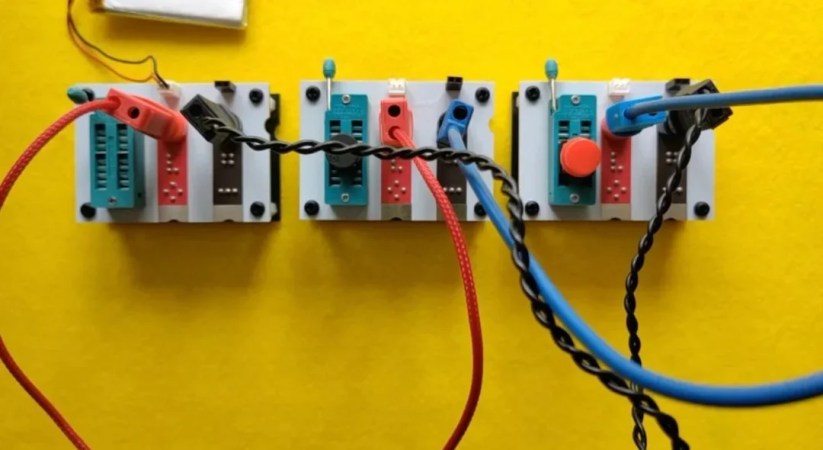
A green box with the answer to if a nuke has gone off with red neon lights

Has A Nuke Gone Off? Indicator

Look out of a window, ask yourself the question, “Has a nuke gone off?”. Maybe, maybe not, and all of us here at Hackaday need to know the answer to these important questions! Introducing the hasanukegoneoff.com Indicator from [bigcrimping] to answer our cries.

An ESP32 running a MicroPython script handles the critical checks from hasanukegoneoff.com for any notification of nuclear mayhem. This will either power the INS-1 neon bulb, indicating “no” or “yes” in the unfortunate case of a blast. Of course, there is also the button required for testing the notification lights; no chance of failure can be left. All of this is fitted onto a custom dual-sided PCB and placed inside a custom 3D-printed enclosure.

Hasanukegoneoff.com’s detection system, covered before here, relies on an HSN-1000L Nuclear Event Detector to check for neutrons coming from the blast zone. [bigcrimping] also provides the project plans for your own blast detector to answer the critical question of “has a nuke gone off” from anywhere other than the website’s Chippenham, England location.

This entire project is open sourced, so keep sure to check out [bigcrimping]’s GitHub for both portions of this project on the detector and receiver. While this project provides some needed dark humor, nukes are still scary and especially so when disarming them with nothing but a hacksaw and testing equipment.

Thanks to [Daniel Gooch] for the tip.

Bento showing fully assembled device and XR glasses

Bento – VR/XR From A Keyboard

XR may not have crashed into our lives as much as some tech billionaires have wished, but that doesn’t stop the appeal of a full display that takes up no physical space. At that point, why not get rid of the computer that takes up living space as well? That is what [Michael] tries to do with Bento, the form factor of an Apple Magic keyboard and the power of a Steam Deck. 

Continue reading “Bento – VR/XR From A Keyboard”

RC rover/car with red and yellow-sided wheels. Electronics are visible on top of vehicle.

An RC Car Driven With Old 3D Printer Motors

With the newer generation of quick and reliable 3D printers, we find ourselves with the old collecting dust and cobwebs. You might pull it out for an emergency print, that is if it still works… In the scenario of an eternally resting printer (or ones not worth reviving), trying to give new life to the functional parts is a great idea. This is exactly what [MarkMakies] did with a simple RC rover design from an old Makerbot Replicator clone. 

Using a stepper motor to directly drive each wheel, this rover proves its ability to handle a variety of terrain types. Stepper motors are far from the most common way to drive an RC vehicle, but they can certainly give enough power. Controlling these motors is done from a custom protoboard, allowing the use of RC control. Securing all these parts together only requires a couple of 3D printed parts and the rods used to print them. Throw in a drill battery for power, and you can take it nearly anywhere! 

Continue reading “An RC Car Driven With Old 3D Printer Motors”

Red and black grabber combat robot

Step Into Combat Robotics With Project SVRN!

We all love combat robotics for its creative problem solving; trying to fit drivetrains and weapon systems in a small and light package is never as simple as it appears to be. When you get to the real lightweights… throw everything you know out the window! [Shoverobotics] saw this as a barrier for getting into the 150g weight class, so he created the combat robotics platform named Project SVRN.

You want 4-wheel drive? It’s got it! Wedge or a Grabber? Of course! Anything else you can imagine? Feel free to add and modify the platform to your heart’s content! Controlled by a Malenki Nano, a receiver and motor controller combo board, the SVRN platform allows anyone to get into fairyweight fights with almost no experience.

With 4 N10 motors giving quick control, the platform acts as an excellent platform for various bot designs. Though the electronics and structure are rather simple, the most important and impressive part of Project SVRN is the detailed documentation for every part of building the bot. You can find and follow the documentation yourself from [Shoverobotics]’s Printables page here!

If you already know every type of coil found in your old Grav-Synthesized Vex-Flux from your Whatsamacallit this might not be needed for you, but many people trying to get into making need a ramp to shoot for the stars. For those needing more technical know-how in combat robotics, check out Kitten Mittens, a bot that uses its weapon for locomotion!

Continue reading “Step Into Combat Robotics With Project SVRN!”

Camera is seen on the left with an Arduino connected to the right

Look To The Sky With This Simple Plane Tracker

Do you ever get tired of stressing your neck looking for planes in the sky? Worry not! Here is a neat and cheap Arduino/Ras Pi project to keep your neck sore free! [BANK ANGLE] presents a wonderfully simple plane tracking system using an affordable camera and basic microcontrollers.

The bulk of the system relies on a cheap rotating security camera that gets dissected to reveal its internals. Here stepper control wires can be found and connected to the control boards required to allow an Arduino nano to tell the motors when and where to spin. Of course, the camera system doesn’t just look everywhere until it finds a plane, a Raspberry Pi takes in data from local ADS-B data to know where a nearby plane is.

After that, all that’s left is a nifty overlay to make the professional look. Combining all these creates a surprisingly capable system that gives information on the aircraft’s azimuth, elevation, and distance.

If you want to try your hand at making your own version of [BLANK ANGLE]’s tracker, check out his GitHub page. Of course, tracking planes gets boring after a while so why not try tracking something higher with this open-source star tracker?

Continue reading “Look To The Sky With This Simple Plane Tracker”

Wire-frame image of gearbox, setup as a differential

Roller Gearbox Allows For New Angles In Robotics

DIY mechatronics always has some unique challenges when relying on simple tools. 3D printing enables some great abilities but high precision gearboxes are still a difficult problem for many. Answering this problem, [Sergei Mishin] has developed a very interesting gearbox solution based on a research paper looking into simple rollers instead of traditional gears. The unique attributes of the design come from the ability to have a compact angled gearbox similar to a bevel gearbox.

Multiple rollers rest on a simple shaft allowing each roller to have independent rotation. This is important because having a circular crown gear for angled transmission creates different rotation speeds. In [Sergei]’s testing, he found that his example gearbox could withstand 9 Nm with the actual adapter breaking before the gearbox showing decent strength.

Continue reading “Roller Gearbox Allows For New Angles In Robotics”

Grid overlayed onto a mason jar. Across the grid are high voltage purple coronas.

High Voltage For Extreme Ozone

Don’t you hate it when making your DIY X-ray machine you make an uncomfortable amount of ozone gas? No? Well [Hyperspace Pirate] did, which made him come up with an interesting idea. While creating a high voltage supply for his very own X-ray machine, the high voltage corona discharge produced a very large amount of ozone. However, normally ozone is produced using lower voltage, smaller gaps, and large surface areas. Naturally, this led [Hyperspace Pirate] to investigate if a higher voltage method is effective at producing ozone.

Using a custom 150kV converter, [Hyperspace Pirate] was able to test the large gap method compared to the lower voltage method (dielectric barrier discharge). An ammonia reaction with the ozone allowed our space buccaneer to test which method was able to produce more ozone, as well as some variations of the designs.

Continue reading “High Voltage For Extreme Ozone”