AI For The Skeptics: Attempting To Do Something Useful With It

There are some subjects as a writer in which you know they need to be written, but at the same time you feel it necessary to steel yourself for the inevitable barrage of criticism once your work reaches its audience. Of these the latest is AI, or more specifically the current enthusiasm for Large Language Models, or LLMs. On one side we have the people who’ve drunk a little too much of the Kool-Aid and are frankly a bit annoying on the subject, while on the other we have those who are infuriated by the technology. Given the tide of low quality AI slop to be found online, we can see the latter group’s point.

This is the second in what may become an occasional series looking at the subject from the perspective of wanting to find the useful stuff behind the hype; what is likely to fall by the wayside, and what as yet unheard of applications will turn this thing into something more useful than a slop machine or an agent that might occasionally automate some of your tasks correctly. In the previous article I examined the motivation of that annoying Guy In A Suit who many of us will have encountered who wants to use AI for everything because it’s shiny and new, while in this one I’ll try to do something useful with it myself.

Continue reading “AI For The Skeptics: Attempting To Do Something Useful With It”
Audio Reactive LED Strips Are Hard

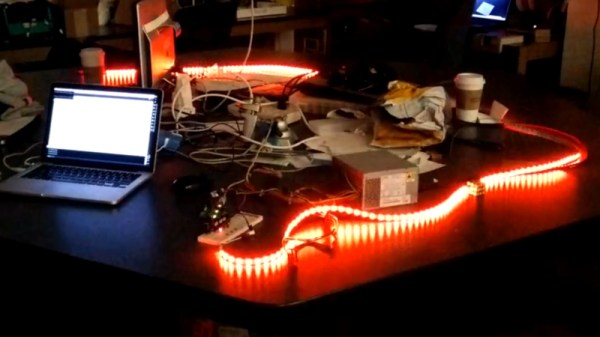
Back in 2017, Hackaday featured an audio reactive LED strip project from [Scott Lawson], that has over the years become an extremely popular choice for the party animals among us. We’re fascinated to read his retrospective analysis of the project, in which he looks at how it works in detail and explains that why for all its success, he’s still not satisfied with it.

Sound-to-light systems have been a staple of electronics for many decades, and have progressed from simple volume-based flashers and sequencers to complex DSP-driven affairs like his project. It’s particularly interesting to be reminded that the problem faced by the designer of such a system involves interfacing with human perception rather than making a pretty light show, and in that context it becomes more important to understand how humans perceive sound and light rather than to simply dump a visualization to the LEDs. We receive an introduction to some of the techniques used in speech recognition, because our brains are optimized to recognize activity in the speech frequency range, and in how humans register light intensity.

For all this sophistication and the impressive results it improves though, he’s not ready to call it complete. Making it work well with all musical genres is a challenge, as is that elusive human foot-tapping factor. He talks about using a neural network trained using accelerometer data from people listening to music, which can only be described as an exciting prospect. We genuinely look forward to seeing future versions of this project. Meanwhile if you’re curious, you can head back to 2017 and see our original coverage.

The Brits Made A Rocket. What Happened To It?

Like many long-established broadcasters, the BBC put out a selection of their archive material for us all to enjoy online. Their most recent may be of interest to Hackaday readers and has more than a bit of personal interest to your scribe, as it visits the Spadeadam rocket test range on the event of its closure in 1973. This marked the final chapter in the story of Blue Streak, the British intercontinental missile project that later became part of the first European space launcher.

It’s possible citizens of every country see their government as uniquely talented in the throwing away of taxpayer’s money, but the sad story here isn’t in Blue Streak itself which was obsolete as a missile by the time it was finished. Instead it lies in the closure of the test range as part of the ill-advised destruction of a nascent and successful space industry, just as it had made the UK the third nation to have successfully placed a satellite in orbit.

We normally write in the second person in our daily posts here at Hackaday, but for now there’s a rare switch into the first person. My dad spent a large part of the 1950s working as a technician for de Haviland Propellers, later part of Hawker Siddeley, and then British Aerospace. He was part of the team working on Blue Streak at Spadeadam and the other test site at RAF Westcott in Buckinghamshire, and we were brought up on hair-raising tales of near-disasters in the race to get British nukes flying. He’s not one of the guys in the video below, as by that time he was running his metalwork business in Oxfordshire, but I certainly recognise the feeling of lost potential they express. Chances are I’ll never visit what remains of the Spadeadam test stands in person as the site is now the UK’s electronic warfare test range, so the BBC film represents a rare chance for a closer look.

In a related story, the trackers for the same program in Australia were saved from the scrapheap.

Continue reading “The Brits Made A Rocket. What Happened To It?”

You’ve All Seen A Hackintosh, But Have You Seen One On A Wii?

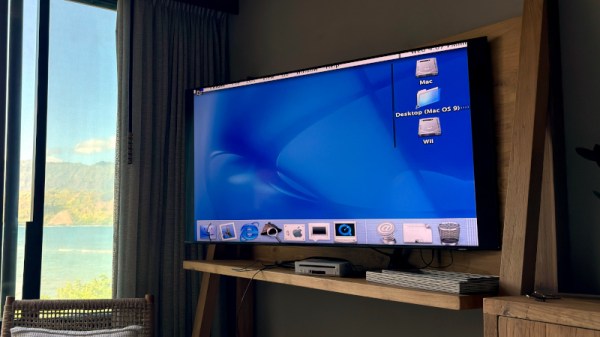
The Intel era of Apple Macs led to so-called “Hackintoshes”, more normal PCs running x86 MacOS X. Now Bryan Keller proves that a Hackintosh isn’t restricted to the x86 era, not by doing it with a modern ARM version, but by going back to PowerPC, and the Nintendo Wii.

The Wii can be thought of in hardware terms as not too far from a Mac G3 with a little less memory, having a PowerPC 750-family processor, a close relative as those in the first generation of MacOS X capable Macs. Since the roots of MacOS X are shared with its open-source equivalent Darwin, he reasons it should be possible to port just enough Darwin to the Wii to enable the closed-source OS X to run on top of it. He’s running OS X 10.0, the earliest version from 2001.

The write-up is a fascinating path through writing a bootloader and running a patched kernel that flashes the Wii LEDs, and then the process of making the Wii’s very different hardware from a Mac, accessible to the OS. It boots from an SD card and uses a framebuffer for display so perhaps it’s not as fast as you might hope, but he gets it working. Even for someone not versed in MacOS or the Wii, it’s a good write-up that makes its points accessible.

Something that makes us happy about this piece of work is its place in the greater picture, after all the Wii has found itself running classic MacOS too.

AI For The Skeptics: Pick Your Reasons To Be Excited

It’s odd being a technology writer in 2026, because around you are many people who will tell you that your craft is outdated. Like the manufacturers of buggy-whips at the turn of the twentieth century, the automobile (in the form of large language model AI) is on the market, and your business will soon be an anachronism. Adapt or go extinct, they tell you. It’s an argument I’ve found myself facing a few times over the last year in my wandering existence, and it’s forced me to think about it. What are the reasons everyone is excited about AI and are those reasons valid, what is there to be scared of, and what are the real reasons people should be excited about it?

If We Gotta Take This Seriously, How Can We Do It?

A couple in a horse drawn buggy, circa 1900ish
The futures looking bright in the buggy-whip department! Public domain.

I’ll start by repeating my tale from a few weeks ago when I asked readers what AI applications would survive when the hype is over. The reaction of a friend with decades of software experience on trying an AI coding helper stuck with me; she referenced her grandfather who had been born in rural America in the closing years of the nineteenth century, and recalled him describing the first time he saw an automobile. I agree with her that this has the potential to be a transformative technology, and while it’s entertaining to make fun of its shortcomings as I did three years ago when the idea of what we now call vibe coding first appeared, it’s already making itself useful in some applications. Simply dismissing it is no longer appropriate, but equally, drinking freely of the Kool-Aid seems like joining yet another hype bandwagon that will inevitably derail. A middle way has to be found. Continue reading “AI For The Skeptics: Pick Your Reasons To Be Excited”

934 MHz: When The Government Really Doesn’t Want You To Have CB

In the mid 1970s there were a spate of movies depicting the romance and lifestyle of truck drivers in the southern half of the United States. Over on the other side of the Atlantic these were naturally received not as works of drama but as documentaries, and thus began a craze for British drivers to do up their Ford Capri so in the right light and with your eyes nearly closed, it almost looked like Burt Reynolds’ Pontiac Trans Am from Smokey and the Bandit.

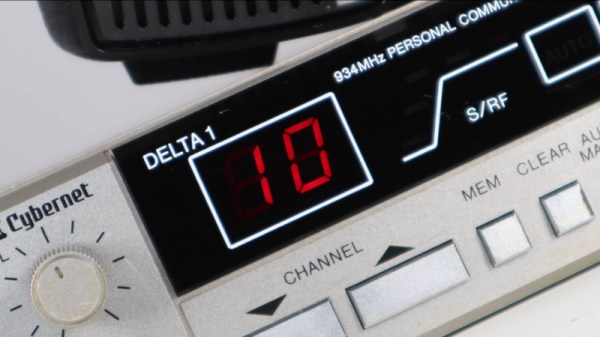
Such a fine automobile was of course incomplete without a CB radio, highly illegal at the time, which led to an underground CB craze and its eventual legalization in 1981. [Ringway Manchester] is here with a tale from that era, of 934 MHz CB, an odd and underused allocation that was eventually phased out for commercial services.

When UK CB was eventually legalized by the government, it was very obvious that they really didn’t want to. Brits got 27 MHz as FM only with meager power and a weird set of frequencies that nobody else had, and a second band way up in the UHF range, at 934 MHz. We remember they originally tried to make a UHF band the only allocation on purpose because it was nearly useless for mobile operation, and Brits only got 27 MHz by fighting back in the political lobbying space.

The video below tells the story of the band, with relatively scarce and expensive equipment leading to it being an exclusive band more similar to the amateur bands, with little resemblance to its raucous 27 MHz counterpart. How much activity there was depended very much on where in the country you were, which of course wasn’t where your Hackaday scribe was as a teenager even if it had been affordable. Eventually the government saw the little flashing pound signs and grabbed it back for a mobile radio service that never materialized, and now the frequencies are part of the mobile phone spectrum.

Have a watch for an odd bit of UK radio nostalgia and some 2020s illegal CB’ers, and if you want more it’s a subject we’ve touched on before.

Continue reading “934 MHz: When The Government Really Doesn’t Want You To Have CB”

Cleaning An IBM 5150, And The Perfect Period PCB Soldermask

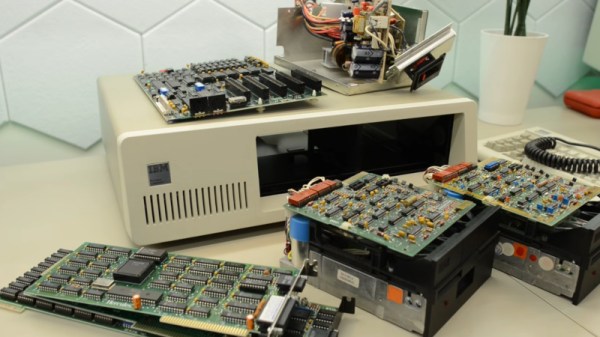
Now that early PCs have moved firmly from the realm of e-waste into being collector’s items, it’s worth putting in some effort to restore them if you find one. [Epictronics] has an early IBM 5150, the ancestor of all today’s PCs, and is bringing it back to life. Along the way, he’s building a replica AdLib sound card, making a useful discovery about how to make new parts look authentic.

The video below the break is a gentle journey through an early PC teardown, followed by the construction of the replica sound card. Here’s the interesting nugget of information: these new cards are careful recreations of the originals, but they just don’t look right. It seems modern soldermask is too shiny, and as luck would have it, there’s another option that is much more period-authentic. We hadn’t noticed matte green was available, but it certainly captures the look of those days much better.

As you might expect, such an old machine has a range of dead capacitors and a few chips. There’s a lucky escape with a Varta battery on an expansion card, having very little leakage, and part of one of the floppy drives needs some surgery. It’s gentle hacking that’s engaging to watch, and of course, at the end, we’re rewarded with the thing booting properly.

You might think reproducing a sound card is unusual, but we’ve seen it a number of times.

Continue reading “Cleaning An IBM 5150, And The Perfect Period PCB Soldermask”