Never Drill In The Wrong Place, With This Camera!

It’s fair to say that one of the biggest advances for the electronic constructor over the last decade or so has been the advent of inexpensive small-order PCB manufacture. That said, there are still plenty who etch their own boards, and for them perhaps the most fiddly part of the process comes in drilling holes accurately. It’s to aid in this task that [John McNelly] has created a camera with a periscope, to give the drill bit perfect alignment with the hole.

The idea is simple enough, an off-the-shelf all-in-one microscope camera points sideways at a mirror allowing it to look upwards. The viewport is placed under the drill and the crosshairs on the microscope are lined up with the end of the drill. Then the board can be placed on top and the pad lined up with the crosshairs, and a perfectly placed hole can be drilled. It’s a beautiful piece of lateral thinking which we like, as it ends that lottery of slightly off-centre holes. You can see it in glorious portrait-mode action in the video below the break.

Oddly this isn’t the first PCB drilling microscope we’ve shown you. but it may well be the more elegant of the two.

Continue reading “Never Drill In The Wrong Place, With This Camera!”
This Camera Does Not Exist

Blender is a professional-grade 3D-rendering platform and much more, but it suffers sometimes from the just-too-perfect images that rendering produces. You can tell, somehow. So just how do you make a perfectly rendered scene look a little more realistic? If you’re [sirrandalot], you take a photograph. But not by taking a picture of your monitor with a camera. Instead, he’s simulating a colour film camera in extraordinary levels of detail within Blender itself.

The point of a rendering package is that it simulates light, so it shouldn’t be such a far-fetched idea that it could simulate the behaviour of light in a camera. Starting with a simple pinhole camera he moves on to a meniscus lens, and then creates a compound lens to correct for its imperfections. The development of the camera mirrors that of the progress of real cameras over the 20th century, simulating the film with its three colour-sensitive layers and even the antihalation layer, right down to their differing placements in the focal plane. It’s an absurd level of detail but it serves as both a quick run-down of how a film camera and its film work, and how Blender simulates the behaviour of light.

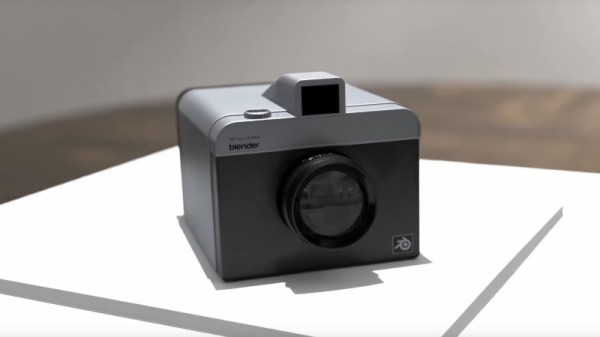
Finally we see the camera itself, modeled to look like a chunky medium format Instamatic, and some of its virtual photos. We can’t say all of them remove the feel of a rendered image, but they certainly do an extremely effective job of simulating a film photograph. We love this video, take a look at it below the break.

Continue reading “This Camera Does Not Exist”

How To Land A Model Rocket Vertically

Perhaps most readers will remember when they saw the first SpaceX demonstration of a rocket stage landing vertically on the pad under control. It’s something of a shock to be reminded that their first suborbital demonstration “hops” were around a decade ago, and how quickly what was once so special has become commonplace. We’re now in the era of the more complex model rockets having the same capability, with [BPS.space] managing it last year, and now [TTS Aerospace] sharing a video showing how they achieved the same feat.

The basics of the system revolve around a directed rocket nozzle, but to make it work is a lot more complex than simply hooking up a flight controller and calling it good. The steps in arriving at a landable rocket are examined, with plenty of failures shown along the way. Even the legs are more complex than they might appear, having to combine lightness, ease of unfurling under the power of elastic, and enough strength and give to survive a rough landing.

Those of us from countries where model rocketry is a highly licensed activity can only look on in envy at these projects, and we look forward to seeing where this avenue leads next. We covered the [BPS.space] rocket last year, should you be interested.

Continue reading “How To Land A Model Rocket Vertically”

Punched Cards Are In The Cloud, With This Arduino

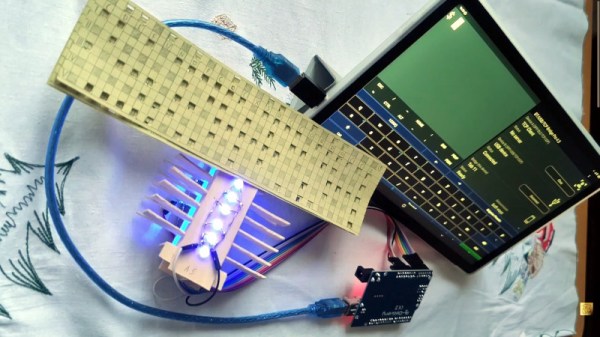
Grizzled veterans of the computing industry will relate stories of submitting projects on stacks of punched cards, something those of us who stored their 8-bit works on audio cassettes could only imagine. But for those who fancy experimenting with the format it’s still possible to make a basic card reader using LEDs and light sensors, as [Nino Ivanov] has done using an Arduino Uno as the brains. And these aren’t just for show, each of his cards holds a LISP program that runs in a cloud service.

The Uno does the job of reading, passing its data over its USB serial port to a tablet. On the tablet the serial data is piped to a cloud API to a LISP interpreter. It seems a needlessly complex way to run a factorial program and it’s certainly a little over the top, but on the other hand we love it as a glorious combination of the old and the new. With only 23 characters per card it’s quite an impressive feat to even fit a program on the format, perhaps writing code to fit on minimalist punched cards like this could become a programming challenge in its own right for a generation accustomed to mega-and gigabytes.

If you fancy a go yourself, this isn’t the first punched card reader we’ve shown you.

Continue reading “Punched Cards Are In The Cloud, With This Arduino”

What’s In A Slip Ring?

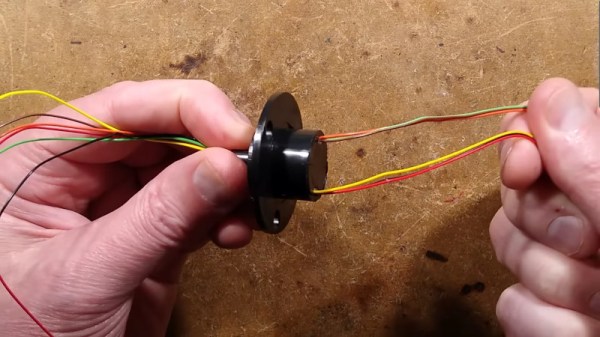
We know that when [Big Clive] puts up another video, the chances are we’re in for another fascinating look into a piece of tech on his bench. The latest is a slip ring assembly, and he gives it a teardown to reveal its secrets.

For most of us, the only place we encounter a slip ring is in some electric motors or alternators when it provides a connection via a conductive ring and a graphite brush from a fixed component to a rotating one. But they also appear as components in their own right wherever a rotating assembly needs an electrical contact, and it’s one of these that [Clive] has on his bench. It’s a compact unit with an impressive six conductors, and its manufacturer boldly claims that it’s good for mains voltages. We’re going with the verdict in the video below the break. That’s wishful thinking, given the size of the unit.

Inside is a rotor with six brass rings and a couple of decent little bearings, while the other half of the unit is a set of gold-plated spring contacts. There is extensive use of potting, and the verdict is that this is a surprisingly good quality component for the eBay price. We look forward to our community finding inventive uses for them. Having a ready-made unit sure beats making your own.

Continue reading “What’s In A Slip Ring?”

Get Back Your Replaceable Batteries, Thanks To The EU

The world’s tech companies must harbour a hearty dislike for the European Union because when the many cogs of its bureaucracies turn, they find themselves with little choice but to follow or risk losing access to a huge and affluent market. There are a few areas of technology that don’t have some concessions to EU rules in their manufacturing process, and if a common charging connector or right to repair weren’t enough, they’re back for another clash with the mobile phone industry. If you hanker for the days of replaceable mobile phone batteries, you’re in luck because an EU Parliament vote has approved a set of rules covering batteries among which will be a requirement for replaceable cells in portable appliances.

We expect that the phone manufacturers will drag their feet just as some of them have over charger ports, but the greater ease of maintenance, as well as extra longevity for phones, can only be a good thing. There are a few other measures in the package, and one of them caught our eye, the introduction of a battery passport for larger industrial and EV batteries. There’s little more information in the press release, but we hope that it doesn’t inhibit their exploitation by people in our community when introduced.

We look forward to seeing more replaceable battery models appear in due course, meanwhile, you can read some of our coverage of the EU’s right-to-repair measures.

Header: Andy Melton, USA, CC BY-SA 2.0.

Your IPhone Can’t Do What This WinCE Device Can!

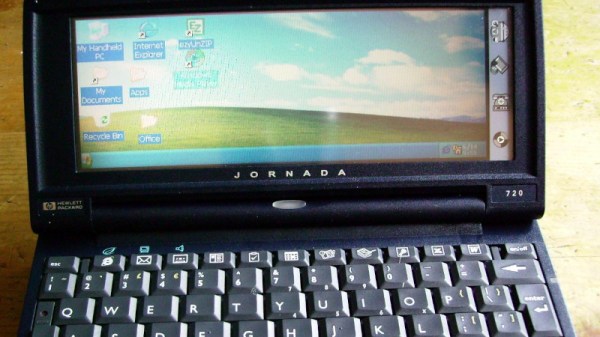
Most of us probably now have a smartphone, an extremely capable pocket computer — even if sometimes its abilities are disguised a little by its manufacturer. There are many contenders to the crown of first smartphone, but in that discussion it’s often forgotten that the first generally available such devices weren’t phones at all, but PDAs, or Personal Digital Assistants. The fancier ones blurred the line between PDA and laptop and were the forerunner devices to netbooks, and it’s one of these that [Remy] is putting through its paces. He makes the bold claim that it can do things the iPhone can’t, and while the two devices are in no way comparable he’s right on one point. His HP Journada 720 can host a development environment, while the iPhone can’t.

The HP was something of a turn-of-the-millennium object of desire, being a palmtop computer with a half-decent keyboard a 640×240 pixel TFT display, and 32 MB of RAM alongside its 206 MHz Intel StrongARM CPU. Its Windows CE OS wasn’t quite the desktop Windows of the day, but it was close enough to be appealing for the ’90s exec who had everything. Astoundingly it has more than one Linux distro that can run on it with some level of modernity, which is where he’s able to make the claim about the iPhone being inferior.

We remember the Journada clamshell series from back in the day, though by our recollection the battery life would plummet if any attempt was made to use the PCMCIA slot. It was only one of several similar platforms offering a mini-laptop experience, and we feel it’s sad that there are so few similar machines today. Perhaps we’ll keep an eye out for one and relive the ’90s ourselves.