The Simplest Social Engineering Hack Of Them All

Here at Hackaday we cover news and interesting features for the hacker community, with an emphasis more on the hardware side. Nevertheless we also cover stories from time to time from the broader world of security. These usually involve vulnerabilities discovered through the patient work of software or hardware researchers, and are certainly what we’d call hacking. But what about those information security breaches that aren’t hacks like that at all? What happens when the person being breached simply gives you the information?

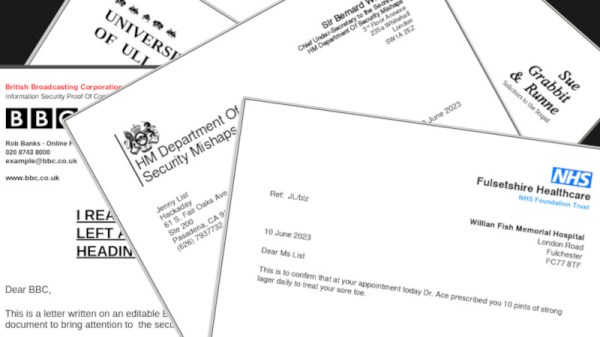
I’ve got one, and while it’s Not A Hack, it’s definitely something that we and those outside our community need to talk about. I’m talking about the depressingly common occurrence of organisations who should know better, gifting their letterhead to all and sundry in the form of freely editable Word documents. Continue reading “The Simplest Social Engineering Hack Of Them All”


Ham Almost Cooks ‘Dog

For those of us licensed in other countries it comes as something of a surprise to find that American radio amateurs now have to run RF exposure calculations as part of their licence requirements. [Ham Radio Crash Course] as approached this in a unique fashion, by running around 800 watts of 6-metre power into a vertical antenna festooned with hotdogs. That’s right, this ham is trying to cook some ‘dawgs! Is his station producing dangerous levels of power that might cook passers-by?

Of course, aside from a barely-warmed line along where the ‘dogs were attached to the antenna there’s no heating to be found. But we think he’s trying to make the point in the video below the break about the relative pointlessness of applying RF field limits which are definitely relevant at much higher frequencies, to hams at low frequencies.

It leaves us curious as to how that 800 watts could be efficiently transferred into the sausages and really cook them. Strapping them to a vertical is we think the equivalent of strapping anything resistive to a conductor, they do not form a significant  enough part of the circuit. We think that even six metres could cook a sausage if it could be efficiently coupled into it, so we’d suggest putting a grounded sausage up the middle of a close-wound helix.

If you have any thoughts on the RF exposure calculations, or on the best way to cook a ‘dog with 6m, we’d love to hear the, in the comments. Meanwhile, this isn’t the first piece of ‘dog-based shenanigans we’ve brought you.

Continue reading “Ham Almost Cooks ‘Dog”

It’s Never Too Late To Upgrade Your ZX81 Keyboard

Sir Clive Sinclair’s ZX81 was a phenomenal sales success as one of the cheapest machines available in the early 1980s, but even its most fervent admirers will admit that it suffered heavily from the Sinclair economy drive. In particular that membrane keyboard was notorious for its lack of feedback, and a popular upgrade back in the day was a replacement keyboard. Now we can bring you what might be the ultimate in ZX replacement keyboards, in the form of [Brian Swetland]’s mechanical ZX81 keyboard.

The familiar 40-key layout is all there, using Cherry MX key switches and a beautiful set of custom-printed keycaps. There’s little more to a ZX keyboard than the matrix wiring, and in this case it’s all incorporated on a PCB. None of these techniques were readily available to individuals back in the ’80s, so a large piece of perfboard, key switches from an old terminal keyboard, and Letraset would have had to suffice.

We have to admit liking this project a lot, in fact we’re even tempted by a set of these keycaps for a regular keyboard just for old time’s sake. If you’re interested in the ZX81 then take a look at how we used one to help us through the pandemic.

This Rohde & Schwarz Computer Is A Commodore PET

The IEE-488 or GPIB bus for controlling instruments by computer has existed now for many decades. It’s often implemented over USB or Ethernet here in 2023, but the familiar connector can still be found on the backs of pricey instruments. In the earlier days of GPIB when a powerhouse Linux laptop was decades away, what computer did the would-be GPIB user reach for? If they were a Rohde and Schwarz customer in the late 1970s the chances are it would have been the R&S PUC process controller, an 8-bit microcomputer that under its smart exterior turns out to be an enhanced Commodore PET. [NatureAndTech] has one for teardown, and you can see it in the video below the break.

Readers with long memories will remember that the PET had an IE-488 bus on a card edge connector, and it’s possible that’s why R&S took it as the basis for their machine. But this isn’t merely a PET in a fancy box, instead it’s a fully new PET-compatible computer, and it has some interesting features. There’s more memory than the original, a set of disk drives, and an expansion bus complete with a high-res graphics card allowing pixel graphics rather than text. Surprisingly though it has a BASIC interpreter it’s a hardware clone of the PET only, the ROM is unique to Rohde & Schwarz.

We think this machine is probably rare enough that we’re unlikely to see one in the flesh, but it’s been a fascinating thing to examine. You can join in with the video below the break, or you can look at the PET’s impact on a more recent scene.

Continue reading “This Rohde & Schwarz Computer Is A Commodore PET”

Two Pots On Your Moped

The fastest motorcycle in the world is not some elite racer piloted across the salt flats at crazy speeds, instead it’s your first bike. Even if it’s a 50 cc moped, no other motorcycle you will own afterwards will give you that same hit as the first time you sit astride it and open the throttle. It has to be admitted though, that 50 cc mopeds are slow if it’s not your first ever ride. Really slow. How can they be made faster? Perhaps an extra cylinder will do the trick. In the video below the break, [LeDan] takes a single cylinder Simson moped engine and turns it into a 2-cylinder model.

The build has something of the machining porn about it, but who doesn’t like to sit down and watch as rough metal is transformed into a machined finish? A second Simson engine is used as a donor, and from it another crankcase section is fabricated. In that foes a newly enlarged crankshaft which we’re supprised not to see being balanced, and on the end of the whole assembly goes the Simson end casting. Two cylinders and their blocks the bolt on top, and the engine is complete. It’s a twin-carb model, and we have to admit curiosity as to whether small two-strokes need their carbs balancing. The result seems to work, though we don’t see it on a bike or at high revs. The kid with this engine really would have the fastest motorcycle in the world — compared to his mates.

As you might expect, this isn’t the first small engine build we’ve seen.

Continue reading “Two Pots On Your Moped”

A Ride-On Picnic Table For Those Idylic Summer Evenings

For most outsiders the Netherlands is a country of picturesque cities, windmills, tulips, and maybe those famous coffee shops. Head away from the coast though and you enter the country’s rural hinterland, farming country with lush green fields, dairy cattle, and farm lads doing what they do best, which is hacking old machinery to do crazy things under those wide skies. [Plodno] are based on a farm somewhere in the eastern Netherlands, and the latest of these lads’ creations is a motorised picnic table (Dutch language, you’ll need YouTube translated subtitles).

This is farm hacking at its best, with a scrap FIAT hatchback donating its running gear to a welded tubular frame, with a chain drive to a small single-cylinder engine. There’s no suspension save for the air in the tyres, the steering column is vertical, and the brake is a single inboard disk on the rear axle. Perhaps it’s fortunate that the intended beating heart, a Kawasaki motorycle engine, was misfiring, as it would have been truly lethal with that much power. We’re not too convinced at the legality of taking such a contraption on the public road in the Netherlands, but they seem to get away with it. Take a look at the build in the video below the break.

Here at Hackaday we like a good hacky farm build, even though sometimes they’re not so well-assembled.

Continue reading “A Ride-On Picnic Table For Those Idylic Summer Evenings”

A 489 Megapixel Camera For Not A Lot

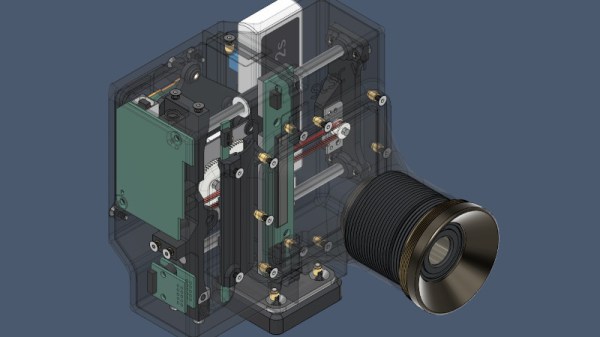
The megapixel wars of a decade ago saw cameras aggressively marketed on the resolution of their sensors, but as we progressed into the tens of megapixels it became obvious even to consumers that perhaps there might be a little more to the quality of a digital camera than just its resolution. Still, it’s a frontier that still has a way to go, even if [Yunus Zenichowski]’s 489 megapixel prototype is a bit of an outlier. As some of you may have guessed it’s a scanner camera, in which the sensor is a linear CCD that is mechanically traversed over the focal plane to capture the image line by line.

In the 3D printed shell are the guts of a cheap second-hand Canon scanner, and the lens comes from a projector. Both these components make it not only one of the highest resolution cameras we’ve ever brought you, but also by no means the most expensive. It’s definitely a work in progress and the results of a sensor designed for the controlled environment of a document scanner being used with real-world light leave something to be desired, but even with the slight imperfections of the projector lens it’s still a camera capable of some fascinating high-resolution photography. The files are all available, should you be interested, and you can see it in action in the video below the break.

It’s by no means the first scanner camera we’ve brought you, though some of the earlier projects now have dead links. It is however easily the one with the highest resolution.

Continue reading “A 489 Megapixel Camera For Not A Lot”