Shake Your PCB Etching, With An Old Optical Drive

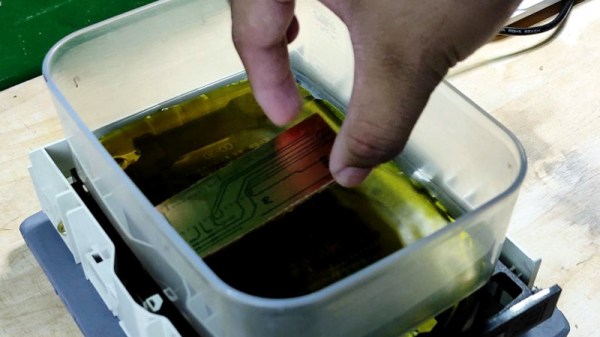
Easy PCB fabrication in China has revolutionised electronic construction at our level, but there are still times when it makes sense to etch your own boards. It’s a messy business that can also be a slow one, but at least a project from [earldanielph] takes away one chore. It agitates the etchant solution round the board, by moving the tank backwards and forwards on the drawer of an old optical drive.

The first part of the build is simply removing all parts of the drive except the drawer mechanism and its motor. This is still, in most cases, a DC motor, so an Arduino can easily drive it with a motor control shield. It’s worth a moment to reflect on how little there is to a modern optical drive.

The Arduino receives a sketch that moves the tray backward and forward, and a piece of ply is attached to the tray. This becomes a stand for a plastic tub containing the etchant and board, and the liquid is soon swishing back and forwards over the surface. You can see the result in the video below the break. Definitely a saving over manual agitation. It’s an inventive machine, but it’s not the first PCB agitator we’ve seen.

Continue reading “Shake Your PCB Etching, With An Old Optical Drive”

Run Linux By Emulating RISC-V On A RISC-V Microcontroller

For years it was a given that it was impossible to run a Linux based operating system on a less powerful computer whose architecture lacked a memory management unit. There were projects such as uCLinux which sought to provide some tidbits to low computing power Linux users, but ultimately they came to naught. It is achievable after a fashion though, by using the limited architecture to emulate a more powerful one. It’s been done on AVR chips emulating ARM, on ARM chips, and now someone’s done it on an ESP32-C3 microcontroller, a RISC-V part running a RISC-V emulator. What’s going on?

RISC-V is an architecture specification that can be implemented at many levels from a simple microcontroller or even a pile of 74 logic to a full-fat application processor. The ESP32-C3 lies towards the less complicated end of this curve, though that’s not the whole reason for the emulation. The PSRAM storage is used by the C3 as data storage and can’t be used to run software, so to access all that memory capacity an emulator is required that in turn can use the PSRAM as its program memory. It’s a necessary trick for Espressif’s implementation of the architecture.

Surprisingly it’s not as slow as might be expected, with a boot-up time under two minutes. It’s not what we’d expect from our desktop powerhouses, but it’s not so long ago that certain lower-power full-fat processors could be just as lethargic. For past glories, see the AVR running Linux, and the RP2040.

NFC Antennas Have Other Uses

As NFC chips proliferate, so do the antennas they require for operation, and since many NFC-enabled items are single-use, this means there’s an opportunity to put them to other uses. It’s an avenue pursued by [Brother-live], as he strips the antennas from spent metro tickets and gets experimenting.

The antenna in an NFC-enabled card is a flexible PCB laminated between the plastic outer layers, with the tracks forming a coil round the outside of it. Using some solvent the cards can be easily separated and the antennas retrieved. Once the chip has been removed they can be cleaned up and soldered to, allowing wires to be connected.

What can you do with an NFC antenna? Not a huge amount as you can see in the (Russian language, English subtitles) video below the break, but he tries it as a not-very-good heating pad, a power harvesting antenna from NFC readers, and perhaps most promisingly, as the coil of a moving-coil speaker. We’re not sure how much effort would be worth making on that last front, but we think with a bit of care there might be room for audible improvement.

If you’ve ever been tempted to have a look at an NFC card, it’s a subject we’ve covered before.

Continue reading “NFC Antennas Have Other Uses”

A High Precision ADC That You Can Understand!

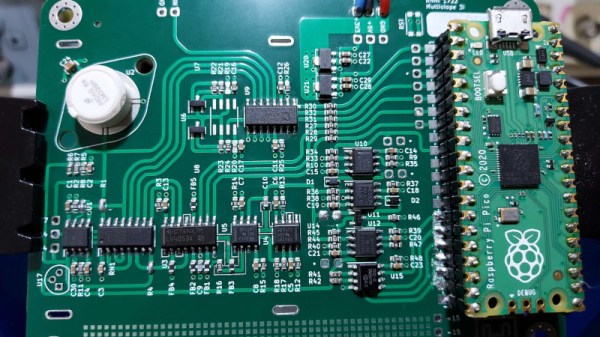
In a world where an analogue to digital converter is all too often an integrated peripheral buried inside a microcontroller, it’s easy to forget how simple these devices can be when built from first principles. An entry in our Op-Amp Challenge from [NNNI] demonstrates this perfectly, it’s a high resolution multi-slope ADC for instrumentation purposes, constructed using a mixture of op-amps, logic chips, and a Raspberry Pi Pico. Best of all, it’s easy to understand, so there’s little of that analogue mystique to worry about.

This type of ADC measures an analogue value by counting how long it takes to charge a capacitor to that voltage. A simple version that measures charge time has a few drawbacks, so this project goes from single slope to multi slope by measuring both charge and discharge times compared to the voltage. Pay attention to component matching and reference stability, and such a design can offer a very high resolution measurement.

The value in this project lies not only in the design itself, but also in the extremely comprehensive description of its operation, which should teach most readers a thing or two. That curvy-line PCB is rather nice, too. We used single slope ADCs to read analogue joysticks back in the day, but we certainly learned something here. Want to see another? This isn’t the first dual slope ADC we’ve seen.

Raspberry Pi Camera Conversion Leads To Philosophical Question

The Raspberry Pi HQ camera module may not quite reach the giddy heights of a DSLR, but it has given experimenters access to a camera system which can equal the output of some surprisingly high-quality manufactured cameras. As an example we have a video from [Malcolm-Jay] showing his Raspberry Pi conversion of a Yashica film camera.

Coming from the viewpoint of a photographer rather than a hardware person, the video is particularly valuable for his discussion of the many lens options beyond a Chinese CCTV lens which can be used with the platform. It uses only the body from the Yashica, but makes a really cool camera that we’d love to own ourselves. If you’re interested in the Pi HQ camera give it a watch below the break, and try to follow some of his lens suggestions.

The broken camera he converted is slightly interesting, and raises an important philosophical question for retro technology geeks. It’s a Yashica Electro 35, a mid-1960s rangefinder camera for 35 mm film whose claim to fame at the time was its electronically controlled shutter timing depending on its built-in light meter. The philosophical question is this: desecration of a characterful classic camera which might have been repaired, or awesome resto-mod? In that sense it’s not just about this project, but a question with application across many other retro tech fields.

A working Electro 35 is a fun toy for an enthusiast wanting to dabble in rangefinder photography, but it’s hardly a valuable artifact and when broken is little more than scrap.  One day we’d love to see a Pi conversion with a built-in focal length converter allowing the use of the original rangefinder mechanism, but we’ll take this one any day!

How about you? Would you have converted this Yashica, repaired it somehow, or just hung onto it because you might get round to fixing it one day? Tell us in the comments!

Continue reading “Raspberry Pi Camera Conversion Leads To Philosophical Question”

A Clock Timebase, No Microcontroller

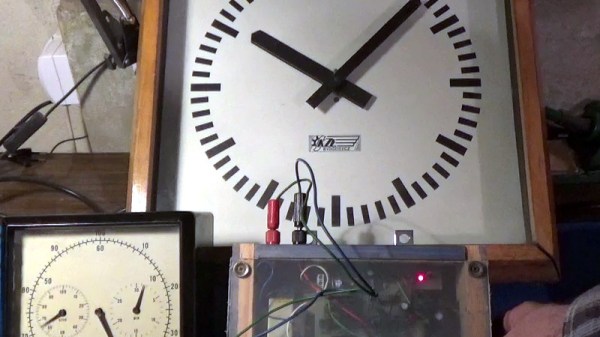
Making an electronic clock is pretty easy here in 2023, with a microcontroller capable of delivering as many quartz-disciplined pulses as you’d like available for pennies. But how did engineers generate a timebase back in the old days, and how would you do it today? It’s a question [bicyclesonthemoon] is answering, with a driver for a former railway station clock.

The clock has a mechanism that expects pulses every minute, a +24V pulse on even minutes, and a -24V pulse on odd ones. He received a driver module with it, but for his own reasons wanted a controller without a microcontroller. He also wanted the timebase to be derived from the mains frequency. The result is a delve back into 1970s technology, and the type of project that’s now a pretty rare sight. Using a mixture of 4000 series logic and a few of the ubiquitous 555s [bicyclesonthemoon] recovers 50Hz pulses from the AC, and divides them down to 1 pulse per minute, before splitting into odd and even minutes to drive a pair of relays which in turn drive the clock. We like it, a lot.

Mains-locked clocks are less common than they used to be, but they’re still a thing. Do you still wake up to one?

What Can You Do With Discarded Fish Aggregation Devices

Often we bring you projects at the end of their trajectory so that you can marvel at a job well done, but sometimes we point you instead to the start of the story. Such is the case with [Brett Smith]’s investigation of discarded fish aggregation buoys, referred to as FADs. These 700-plus dollar devices are deployed in the ocean in the thousands by commercial fishing fleets, and most are not recovered. He’s looking at them from the point of view of re-using their technology in the marine conservation business.

His progress has been documented in a series of short YouTube videos, starting with an introduction that we’ve placed below the break. So far he’s gone on to a complete teardown, and then a detailed look at the PCB. Inside they have a solar charger for a bank of NiCd cells, an echo sounder, a GPS receiver, and an Iridium satellite modem allowing the device to phone home. There’s certainly plenty in there to experiment with, including a few slightly exotic parts, so keep an eye on his channel as we’re sure to see more.

These devices have never made it to Hackaday before, but we have seen an echo sounder on a surfboard.

Continue reading “What Can You Do With Discarded Fish Aggregation Devices”