Why Do Rifa Capacitors Fail?

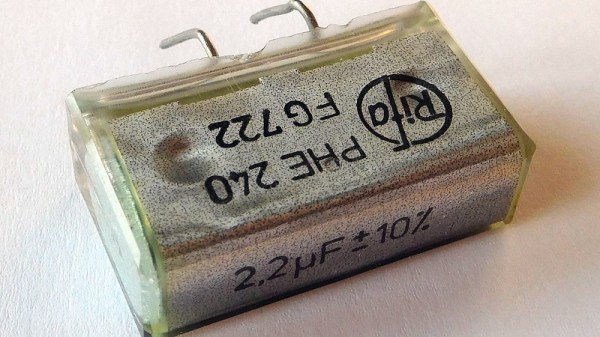
Anyone who works with older electronic equipment will before long learn to spot Rifa capacitors, a distinctive yellow-translucent component often used in mains filters, that is notorious for failures. It’s commonly thought to be due to their absorbing water, but based upon [Jerry Walker]’s long experience, he’s not so sure about that. Thus he’s taken a large stock of the parts and subjected them to tests in order to get to the bottom of the Rifa question once and for all.

What he was able to gather both from the parts he removed from older equipment and by applying AC and DC voltages to  test capacitors, was that those which had been used in DC applications had a much lower likelihood of exhibiting precursors to failure, and also a much longer time before failure when connected to AC mains.

Indeed, it’s only at the end of the video that he reveals one of the parts in front of him is an ex-DC part that’s been hooked up to the mains all the time without blowing up. It’s likely then that these capacitors didn’t perform tot heir spec only when used in AC applications. He still recommends replacing them wherever they are found and we’d completely agree with him, but it’s fascinating to have some light shed on these notorious parts.

Continue reading “Why Do Rifa Capacitors Fail?”

Apple Never Gave Them USB. Now, They’re Getting It For Themselves

These days we use USB as a default for everything from low-speed serial ports to high-capacity storage, and the ubiquitous connector has evolved into a truly multi-purpose interface. It’s difficult to believe then, that the first Apple Mac to be designed with a USB interface was shipped without it; but that’s the case with 1997’s grey Power Mac G3.

On the personality board are all the footprints for a single USB 1.1 port, but USB-hungry Apple fanboys had to wait for the translucent iMac and later G3 before they had a machine with the parts fitted. [Croissantking] is righting that particular wrong, by piecing together the missing Apple circuit using parts from contemporary cards for PCs. Over a long forum thread there are a few teething problems, but it certainly seems as though grey G3 owners will soon be able to have reliable USB upgrades.

If omitting USB from a 1997 Mac seems unexpected, it’s as well to remember how slow the first USB versions were. At the time SCSI was king in the high-speed peripheral world, and USB seemed more appropriate as a replacement for Apple Desktop Bus and the serial port. Even when they embraced USB they were reluctant to follow the standards of the PC world, as we remember finding out when for curiosity’s sake we tried swapping the mice and keyboards between an iMac and a Windows PC. We have USB’s success to thank for releasing Mac users from a world of hugely overpriced proprietary peripherals.

If you fancy hacking a ’90s PowerMac, make sure you get one that works.

Thanks [Doug] for the tip.

Why A Community Hackerspace Should Be A Vital Part Of Being An Engineering Student

Travelling the continent’s hackerspaces over the years, I have visited quite a few spaces located in university towns. They share a depressingly common theme, of a community hackerspace full of former students who are now technology professionals, sharing a city with a university anxious to own all the things in the technology space and actively sabotaging the things they don’t own. I’ve seen spaces made homeless by university expansion, I’ve seen universities purposefully align their own events to clash with a hackerspace open night and discourage students from joining, and in one particularly egregious instance, I’ve even seen a university take legal action against a space because they used the name of the city, also that of the university, in the name of their hackerspace. I will not mince my words here; while the former are sharp practices, the latter is truly disgusting behaviour.

The above is probably a natural extension of the relationship many universities have with their cities, which seems depressingly often to be one of othering and exclusion. Yet in the case of hackerspaces I can’t escape the conclusion that a huge opportunity is being missed for universities to connect engineering and other tech-inclined students with their alumni, enhance their real-world skills, and provide them with valuable connections to tech careers.

Yesterday I was at an event organised by my alma mater, part of a group of alumni talking to them about our careers.  At the event I was speaking alongside an array of people with varying careers probably more glittering than mine, but one thing that came through was that this was something of a rare opportunity for many of the students, to talk to someone outside the university bubble. Yet here were a group of engineers, many of whom had interesting careers based locally, and in cases were even actively hiring. If only there were a place where these two groups could informally meet and get to know each other, a community based on a shared interest in technology, perhaps?

It’s not as though universities haven’t tried on the hackerspace front, but I’m sad to say that when they fill a room with cool machines for the students they’re rather missing the point. In some of the cases I mentioned above the desire to own all the things with their own students-only hackerspace was the thing that led to the community hackerspaces being sabotaged. Attractive as they are, there’s an important ingredient missing, they come from a belief that a hackerspace is about its facilities rather than its community. If you were to look at a room full of brand-new machines and compare it with a similar room containing a temperamental Chinese laser cutter and a pair of battered 3D printers, but alongside a group of seasoned engineers in an informal setting, which would you consider to be of more benefit to a student engineer? It should not be a difficult conclusion to make.

Universities value their local tech industry, particularly that which has some connection to your university. You want your students to connect with your alumni, to connect with the local tech scene, and to ultimately find employment within it. At the same time though, you’re a university, you see yourselves as the thought leader, and you want to own all the things. My point is that these two positions are largely incompatible when it comes to connecting your engineering students with the community of engineers that surround you, and you’re failing your students in doing so.

Thus I have a radical proposal for universities. Instead of putting all your resources on a sterile room full of machines for your students, how about spending a little into placing them in a less shiny room full of professional engineers on their off-time? Your local hackerspace is no threat to you, instead it’s a priceless resource, so encourage your students to join it. Subsidise them if they can’t afford the monthly membership, the cost is peanuts compared to the benefit. Above all though, don’t try to own the hackerspace, or we’re back to the first paragraph. Just sometimes, good things can happen in a town without the university being involved.

It’s Difficult To Read An Audiophile Guide As An Analogue Engineer

Sitting on a train leaving the Hackaday Berlin conference, and Hacker News pops up Julian Shapiro with a guide to HiFi. What Hackaday scribe wouldn’t give it a click, to while away the endless kilometres of North European Plain!

It’s very easy as an analogue electronic engineer, to become frustrated while reading audiophile tracts, after all they have a tendency to blur superficial engineering talk with pseudoscience. There’s a rich vein of parody to be found in them, but nevertheless it’s interesting to read them because just sometimes the writer gets it and doesn’t descend into the world of make-believe. Continue reading “It’s Difficult To Read An Audiophile Guide As An Analogue Engineer”

Gordon Moore, 1929 — 2023

The news emerged yesterday that Gordon Moore, semiconductor pioneer, one of the founders of both Fairchild Semiconductor and Intel, and the originator of the famous Moore’s Law, has died. His continuing influence over all aspects of the technology which makes our hardware world cannot be overstated, and his legacy will remain with us for many decades to come.

A member of the so-called “Traitorous Eight” who left Shockley Semiconductor in 1957 to form Fairchild Semiconductor, he and his cohort laid the seeds for what became Silicon Valley and the numerous companies, technologies, and products which have flowed from that. His name is probably most familiar to us through “Moore’s Law,” the rate of semiconductor development he first postulated in 1965 and revisited a decade later, that establishes a doubling of integrated circuit component density every two years. It’s a law that has seemed near its end multiple times over the decades since, but successive advancements in semiconductor fabrication technology have arrived in time to maintain it. Whether it will continue to hold from the early 2020s onwards remains a hotly contested topic, but we’re guessing its days aren’t quite over yet.

Perhaps Silicon Valley doesn’t hold the place in might once have in the world of semiconductors, as Uber-for-cats app startups vie for attention and other semiconductor design hubs worldwide steal its thunder. But it’s difficult to find a piece of electronic technology, whether it was designed in Mountain View, Cambridge, Shenzhen, or wherever, that doesn’t have Gordon Moore and the rest of those Fairchild founders in its DNA somewhere. Our world is richer for their work, and that’s what we’ll remember Gordon Moore for.

You can read our thoughts on Moore’s famous law. If you ever wondered how Silicon Valley became the place for electronics, the story is probably much older than you think.

A LEGO Camera You Just Might Own Yourself

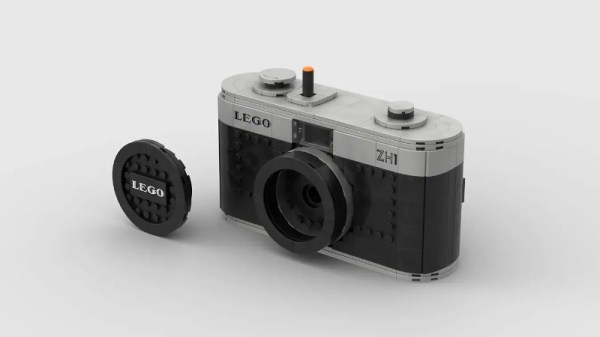
A camera makes for an interesting build for anyone, because it’s an extremely accessible technology that can be made from materials as simple as cardboard. More robust cameras often require significant work, but what if you could make a usable camera from LEGO? It’s a project taken on by [Zung92], who hasn’t simply made a working 35 mm camera from everyone’s favorite construction toy — he’s also managed to make it exude retro style. Best of all, you can vote for it on the LEGO Ideas website, and you might even get the chance to have one for yourself.

Frustratingly there’s little in the way of in-depth technical detail on the Ideas website, but he does mention that it was a challenge to make it light proof. Even the lens is a LEGO part, and if diffraction-based photography isn’t for you there’s also a pinhole option. We look forward to seeing this camera progress, and we hope we’ll see it advance to becoming a LEGO Ideas kit.

This is an extremely polished design, but surprisingly, it’s not our first LEGO camera.

Thanks [Michael] for the tip.

Digitizing Sound On An Unmodified Sinclair ZX81

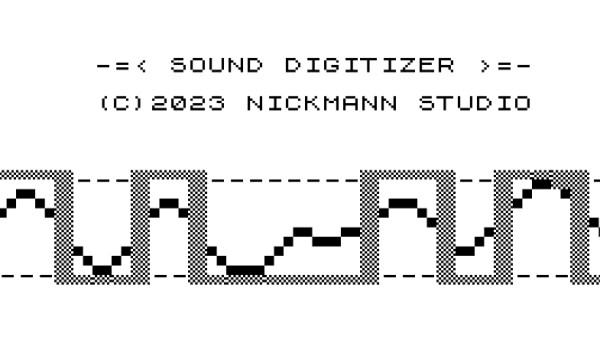
Whatever the first computer you used to manipulate digital audio was, the chances are it came with dedicated sound hardware that could play, and probably record, digitized audio. Perhaps it might have been a Commodore Amiga, or maybe a PC with a Sound Blaster. If you happen to be [NICKMANN] though, you can lay claim to the honor of doing so on a machine with no such hardware, because he managed it on an unmodified Sinclair ZX81.

For those of you unfamiliar with the ZX, it embodied Clive Sinclair’s usual blend of inflated promises on minimal hardware and came with the very minimum required to generate a black-and-white TV picture from a Zilog Z80 microprocessor. All it had in the way of built-in expansion was a cassette interface, 1-bit read and write ports exposed as 3.5 mm jacks on its side. It’s these that in an impressive feat of hackery he managed to use as a 1-bit sampler with some Z80 assembler code, capturing a few seconds of exceptionally low quality audio in an ’81 with the plug-in 16k RAM upgrade.

From 2023 of course, it’s about as awful as audio sampling gets, but in 1980s terms it’s pulling off an almost impossible feat that when we tried it with a 1-bit PC speaker a few years later, we didn’t succeed at. We’re impressed.

The ’81 may be one of the simplest of the 8-bit crop, but in its day it set many a future software developer on their career path. It’s still a machine that appears here today, from time to time.