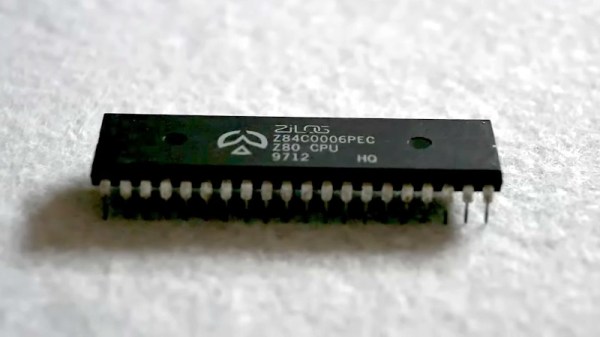
The microprocessor feature which probably most enables the computing experience we take for granted today is protected mode. A chip with the required hardware can run individual software processes in their own environments, enabling multitasking and isolation between processes. Older CPUs lacked this feature, meaning that all the resources were available to all software. [Andy Hu] has done the seemingly impossible with a Zilog Z80, enabling a protected mode on the chip for the first time in over four decades. Has he found an elusive undocumented piece of silicon missed by every other researcher? Not quite, but it is a clever hack.
The Z80 has two address spaces, one for memory and the other for I/O. He’s taken the I/O request line and fed it through a flip-flop and some logic to call a hardware interrupt the first time an I/O call is made or when a RST instruction is executed. Coupled with a small piece of memory for register contents, and he’s made a Z80 with a fully-functional protected mode, for the cost of a few logic chips. It’s explained in the video below the break, and we hope you agree that it’s rather elegant given the resources in hand. It’s too late for the commercial 8-bit machines of the past, but it would be interesting to see what today’s retrocomputer designers make of it.
For over a century now, radio amateurs have made tuned circuits using a coil of wire and a variable capacitor. In recent decades the supply of variable capacitors has dwindled, as SDR technology has supplanted the traditional tuning capacitor. No more tuned circuits for the radio amateurs? Not quite, as [Bill Meara N2CQR] shows us in the video below the break by making variable inductors using permeability tuning. This is hardly high-tech, the major component is as simple as a glue stick.
A permeability tuned inductor has a core that is moved in and out of its center by means of a screw. A glue stick has a glue core on a lead screw from a knob at its end, so an old glue stick with the glue replaced by a ferrite ring makes a reasonable permeability tuned former. The coil is wound on its outside, and when assembled into an oscillator it gives a useful tuning range. This is hardly a new idea as permeability tuning could be found in car radios and TV tuners among other applications back in the day, but it’s still a good trick to bear in mind.
We’ve featured plenty of Bill’s videos before here at Hackaday, most recently tracking down an unusual early TV.
Seasoned Hackaday readers may have noticed over the years, that some of us who toil under the sign of the Jolly Wrencher have a penchant for older tech. After all, what’s not to like in a dirt cheap piece of consumer electronics from decades past that’s just begging for a bit of hardware hacking? For me at the moment this is manifesting itself in a selection of 8mm movie cameras, as I pursue a project that will eventually deliver a decent quality digital film cartridge.
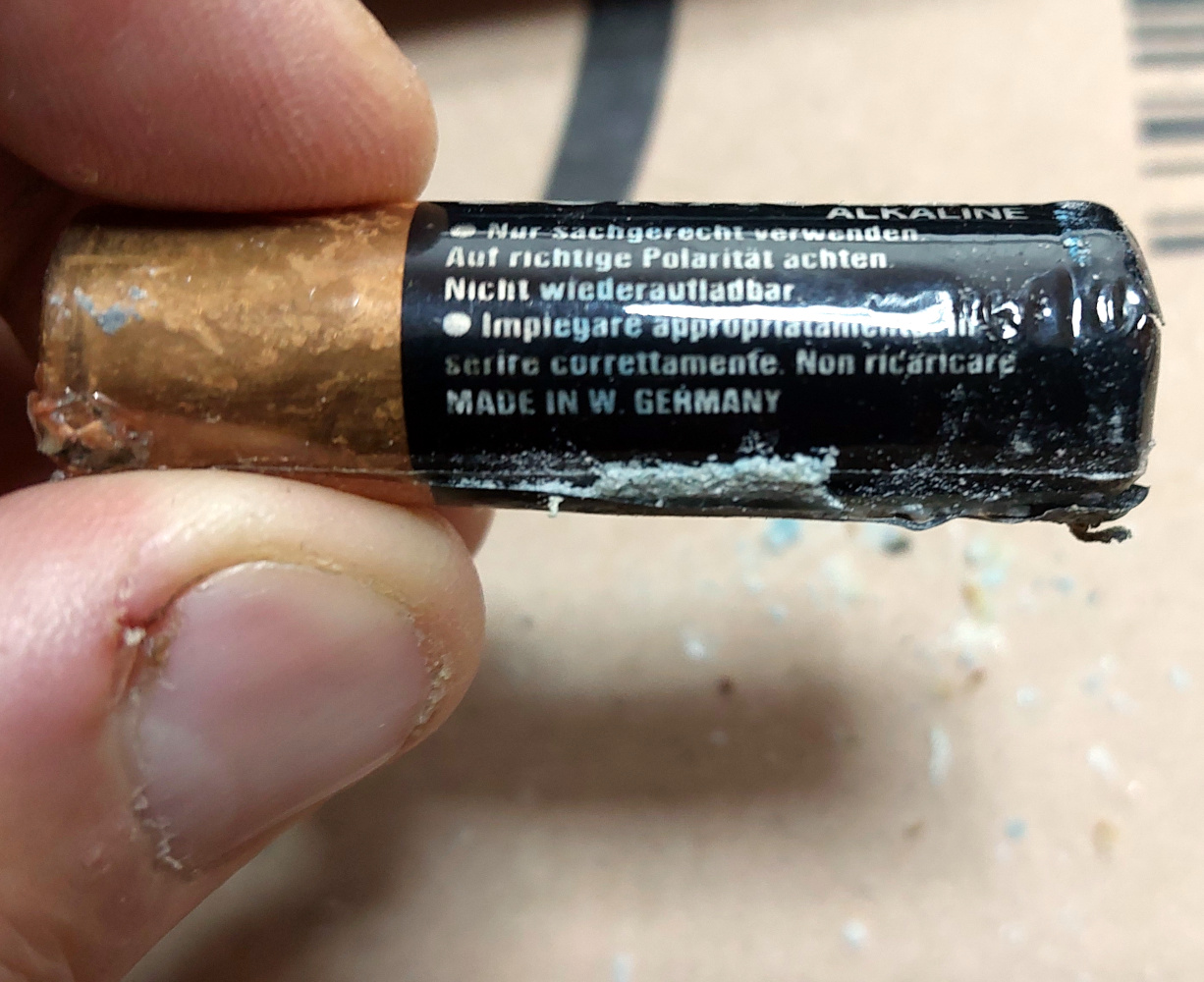
When A Cell Is From West Germany, You Know It’s Old
“Made in West Germany”
The trouble with scouring junk shops for a technology superseded four decades ago is that the cameras I find have in most cases been sitting in a drawer since the early 1980s. They were a valuable item back in the day so of course they were hung on to, then they were forgotten about until one day the grown-ups who were once the kids featured in the home movies are clearing the house, and they start their journey to my bench.
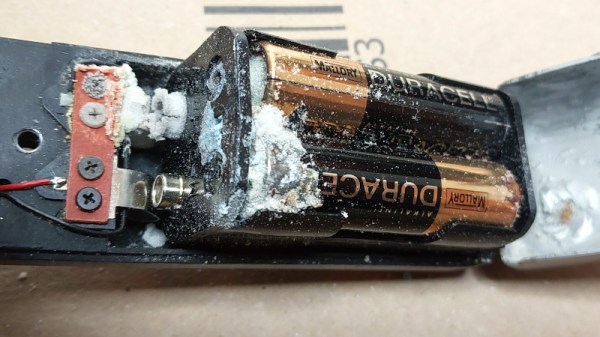
The problem is that very few owners of 8mm cameras had the good sense to remove their batteries before putting them away, so I inevitably end up with a battery compartment full of crusty 1980s Duracells and rusted contacts. This has left me curious, just what has happened here and how can I fix it?
What’s The Leaky Stuff?
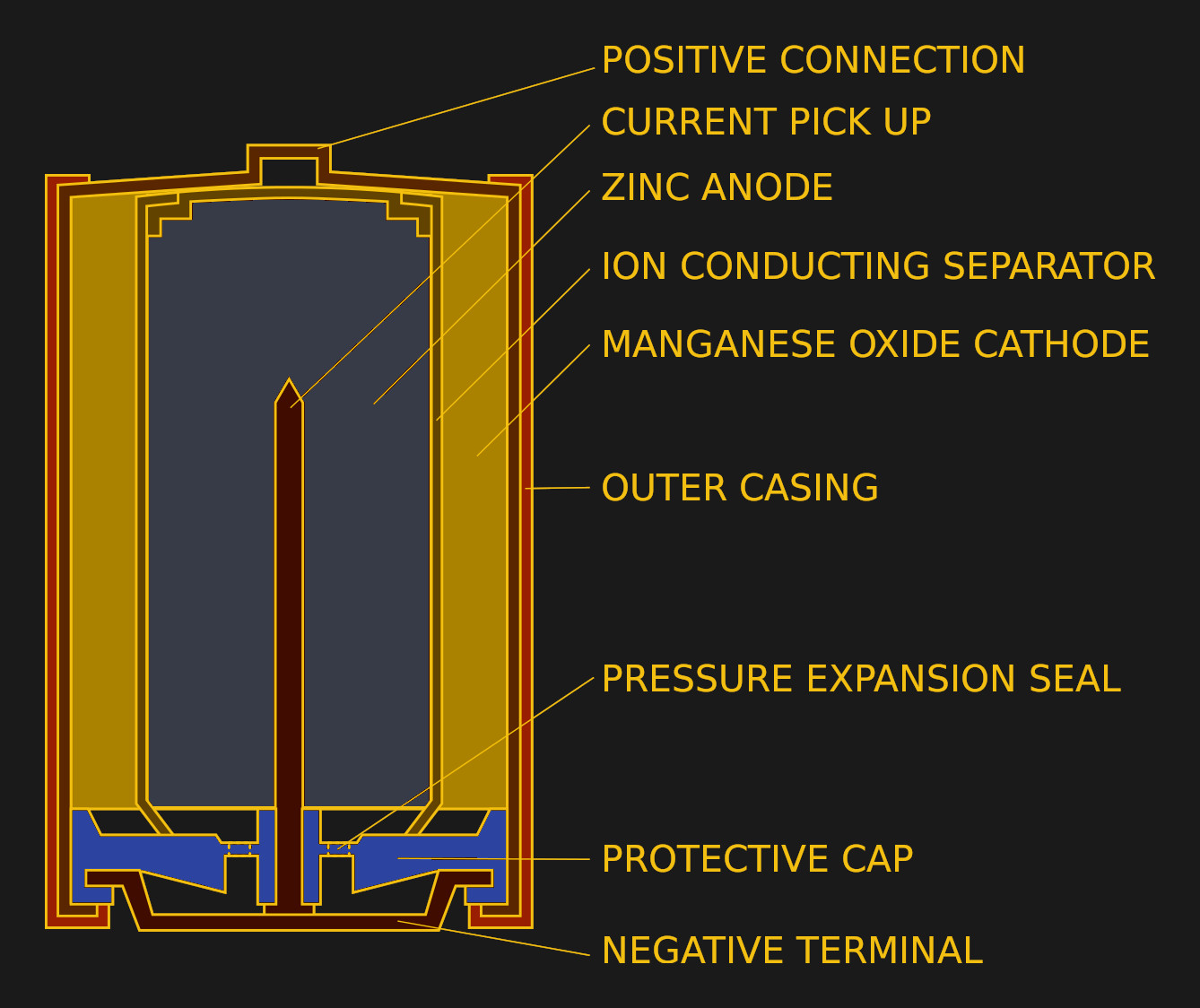
Construction of a zinc-manganese “alkaline” cell. Tympanus, Public domain.
Non-rechargeable cells come in a variety of chemistries, but the commercial ones we’re most familiar with are zinc-carbon “dry cells”, and “Alkaline” zinc-manganese dioxide cells. The zinc-carbon variety are becoming less common here in 2022 and have an acidic zinc chloride or ammonium chloride electrolyte, while the alkaline cells have a higher capacity and a basic potassium hydroxide electrolyte. They both have different failure modes that result in the leaky cells, so it’s worth taking a look at each one.
The failure mode of a zinc-carbon cell is a chemical one, the acidic electrolyte reacts with the zinc can anode, and eventually eats through it. The leaking electrolyte then attacks the surrounding circuitry and battery clips. It’s hardly a concentrated acid, but it’s enough to do plenty of damage over the years.
Meanwhile an alkaline cell has a build-up of hydrogen as it degrades. It incorporates a vent which allows the hydrogen to escape, however the hydrogen pressure can instead force the electrolyte out through this vent. The electrolyte will then corrode the battery terminals and any other electronics it touches. A feature of alkaline cell leakage is a white crust, this is potassium carbonate formed from the reaction between the potassium hydroxide electrolyte and carbon dioxide in the air.
The Global Parts Bin To The Rescue
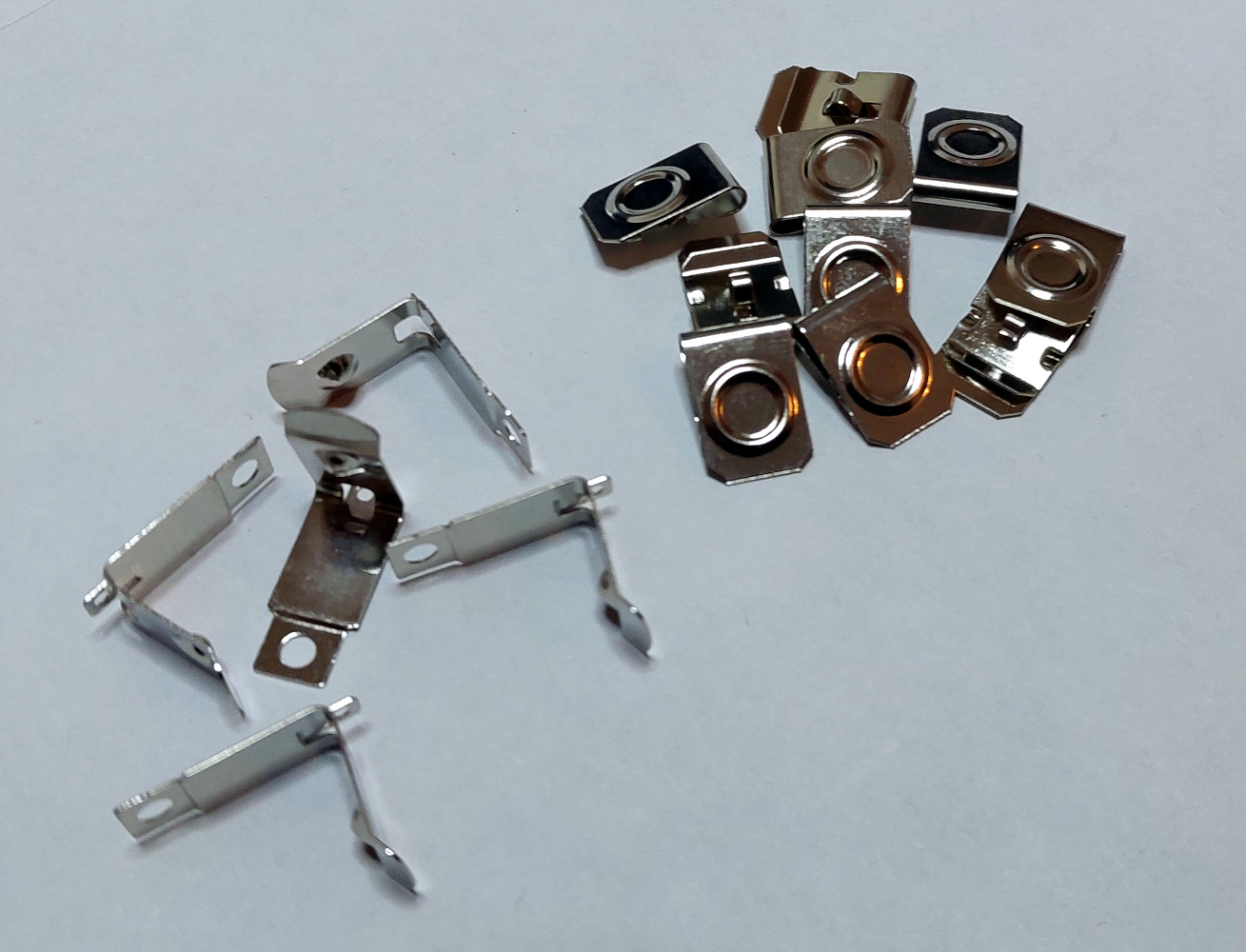
Fresh and new battery clips for AA holders
How much damage has been done is usually a function of how long the leaking batteries have been in the device. Sometimes one is lucky and the battery contacts are salvageable, otherwise they are too far gone and a replacement has to be found. A past me tried all sorts of home-made solutions using stiff copper wire and other materials, but today thanks to the miracle of international commerce it’s usually possible to find a contact the same as or very similar to the old one. A quick AliExpress search on terms such as “AA battery spring” will return numerous options, and it’s simply a case then of paging through to find the one you need on the terms you like.
So those of you who like retro tech will find something familiar in the last few paragraphs, but there’s a lesson to be found in dealing with ancient batteries. Here in 2022 we’re more likely to have lithium polymer cells in our consumer devices and so the need to keep a pile of Duracells at hand is reduced. But the thought of today’s equivalent of a Super 8 camera lying forgotten in a drawer for decades with a cheap li-po pouch cell inside it is far more frightening than something with some crusty manganese cells. Have we just found the root cause of house fires in the 2040s?
Since modern cars use the CAN bus for so many of their functions, it’s unsurprising that it’s a frequent object of interest for those in our community. Some people go no further than commercial plug-in analysers, while others build their own CAN devices. This is what [Magnus Thomé] has done, with his RejsaCAN microcontroller board.
It’s a small PCB with an onboard CAN interface from an ESP32-S3 and a car-friendly power supply circuit, and perhaps most importantly, it has an auto-shutdown feature to prevent battery drain. Software-wise it’s a blank piece of paper for the user to roll their own application, but since the ESP32 is supported by the Arduino ecosystem, there are libraries that make talking CAN as easy as it can be.
[Magnus] has a list of potential applications for the board, many of which take advantage of the ESP’s wireless capabilities. So far, [Magnus] has hooked it up to an LCD display, but we can see so many other useful things coming out powered by something like this.
For those who live in countries where there are plenty of abandoned railways, a popular way to explore them has been by means of home made rail carts. These are usually rudimentary rail trolleys with a small internal combustion engine, and a host of fascinating videos of them can be found online. Such a trolley has one disadvantage though — it’s not the most compact of devices. [Cato] has come up with a rail cart that’s extremely portable by replacing the engine with the guts of a pair of hoverboards.
The chassis of the machine is made from aluminium extrusion, and its deck from plywood. The wheels are the stock hoverboard wheels with flat flanges applied, which while they don’t have the ideal flange profile of a rail wheel are good enough to keep the thing on track. Finally to control the thing a rather stylish little 3D printed single-axis joystick serves as a combined throttle and brake.
Those of us who hail from places where abandoned railways have their track speedily ripped up can only gaze in envy and imagine speeding along the rails on one of these. The build starts with a warning never to use one of these on an active track, but should you wish to drive a real train there are plenty of places to do that.
The caterers for the volunteer workforce behind the summer’s MCH hacker camp in the Netherlands served all-vegan food. This wasn’t the bean sprouts and lentils that maybe some of the more meat-eating readers might imagine when confronted with vegan food, nor was it a half-as-good array of substitutes with leathery soy hamburgers and rubbery fake cheese smelling suspiciously of feet.
Instead it was a well-crafted, interesting, and tasty menu that was something to look forward to after several hours driving a vanload of handwashing sinks. It was in one of their meals that I found food for thought when driving a week later past the huge Garzweiler open-cast lignite mine on my way through Germany to Luxembourg’s Haxogreen as part of my European hacker camp summer tour.
The meal was deep-fried soy protein strips and the mine is probably one of Western Europe’s dirtiest and most problematic CO2 sources in a country that likes to imagine itself as environmentally friendly, so where in this unlikely connection did I find a pairing? Continue reading “Engineers: Be Subversive To Be Green”→
The designers of older equipment that contained a CRT monitor rarely made the effort to design their own driver and deflection circuitry. Instead they were more likely to buy an off the shelf assembly from a monitor manufacturer, and simply supply it with their video. [TomV] has an old HP 16500A logic analyzer, and in it he found a Sony monitor chassis. With a quest for a microfiche service manual and a bit of reverse engineering, he was able to hook it up to a VGA port and use it as an extension monitor for his laptop.
The monitor chassis is a Sony CHM-9001-00, which sports their 10″ Trinitron tube. These were among the very best CRT tubes of the day, making it the type of module 1990s hacker would have been very pleased to get their hands on. Here in 2022 a look at the monitor’s 40-pin connector reveals a standard RGB interface which the service manual confirms is within the voltage range to be driven from a VGA output. A Thinkpad X220 is pressed into service, with a 576 by 360 pixel at 60 Hz video mode defined, and there we have it, a modern desktop on an obsolete piece of test equipment.
The intended destination for this monitor is a small arcade cabinet, so it needed to be independent of the HP chassis. The required 120 VDC supply comes from an inverter designed for solar battery charging, which balked at the inrush current from the monitor when fed with 12 V. Increasing the supply voltage on the low voltage side solved that, leading to a very serviceable monitor. We have no use for one, but we’d be lying if we said we didn’t want one.