Badges Of 2022: BornHack

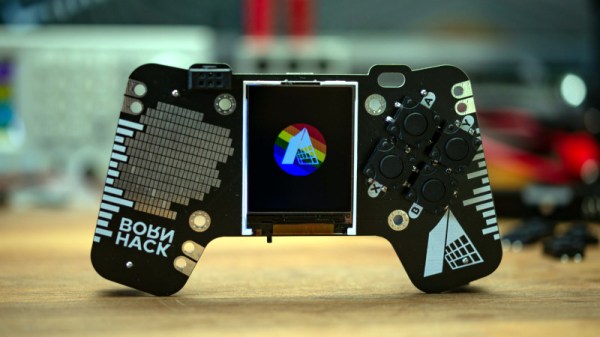
While the rest of the world’s hacker camps shut their doors through the pandemic there was one which managed through a combination of careful planning and strict observation of social distancing to keep going. The Danish hacker community gather every August for BornHack, a small and laid-back event in a forest on the isle of Fyn that has us coming back for more every year. They always have an interesting badge thanks to the designs of [Thomas Flummer], and this year looks to be no exception as they’ve dropped some details of the upcoming badge.

In short, it’s a beautifully designed hand-held games console with a colour screen, powered by the ubiquitous-in-the-chip-shortage RP2040 microcontroller. On board are the usual interfaces and a prototyping area plus CircuitPython for easy coding, and we expect it to sprout some addictive and playable gaming action. It’s the sort of PCB that we could imagine coming as a product from the likes of Pimoroni, but for now the only way to get your hands on one is to go to the event. We’ll being you a review when we have one. Meanwhile you can take a look at a previous year’s badge.
A Mostly Fair Deal For All With A Raspberry Pi

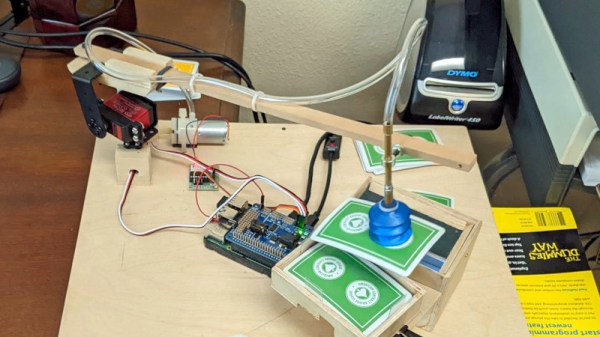
To be a professional card dealer takes considerable skill, something that not everybody might even have the dexterity to acquire. Fortunately even for the most ham-fisted of dealers there’s a solution, in the form of the Dave-O-matic, [David Stern]’s automated card dealer using a Raspberry Pi 4 with a camera and pattern recognition.

It takes the form of a servo-controlled arm with a sucker on the end, which is able to pick up the cards and present them to the camera. They can then be recognized by value, and pre-determined hands can be dealt or alternatively a random hand. It seems that the predetermined hands aren’t an aid in poker cheating, but a part of the bridge player’s art. You can see it in action in the video below the break.

We like the project, but sadly at this point we must take [Dave] to task, because while tantalizing us with enough detail to get us interested he’s slammed the door in our faces by failing to show us the code. it would be nice to think that the clamor from disaffected Hackaday readers might spur him into throwing us a crumb or two.

It probably won’t surprise you to find that this isn’t the first Raspberry Pi to find itself dealing cards.

Continue reading “A Mostly Fair Deal For All With A Raspberry Pi”

TensorFlow Lite – On A Commodore 64

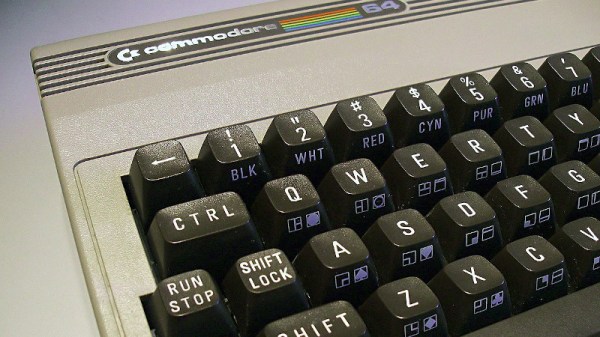
TensorFlow is a machine learning and AI library that has enabled so much and brought AI within the reach of most developers. But it’s fair to say that it’s not for the less powerful computers. For them there’s TensorFlow Lite, in which a model is created on a larger machine and exported to a microcontroller or similarly resource-constrained one. [Nick Bild] has probably taken this to its extreme though, by achieving this feat on a Commodore 64. Not just that, but he’s also done it using Commodore BASIC.

TensorFlow Lite works by the model being created as a C array which is then parsed and run by an interpreter on the microcontroller. This is a little beyond the capabilities of the mighty 64, so he has instead created a Python script that does the job of the interpreter and produces Commodore BASIC code that can run on the 64. The trusty Commodore was one of the more powerful home computers of its day, but we’re fairly certain that its designers never in their wildest dreams expected it to be capable of this!

If you’re interested to know more about TensorFlow Lite, we’ve covered it in the past.

Header: MOS6502, CC BY-SA 3.0.

Windows 98 For Spaceships? Not Quite!

One of the news items that generated the most chatter among Hackaday editors this week was that ESA’s Mars Express mission is receiving a software update. And they’re updating the operating system to…Windows 98.

Microsoft’s late-90s consumer desktop operating system wouldn’t have been the first to come to mind as appropriate for a spacecraft, but ESA were quick to remind us that it was the development toolchain, not the craft itself, that depended upon it. It’s still quite a surprise to find Windows 98 being dusted off for such an unexpected purpose, and it’s led us to consider those now-almost-forgotten operating systems once more, and to question where else it might still be found. Continue reading “Windows 98 For Spaceships? Not Quite!”

Classic Amp Revived With A Pi

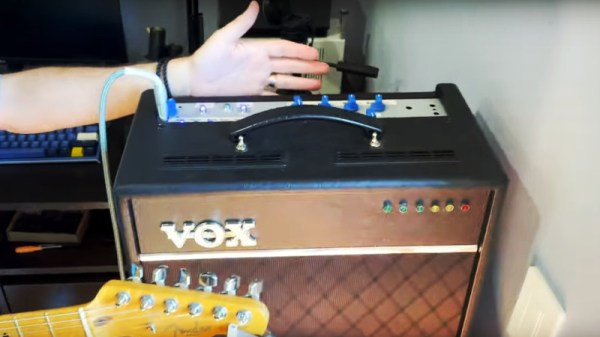
Guitar amplifiers have a hard life, and as anyone who’s run a venue can tell you, they often have significant electrical issues after a life on the road. [Dsagman] had a Vox amplifier with fried internals, and rather than repair the original he rebuilt it with a Raspberry Pi inside to provide a fully-loaded array of effects.

Though the subject is the Vox, it’s best to see this as more a tale of how to create a guitar effect array in a Pi than specifically put it in an amplifier. The Pi has an audio board and an MCP3008 ADC added to it, and using those two it takes its inputs from a series of potentiometers and process the audio passing through the audio board. In addition there are a series of LED indicators and an LED bar graph to keep the user in touch with what’s going on.

The whole lot is nicely integrated in the VOX case with all the potentiometers on an aluminium panel. He discusses amplifier choice, but as you might expect the final choice is a Class D module. All in all an amp many readers would probably go for.

As long-time readers will remember, guitar effects have made quite a few appearances around here. Continue reading “Classic Amp Revived With A Pi”

New Gear Saves Old Printer

As the digital photographic revolution took off, and everyone bought a shiny new film-less camera, there was a brief fad for photo printers. The idea was you’d have the same prints you’d always had from film, but the media for these printers would invariably cost a fortune so consumers moved on pretty quickly.

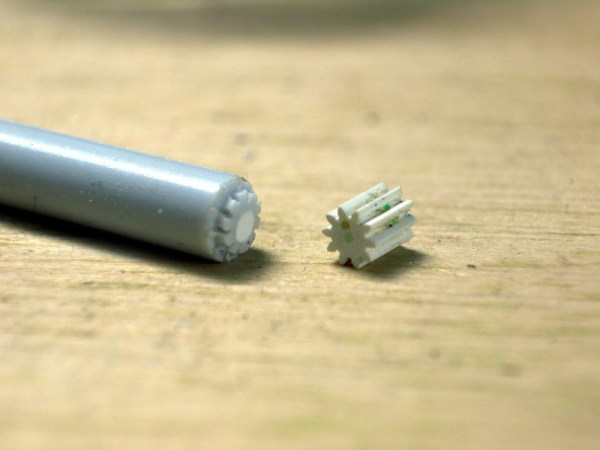
Now the pop up in second-hand stores and the like, which is how [Amen] acquired a Canon Selphy 740. It didn’t work, and on investigation it was found that a particularly tiny plastic gear had failed. Most people would have tossed the printer in the trash, but they instead opted to CNC-machine a new gear. It’s not everyday you tackle a job this small, so it makes for an interesting tale.

While the first instinct might be to reach reach for a CAD package, [Amen] instead wrote a script to create the raw GCode. The machining is done with a 0.2 mm bit ground to the desired profile. The result: a gear that gets the printer working again. It’s a dye-sublimation printer that leaves a negative image in the cartridge, allowing negative prints to be made with a bit of cartridge rewinding. And for those who might have ended up with a Selphy of their own, there’s a further post about using cheaper aftermarket cartridges.

Continue reading “New Gear Saves Old Printer”

The Warm Glow Of A Luminous Clock

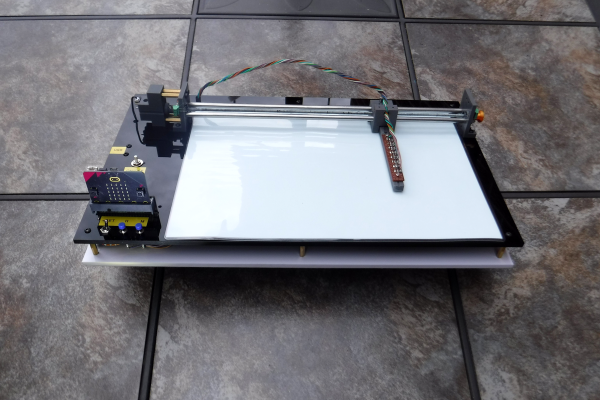
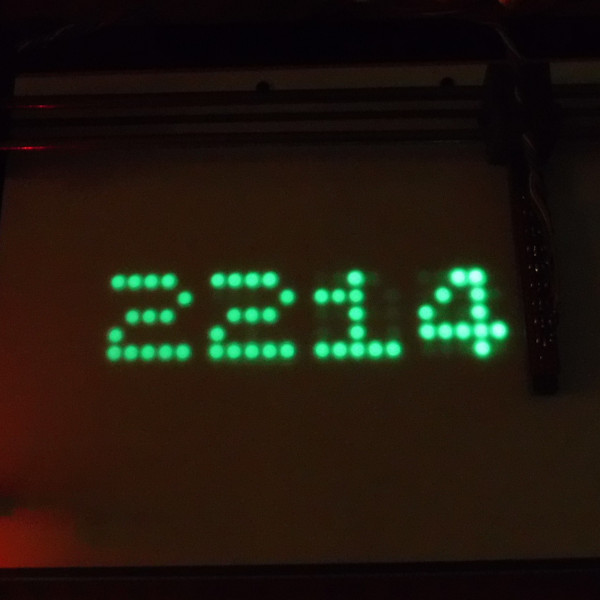
It seems there will never be an end to the number of ways to show the time. The latest is the LumiClock from [UK4dshouse], and it uses the seldom-seen approach of a sheet of luminous paper excited by a strip of UV LEDs that pass over it guided by a lead screw.

At its heart is a micro:bit, which generates the time in dot-matrix digital form as the LEDs are moved across the sheet. It in turn has a real-time-clock module to keep it on time, and it drives a little DC motor via a robotics driver board. The appearance of the whole devices is similar to an X-Y plotter without the Y axis, as a 3D-printed carrier is moved by the lead screw and slides along a pair of stainless steel tubes. The result is an unusual and eye-catching timepiece, whose retro dot-matrix numerals fade away and are refreshed with the new time.

We’ve had a bit of a play ourselves with UV luminous materials, and we can confirm they make an interesting alternative to some other display ideas in dimmer environments. This isn’t the first such clock we’ve shown you.