The Honda Takedown: How A Global Brand Failed To Read The Room

Perhaps the story of the moment in the world of 3D printing concerns a Japanese manufacturer of cars and motorcycles. Honda has sent a takedown notice requesting the removal of models starting with the word “Honda” to the popular 3D printing model repository site Printables. It’s left in its wake puzzlement, disappointment, and some anger, but what’s really going on? Perhaps it’s time to examine what has happened and to ponder what it means for those who put online printable parts and accessories for cars or any other item manufactured by a large corporation.

If You Make Something, What Rights Do You Have?

Soichiro Honda with his 1964 Formula 1 car
Soichiro Honda, famous for being an engineer rather than a serial litigator. Roderick Eime, CC BY 2.0.

The story is that as far as we can glean from reports online, the takedown notice was sent only to Printables by the European arm of Honda, and was pretty wide-ranging with any Honda-related model in its scope. Printables complied with it, but as this is being written there are plenty of such models available from Thingiverse and other model repository sites.

Anyone who makes a career in content creation has by necessity to have a working knowledge of copyright and intellectual property law as it’s easy for the unwary to end up the subject of a nasty letter, so here at Hackaday while we’re not lawyers this is a subject on which we have some professional experience. What follows then is our take based on that experience, our view on Honda’s motivation, and whether those of you who put up 3D models have anything to worry about. Continue reading “The Honda Takedown: How A Global Brand Failed To Read The Room”
Gaskets, Can They Be 3D Printed?

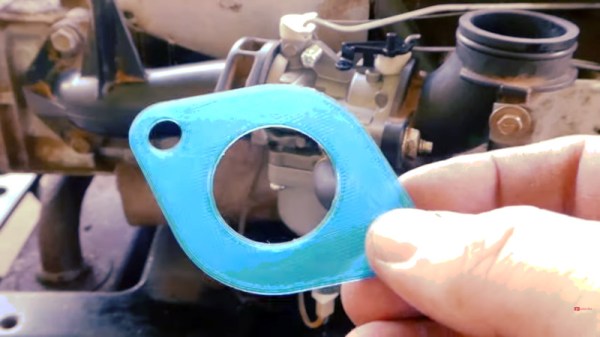
Anyone who’s owned an older engine, whether it be in a car, motorcycle, or garden machine, will at some time have been faced with the need for a gasket. Even when the gasket is readily available there may be an imperative to fix the engine rather than wait for the part to arrive, so it’s common to make your own replacements. Simple ones are easy to cut from thin card, but if you’ve ever tried to do this with a really complex one you’ll know the pain of getting it right. This is the problem tackled in a video from [the_eddies], who has explored the manufacture of replacement gaskets by 3D printing.

The advantages of CAD and easy manufacture are obvious, but perhaps many common plastics might not perform well in hot or oily environments. For that reason he settles on TPU filament, and gives it a test in a bath of 2-stroke fuel mix to see how well it resists degradation. It passes, as it does also when used with a carburetor, though we’d be curious to see the results of a long-term test. We’ve placed the video below the break, so reach your own conclusions.

Gaskets have featured here before, and if you’re interested then there are other machines which can be used to make them.

Continue reading “Gaskets, Can They Be 3D Printed?”

A Line Follower With No Brains

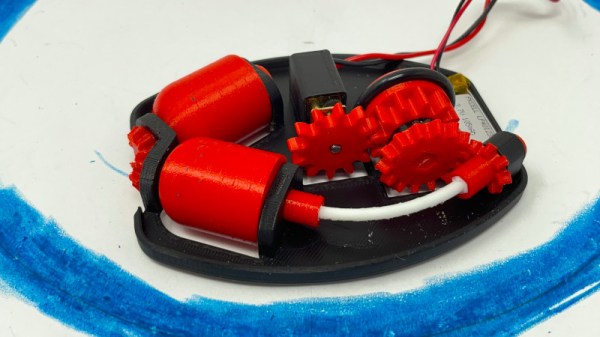
A line follower is a common project for anyone wishing to make a start in robotics, a small wheeled device usually with some kind of optical sensor which allows it to follow a line drawn on the surface over which it runs. In most cases they incorporate a small microcontroller or perhaps an analogue computer which supplies power and steering control, but as the Crayon Car from [Greg Zumwalt] demonstrates, it’s possible to make a line follower without any brains at all.

This seemingly impossible feat is achieved thanks to the line and road surface, it runs on a piece of paper over which the line is drawn with a crayon. The robot has a single straight-line drive wheel at one end and a pair of driven rollers at 90 degrees to each other at the other end, with the magic happening due to the difference in friction between paper and crayon. The robot follows a circular track with no problem, and while we can see it’s not without flaws we doubt it would be possible to make a simpler follower.

Sharp-eyed readers will have noticed that this is not the first line follower we’ve shown you which claims to have no brains, but we’d claim that since the previous machine had an analogue circuit, this one is a more worthy contender to the crown.

Continue reading “A Line Follower With No Brains”

Bare Metal Gives This Pi Some Classic Synths

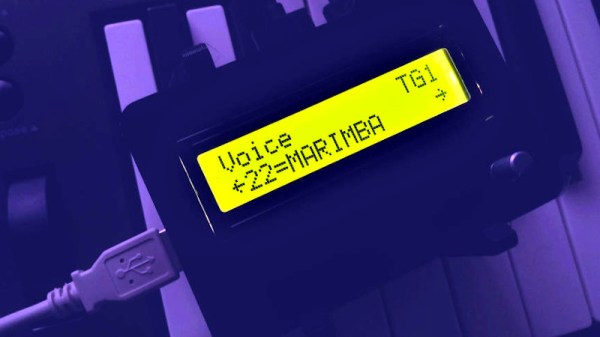
We’re used to seeing the Raspberry Pi crop up in a wide range of the projects we show you here, but it’s fair to say that they usually feature some sort of operating system. There’s another way to use a Pi, more akin to using a microcontroller such as the Arduino: by programming it directly, so-called bare-metal programming. MiniDexed is an example, and it copies a classic Yamaha professional synthesiser of the 1980s, by emulating the equivalent of eight of the company’s famous DX7 synthesisers in one unit. It takes almost any Pi, and with the addition of an audio board, a rotary encoder, and an LCD display, makes a ready-to-go unit. Below the break is a video of it in operation.

It’s fair to say that we’re not experts in Raspberry Pi bare metal programming, but it’s worth a diversion into the world of 1980s synthesisers to explore the DX7. This instrument was a staple of popular music throughout the 1980s and was a major commercial success for Yamaha as an affordable FM synthesiser. This was a process patented at Stanford University in the 1970s and subsequently licensed by the company, unlike other synths of the day it generated sound entirely digitally. It’s difficult to overestimate the influence of the DX7 as its sound can be heard everywhere, and it’s not impossible that you own a Yamaha FM synth even today if you have in your possession a sound card.

Curious about the DX7? Master chip-reverse-engineer [Ken Shirriff] exposed its secrets late last year.

Continue reading “Bare Metal Gives This Pi Some Classic Synths”

The 555 Gives The CarolinaCon Badge Life

For the electronic badge enthusiast, these last two years have seen something of a famine. While the pandemic may not be over yet, we’re learning to live with it in 2022, and there’s the prospect of a flush of new badges even if not all events are in-person yet. First to reach us is the Carolinacon Online 2 badge, a fairly simple affair which naturally has us pleased as punch because it incorporates the only chip that’s guaranteed to get you through the semiconductor shortage, an NE555 timer. It’s got everything, a flashing LED, and, well, that’s it because with the best will in the world a 555 is no powerhouse on its own. As a memento and a way to support the event it fits the bill, but it’s fair to say that this is no electronic tour de force.

Carolinacon Online 2 launches on Friday 29th of April, and features a schedule of talks and a set of merch including the badge. If you’re thinking of previous Carolinacon badges, this event has always taken the simple-but-effective route. The version they produced in 2021 for example had a hidden message behind the silkscreen, revealed through clever placement of LEDs controlled by an ATtiny microcontroller.

Can You Help Solve The Mystery Of This 1930s TV?

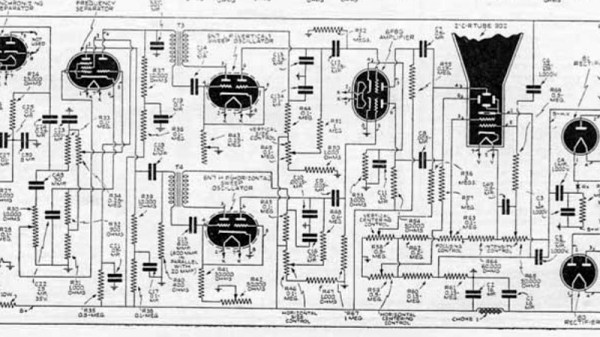
84 years ago, a teenager built a TV set in a basement in Hammond, Indiana. The teen was a radio amateur, [John Anderson W9YEI], and since it was the late 1930s the set was a unique build — one of very few in existence built to catch one of the first experimental TV transmitters on air at the time, W9XZV in Chicago. We know about it because of its mention in a 1973 talk radio show, and because that gave a tantalizing description it’s caught the interest of [Bill Meara, N2CQR]. He’s tracking down whatever details he can find through a series of blog posts, and though he’s found a lot of fascinating stuff about early TV sets he’s making a plea for more. Any TV set in the late ’30s was worthy of note, so is there anyone else out there who has a story about this one?

The set itself was described as an aluminium chassis with a tiny 1″ CRT, something which for a 1930s experimenter would have been an expensive and exotic part. He’s found details of a contemporary set published in a magazine, and looking at its circuit diagram we were immediately struck by how relatively simple the circuit of an electrostatically-deflected TV is. Its tuned radio frequency (TRF) radio front end is definitely archaic, but something that probably made some sense in 1939 when there was only a single channel to be received. We hope that [Bill] manages to turn up more information.

We’ve covered some early TV work here not so long ago, but if you fancy a go yourself it’s not yet too late to join the party.

Home Made Stirling Engines From Expedient Materials

Many of us have read about Stirling engines, engines which form mechanical heat pumps and derive motion from the expansion and contraction of a body of air. A very few readers may have built one, but for many they remain one of those projects we’d rather like to try but never quite have the inclination. The YouTube channel of [Geral Na PrĂ¡tica] should provide plenty of vicarious enjoyment then, with the construction of a range of Stirling engines from commonly available materials. We have Coke cans, PVC pipe, and nebuliser cartridges forming pistons and cylinders, with wire wool serving as a regenerative heat store. The latest video is below the break, an amazing 10-cylinder rotary device.

The Stirling engine is perhaps the quintessential example of a device whose time never came, never able to compete in power and efficiency with first steam engines and then internal combustion engines, it has over the years been subject to a variety of attempted revivals. Today it has appeared variously in solar power projects and in NASA’s hypothetical off-world power plants, and will no doubt continue to be promoted as an alternative energy conversion mechanism. We’ve featured many working model Stirling engines in our time and even done a longer investigation of them, but sadly we’ve yet to see a story involving a practical version.

Continue reading “Home Made Stirling Engines From Expedient Materials”