Ask Hackaday: Is It Time For Waste Heat And Cold Area Heating To Shine?

It’s difficult to escape the topic of energy supply at the moment, with the geopolitical situation surrounding the invasion of Ukraine leaving the natural gas supply to an entire continent in jeopardy. Fortunately we’re watching the green shoots of an early spring here in the Northern hemisphere so the worst of the winter weather is behind us, but industrial customers can take no such solace from the season and will have to weather whatever price hikes are to come. Every alternative idea for energy supply is on the table, and with the parallel imperative of decarbonising the economy this goes beyond the short term into a future without so much need to rely on gas.

The Future is Cloudy

A district heating plant in Vienna, Austria.
A district heating plant in Vienna, Austria. Joadl, CC BY-SA 3.0 AT

A collaboration between a Finnish district heating network and Microsoft caught our eye because the location of a new data centre for the tech giant was chosen specifically to supply waste heat to the network, rather than releasing it to the environment. It’s not uncommon at all for European cities to use district heating networks but they are normally supplied by waste incinerators, boilers, or combined heat and power stations. The use of data centre waste heat is a novelty, as is in particular the siting of the data centre being dictated by the network.
Continue reading “Ask Hackaday: Is It Time For Waste Heat And Cold Area Heating To Shine?”

This Chariot Is Pulled By A Team Of Motorcycles

We’re fans of unusual forms of transport here, so when we saw an article featuring a home-made motorcycle chariot we knew we had to share it with you. You’ll probably notice it comes from the keyboard of our colleague [Lewin Day] as he moonlights writing for The Drive, and he’s brought along a lot of context and history to the dual-Husqvarna chariot built by [Jack Field].

The machine itself is a chariot in the ancient Roman fashion, a two-wheeled platform on which the rider stands and holds the reins. Instead of a team of horses though there is the aforementioned pair of Husqvarna motorcycles, and a pair of rods to their handlebars with throttle and brake controls take the place of reins. It’s fair to say that this might not be the least hazardous of conveyances, but it appears both rideable and controllable, and will appear at motorcycle shows. truth be told we’d like to have a go ourselves, but since it’s in Australia we think there’s little chance. Unexpectedly the motorcycle chariot is not a new idea, with their being used for full-scale races back in the 1930s. There’s a trip into that world with some exciting but lethal-looking racing action to view, but it seems that these machines exist here in 2022 mostly for show.

This isn’t the first machine operated by reins we’ve brought you, how about a rein-operated tractor?

This End Table Conceals A Close Encounter

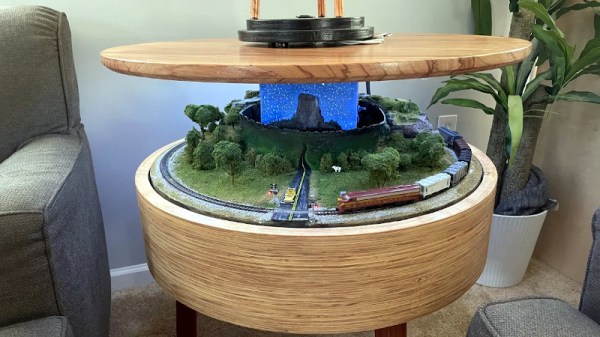
If you’re of a Certain Age, perhaps you had a train set as a child. An oval of track, a loco, and some rolling stock; it matters not whether it was Thomas the Tank Engine or a large express train — they were at the time a pretty cool toy. Move forward a few decades, and model railways have become either super-expensive room-filler layouts, or have sunk low as novelty Christmas ornaments, so that the basic loop of track is in dire need of rescue. Perhaps [Peter Waldraff] can help, with a beautifully-constructed N gauge circular layout concealed in an end table. Even better, when you examine it closely, it becomes apparent that this is no ordinary train set, it’s a scene from Close Encounters Of The Third Kind.

This is a project of two equally well-made parts, the piece of furniture and the train. The former is entirely scratch-built, with a cylindrical outside made from carefully cut rings of plywood and a sliding riser mechanism in the centre with a concrete counterweight. Slide the cylinder upwards, and the layout is revealed — a scratch-built hill in the centre of the ring of track and the lit-up underside of the UFO above it. As the train goes round the track, it even triggers a set of crossing lights and sounds for extra realism. The full story can be seen in the video below the break, and is well worth a watch.

We’ve covered more than one concealed model railway layout in the past, and it comes as no surprise when browsing to find that [Peter]’s work has featured here before.

Continue reading “This End Table Conceals A Close Encounter”

It’s Almost A New Raspberry Pi Compute Module 4. But Not Quite

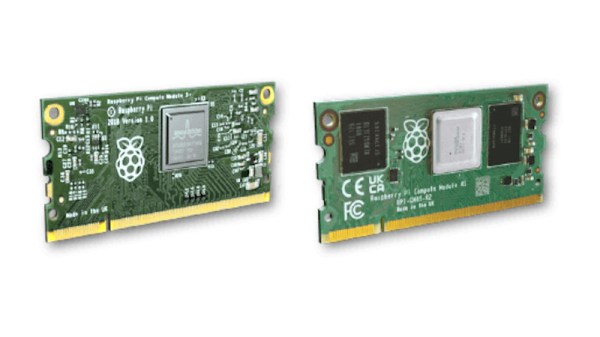
We know that readers are familiar with the global chip shortage and its effects on product availability. The Raspberry Pi folks haven’t escaped its shadow, for even though they’ve managed to preserve availability of their RP2040 microcontroller, it’s fair to say that some of their flagship Linux-capable boards have been hard to find. All of this has had an unlikely effect in the form of a new Raspberry Pi, but unexpectedly it’s one which few end users are likely to get their hands on.

The Raspberry Pi Compute Module has been part of the range since the early days, and in its earlier versions took a SODIMM form factor. The last SODIMM Compute Module had a Pi 3 processor, and this unexpected new model is reported as having a very similar hardware specification but featuring the Pi 4 processor. It seems that the chip shortage has affected supplies of the earlier SoC, and to keep their many industrial customers for the SODIMM Compute Modules in business they’ve had to produce this upgrade. As yet it’s not surfaced for sale on its own and there’s a possibility it will stay only in the realm of industrial boards, but as the story develops there’s a Raspberry Pi forum topic about it for the latest and you can find the pertinent info in the video below the break.

Of course, the Compute Module of the moment remains the CM4 in its newer form factor, which we see as possibly the most exciting of all the Pi products of the moment. Meanwhile this is not the first custom industrial Raspberry Pi to be seen in the wild.

Continue reading “It’s Almost A New Raspberry Pi Compute Module 4. But Not Quite”

Just What On Earth Is A Therm?

With the news here in Europe full of the effect of the war in Ukraine on gas supplies and consequently, prices, there it was on the radio news: a unit of measurement so uniquely British that nobody uses it in the real world and nobody even has a clue what it really means. We’re speaking of the Therm, one of those words from our grandparents’ era of coal gas powered Belling cookers and Geyser water heaters hanging over the bath, which has somehow hung on in the popular imagination as a mysterious unit of domestic gas referred to only in the mass market news media. What on earth is a therm, and why are we still hearing it on the news in the UK?

You can’t Buy A Therm

Asking the internet what a therm is reveals the answer, it’s 100,000 BTU. What’s a BTU? A British Thermal Unit, another anachronistic measurement five decades after the UK went metric, it’s the amount of energy required to raise a pound of water by a degree Fahrenheit. Which in turn is about 1,054 joules, in today’s measurements. So a therm is thus a unit of energy, can we take a look at our gas meters and see how many of them we’ve used this winter? Not so fast, because gas isn’t sold by the therm. Older gas meters had cubic feet on them, and we’re guessing that now they’re calibrated in cubic meters. We can’t even buy a therm of gas, so why on earth are the British media still using it? Continue reading “Just What On Earth Is A Therm?”

Magnetic Hockey Game Uses A 555

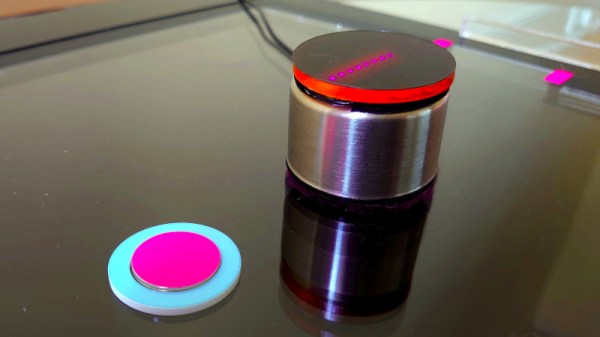
We love a good project here at Hackaday, particularly one that makes us want to pick it up and have a go at whatever it does for ourselves. And when we see such a project and find that it contains the One Chip To Rule Them All (otherwise known as the NE555 timer), our collective cup runneth over with joy. So [Andrew Fentem]’s magnetic hockey project certainly pushes all our buttons, as it’s a game superficially similar to an air hockey table in which a magnetic puck is accelerated by a handheld electronic bat.

The bats look extremely high-tech but are in fact surprisingly simple. Each one contains a Hall effect sensor which triggers the 555 which we’d expect is wired as a monostable, this in turn fires a MOSFET which energises an electromagnet for a set period of time. The puck is a magnet, and thus when it is detected by the Hall sensor it is shot away at high speed by the electromagnet. the result is a fast-paced game which has an extra edge over conventional air hockey, and which being honest, we’d love to have a go at. You can see it in the video below the break.

Of course, if your budget doesn’t stretch to not one but two chips in this era of semiconductor shortages, you can always try a conventional table.

Continue reading “Magnetic Hockey Game Uses A 555”

Build A TPM Module For Your Server

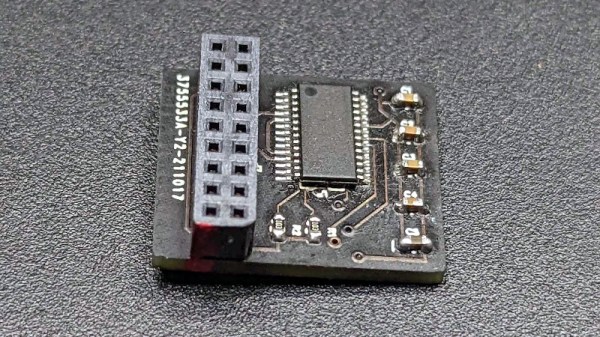
One of the big stories surrounding the announcement of Windows 11 was that it would require support for TPM 2.0, or Trusted Platform Module, to run. This takes the form of an on-board cryptographic processor, which Microsoft claims will help against malware, but which perhaps more importantly for Redmond, can be used to enforce DRM.  Part of the standard involves a hardware module, and [Zane] has built a couple of them for ASrock server motherboards.

The chip in question is the Infineon SLB9965, which with a bit of research was found to map more or less directly to the pins of the TPM socket on the motherboard. The interesting thing here lies in the background research it gives into TPMs, and furthermore the links to other resources dealing with the topic. The chances are that most readers needing a TPM will simply buy one, but all knowledge is useful when it comes to these things.

Our weekly security roundup has been keeping an eye on the use of TPMs for a while, and has even shown us some ways that people have used to bypass the modules.