Squeezing A Wordle Clone Onto The Game Boy

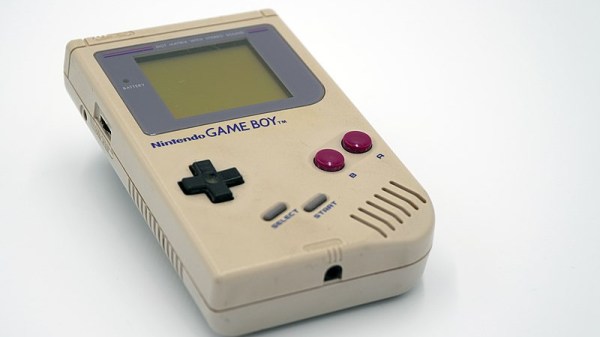
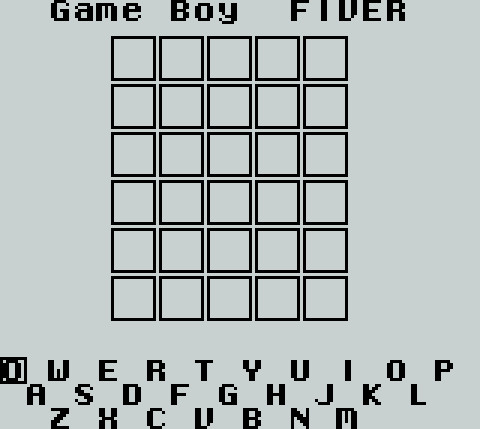
The popular word game Wordle is both an addictive brain teaser for some and a perpetual social media annoyance for others. Its runaway success has spawned a host of clones, among them one created for the Nintendo Game Boy with a reduced vocabulary. [Alexander Pruss] took on the challenge of improving it by fitting the entire 12972-strong 5-letter-word vocabulary as well as the 2315-word answer list into a 32K cartridge along with the code. The challenge in compression on a platform of such meager resources is to devise an algorithm which does not require more computing power or memory than the device has at its disposal. His solution is both elegant and easy to understand.
Starting by dividing the words into lists by first letter such that he can ignore the letter, he can reduce each word to 20 bits as four 5-bit letters. The clever part comes when he organises the words alphabetically, meaning that the 20-bit numbers representing each word are in numerical order.

Thus instead of storing the full number he could store the difference between it and its predecessor. With a few extra tweaks he was able to get the full list down to an impressive 20186 bytes, but was still faced with not enough space. Turning to the Wordle code he found that a library function call could be switched to an alternative with a much more efficient footprint, resulting in a new ROM with all words in place and ready to play.

Of course our community have applied their minds to Wordle and we’ve featured more than one hack based upon it. Mostly they have involved automated solving, so this retro gaming version breaks new ground.

Header image: Sammlung der Medien und Wissenschaft, CC BY 4.0.
It’s Official! The Raspberry Pi Is Now 10!

In any given field there are epoch-defining moments, those events after which nothing was quite the same as it had been before. It’s been a decade since the launch of the first Raspberry Pi single board computer. This was by no means the first inexpensive computer board, nor was it the first to support the GNU/Linux operating system, but it was among the first to promise a combination of those two. Coupled with support from a crop of British 8-bit alumni meant that from when it first gained publicity in early 2011 it garnered a huge buildup of interest.

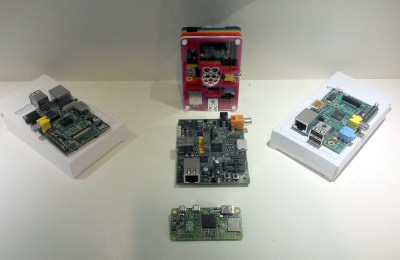
We were first teased with a USB stick style prototype, which morphed into a much larger Raspberry Pi alpha board and finally into pre-production boards much closer to the model launched at the end of February ten years ago.

How To Disappoint Every Single British Geek At 6 AM

An array of Pi prototype boards pictured on display at the Cambridge University Computer Laboratory.

Pedants will claim that the 10th birthday of the Pi is technically not yet upon us because those first Model B boards went on sale on the 29th of February 2012, a leap day. The two distributors, RS and Farnell, were both putting them on sale with the expectation of selling around 10,000 units — a prediction that proved woefully inadequate, with both websites collapsing under the weight of would-be Pi-purchasers within seconds of opening up at 6 AM.

I was ready to order at 6 AM, and was only able to order mine halfway through the day. That short wait would be just the beginning — because they received so many more orders than anticipated, the bulk of the orders weren’t fulfilled until May. Nobody had imagined how wildly successful the Pi boards would become. Continue reading “It’s Official! The Raspberry Pi Is Now 10!”

Neon, Ukraine, And The Global Semiconductor Industry

On our news feeds and TV channels at the moment are many stories concerning the war in Ukraine, and among them is one which may have an effect on the high-tech industries. It seems that a significant percentage of the world’s neon gas is produced in Ukrainian factories, and there is concern among pundits and electronics manufacturers that a disruption of this supply could be a further problem for an industry already reeling from the COVID-related chip shortage. It’s thus worth taking a quick look at the neon business from an engineering perspective to perhaps make sense of some of those concerns.

As most readers will know from their high school chemistry lessons, neon is one of the so-called inert gasses, sitting in the column at the extreme right of the Periodic table. It occurs in nature as a small percentage of the air we breathe and is extracted from the air by fractional distillation of the liquid phase. The important point from the above sentences is that the same neon is all around us in the air as there is in Ukraine, in other words, there is no strategic neon mine in the Ukrainian countryside about to be overrun by the Russian invaders.

So why do we source so much neon from Ukraine, if we’re constantly breathing the stuff in and out everywhere else in the world? Since the air separation industry is alive and well worldwide for the production of liquid nitrogen and oxygen as well as the slightly more numerous inert gasses, we’re guessing that the answer lies in economics. It’s a bit harder to extract neon from air than it is argon because there is less of it in the air. Since it can be brought for a reasonable cost from the Ukrainians who have made it their business to extract it, there is little benefit in American or Western European companies trying to compete. Our take is that if the supply of Ukrainian neon is interrupted there may be a short period of neon scarcity. After that, air extraction companies will quite speedily install whatever extra plant they need in order to service the demand. If that’s your area of expertise, we’d love to hear from you in the comments.

Here at Hackaday we are saddened beyond words at what has happened in Ukraine, and we hope our Ukrainian readers and those Ukrainian hackers whose work we’ve featured make it through safely. We sincerely hope that this madness can be ended and that we can mention the country in the context of cool hacks again rather than war.

If you are interested in the strategic value of inert gasses, have a read about the global helium supply.

Header image: Lestat (Jan Mehlich), CC BY-SA 3.0.

Surgically Implanted Bluetooth Devices Don’t Help Would-Be Exam Cheats

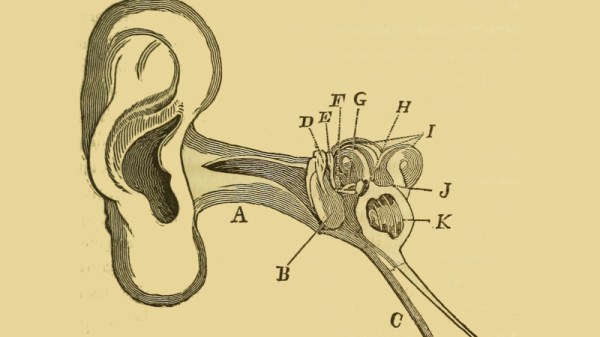
A pair of would-be exam cheats were caught red-handed at the Mahatma Gandhi Memorial Medical College in Indore, India, as they tried to use Bluetooth devices surgically implanted in their ears for a bit of unauthorised exam-time help.

It’s a news story that’s flashed around the world and like most readers we’re somewhat fascinated by the lengths to which they seem to have been prepared to go, but it’s left us with a few unanswered questions. The news reports all have no information about the devices used, and beyond the sensationalism of the story we’re left wondering what the practicalities might be.

Implanting anything is a risky and painful business, and while we’ve seen Bluetooth headphones and headsets of all shapes and sizes it’s hardly as though they’re readily available in a medically safe and sterile product. Either there’s a substantial rat to be smelled, or the device in question differs slightly from what the headlines would lead us to expect.

Continue reading “Surgically Implanted Bluetooth Devices Don’t Help Would-Be Exam Cheats”

A Ball Lens For Optical Fiber Coupling On The Cheap

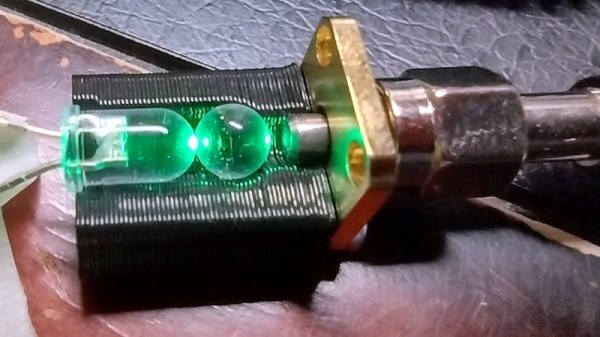
It’s fair to say that for most of us, using a fiber optic cable for digital audio or maybe networking will involve the use of an off-the-shelf termination. We snap the cable into the receptacle, and off we go. We know that inside there will be an LED and some lenses, but that’s it. [TedYapo] though has gone a little further into the realm of fibers, by building his own termination. Faced with the relatively high cost of the ball lenses used to focus light from an LED into the end of the fiber he started looking outside the box. He discovered that spherical glass anti-bumping balls used when boiling fluids in laboratories make an acceptable and much cheaper alternative.

A ball lens has an extremely short focal length, meaning that this same property which allowed Antonie van Leeuwenhoek to use them in his microscopes is ideal for LED focusing in a small space at the end of a fiber. Chromatic aberrations are of no consequence for light of a single wavelength. It seems that the glass balls are uniformly spherical enough to do the job. Fitted with the LED and fiber termination in a 3D-printed block, the relative position of the ball can be controlled for optimum light transfer. It’s a relatively simple hack mentioned in passing in a Twitter thread, but we like it because of its cheapness and also for an insight into the world of optical fiber termination.

Curious to know more about optical fibers? We covered just the video for you back in 2011.

Immersive Stereo Sound Recording With This Binaural Microphone

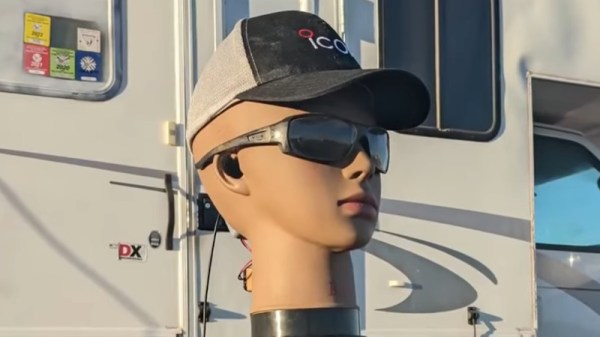
Sound recording has been a consumer technology for so long now that it is ubiquitous, reaching for a mobile device and firing up an app takes only an instant. Anyone who takes an interest in audio recording further will find that while it’s relatively straightforward to make simple recordings. But, as those among you who have fashioned a pair of Shure SM58s into an X configuration with gaffer tape will know, it can be challenging to create a stereo image when recording outside the studio. In the quest to perfect this, [Kevin Loughin] has created a binaural microphone, which simulates a human head with microphones placed as ears to produce ambient recordings with an almost-immersive stereo image.

Commercial binaural microphones can cost thousands of dollars, but this one opts for a more budget design using an off-the-shelf mannequin head sold for hairdressers. It’s filled with high-density foam, and in its ears [Kevin] placed 3D-printed ear canals with electret microphone capsules. On the back goes a battery and a box for the bias circuitry.

The results as you can hear in the video below the break are impressive, certainly so for the cost. It’s not the first such microphone we’ve shown you, compare it with one using a foam-only head.

Continue reading “Immersive Stereo Sound Recording With This Binaural Microphone”

It’s Bad Apple, But On A 32K EPROM

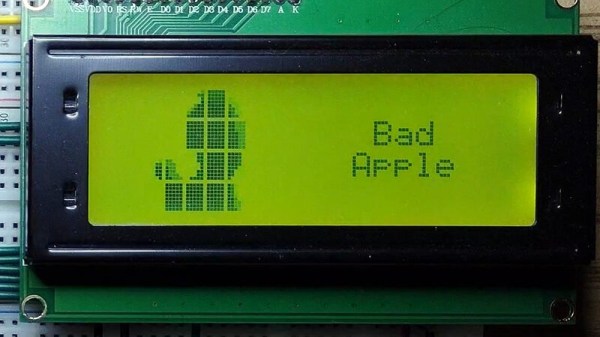
The Bad Apple!! video with its silhouette animation style has long been a staple graphics demo for low-end hardware, a more stylish alternative to the question “Will it run DOOM?”. It’s normal for it to be rendered onto a screen by a small microcomputer or similar but as [Ian Ward] demonstrates in an unusual project, it’s possible to display the video without any processor being involved. Instead he’s used a clever arrangement involving a 32K byte EPROM driving a HD44780-compatible parallel alphanumeric LCD display.

While 32K bytes would have seemed enormous back in the days of 8-bit computing, even when driving only a small section of an alphanumeric LCD it’s still something of a struggle to express the required graphics characters. This feat is achieved by the use of a second EPROM, which carries a look-up table.

It’s fair to say that the result which can be seen in the video below the break isn’t the most accomplished rendition of Bad Apple!! that we’ve seen, but given the rudimentary hardware upon which it’s playing we think that shouldn’t matter. Why didn’t we think of doing this in 1988!

Continue reading “It’s Bad Apple, But On A 32K EPROM”