Ask Hackaday: How Is The Chip Shortage Affecting You?

Some friends of mine are designing a new board around the STM32F103 microcontroller, the commodity ARM chip that you’ll find in numerous projects and on plenty of development boards. When the time came to order the parts for the prototype, they were surprised to find that the usual stockholders don’t have any of these chips in stock, and more surprisingly, even the Chinese pin-compatible clones couldn’t be found. The astute among you may by now have guessed that the culprit behind such a commodity part’s curious lack of availability lies in the global semiconductor shortage.

A perfect storm of political unintended consequences, climate-related crises throttling Taiwanese chip foundries and shutting down those in the USA, and faulty pandemic recovery planning, has left the chipmakers unable to keep up with the demand from industries on the rebound from their COVID-induced slump. Particularly mentioned in this context is the automotive industry, which has seen plants closing for lack of chips and even models ditching digital dashboards for their analogue predecessors.

Chips on order everywhere on the Mouser website.

The fall-out from all this drama in the world’s car factories has filtered down through all levels that depend upon semiconductors; as the carmakers bag every scrap of chip fab capacity that they can, so in turn have other chip customers scrambled to keep their own supply lines in place. A quick scan for microcontrollers through distributors like Mouser or Digi-Key finds pages and pages of lines on back-order or out of stock, with those lines still available being largely either for niche applications, unusual package options, or from extremely outdated product lines. The chances of scoring your chosen chip seem remote and most designers would probably baulk at trying to redesign around an ancient 8-bit part from the 1990s, so what’s to be done?

Such things typically involve commercially sensitive information so we understand not all readers will be able to respond, but we’d like to ask the question: how has the semiconductor shortage affected you? We’ve heard tales of unusual choices being made to ship a product with any microcontroller that works, of hugely overpowered chips replacing commodity devices, and even of specialist systems-on-chip being drafted in to fill the gap. In a few years maybe we’ll feature a teardown whose author wonders why a Bluetooth SoC is present without using the radio functions and with a 50R resistor replacing the antenna, and we’ll recognise it as a desperate measure from an engineer caught up in 2021’s chip shortage.

So tell us your tales from the coalface in the comments below. Are you that desperate engineer scouring the distributors’ stock lists for any microcontroller you can find, or has your chosen device remained in production? Whatever your experience we’d like to know what the real state of the semiconductor market is, so over to you!
New Part Day: ESP32-WROOM-DA

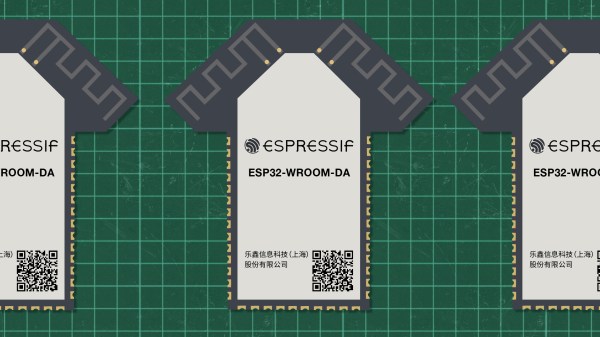
We’re always interested in the latest from the world’s semiconductor industry here at Hackaday, but you might be forgiven for noticing something a little familiar about today’s offering from Espressif. The ESP32-WROOM-DA has more than a passing resemblance to the ESP32-WROOM dual-core-microcontroller-with-WiFi  module that we’ve seen on so many projects over the last few years because it’s a WROOM, but this one comes with a nifty trick to deliver better WiFi connectivity.

The clever WiFi trick comes in the form of a pair of antennas at 90 degrees to each other. It’s a miniaturised version of the arrangement with which you might be familiar from home routers, allowing the device to select whichever antenna gives the best signal at any one time.

We can see that the larger antenna footprint will require some thought in PCB design, but otherwise the module has the same pinout as the existing WROVER. It’s not much of a stretch to imagine it nestled in the corner of a board at 45 degrees, and we’re sure that we’ll see it appearing in projects directly. Anything that enhances the connectivity of what has become the go-to wireless microcontroller on these pages can only be a good thing.

Retrotechtacular: Double For Nothing

If you are in the market for web hosting in 2021 and you sign up with one of the cloud computing providers, you’ll soon see how the different resources are priced. Storage and bandwidth are cheap, while CPU time is expensive. This reflects the state of a modern computer, in which a typical disk drive now holds a terabyte or more and rising by the year while a new processor is becoming a bottleneck whose performance hasn’t increased as much as the manufacturers would like over models from years ago.

Twice As Much Hardware From A Bit Of Software?

In the early 1990s though it was a different matter. A 486 or early Pentium processor was pretty powerful compared to the DOS or Windows 3.1 software it was expected to run, and it was the memory and disk space attached to it that limited performance… and cost an arm and a leg. There was a period in about 1995 when a supposed fire in a chip factory somewhere sent RAM prices into the hundreds of dollars per megabyte, briefly causing an epidemic of RAM raiding in which criminals would break into offices and take only the SIMs from the computers.

A solution to this problem came perhaps surprisingly from the software industry. Disk Doubler was a DOS driver that promised more disk space, achieving this seemingly impossible feat by compressing the disk to fit more data on it. Processor power swapped for disk space was a reasonable trade at the time so it became extremely popular, and eventually Microsoft incorporated their own disk compression into DOS. In some cases it could even speed up a computer with a slow disk drive, as I found out as a student with a 286 packing an MFM drive.

Something For Nothing, Perhaps It’s Too Good To Be True.

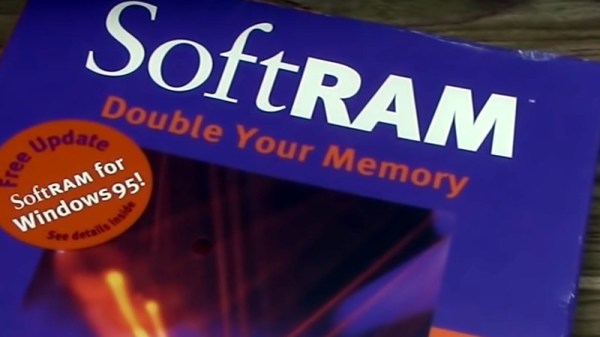
If compression could increase disk space then couldn’t it do the same for RAM? The industry came to the rescue once more with an array of RAM doubler products, first applying the disk doubling technique to on-disk virtual memory, and then doing the same with the contents of the memory itself. The first approach worked at the expense of a system slow-down, while the second, not so much. In fact it was little more than a scam, with software products promising much but delivering absolutely nothing behind the scenes.

Continue reading “Retrotechtacular: Double For Nothing”

Tape Cutter Makes Short Work Of Through-Hole Resistor Reels

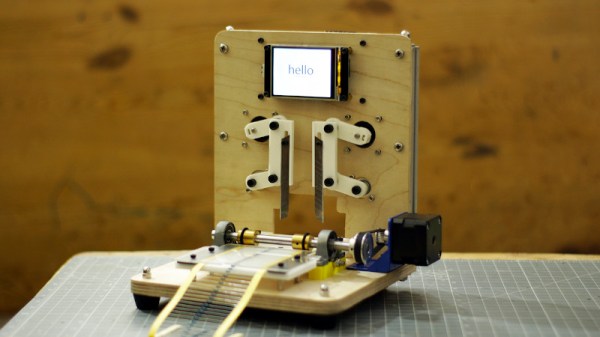
As the world of electronics makes its inexorable movement from through-hole parts to surface-mount, it’s easy to forget about the humble wire-ended resistor. But a stack of them is still a very useful resource for any experimenter, and most of us probably have a bunch of them with their accompanying twin strips of tape. We’re entranced by [Sandeep]’s automated resistor tape cutting machine, which uses a fearsome looking pair of motorized knives to slice the tape into predetermined lengths.

At its heart is an Arduino and a set of stepper drivers, and it uses a PCB that he’s designed as a multipurpose board for motor-based projects. One motor advances the reel of resistors, while the other two operate those knives that simultaneously slice the two tapes. The whole is held in a wooden frame with 3D-printed parts, and control is through a touch screen. This feels more like an industrial machine than a maker project, and as can be seen in the video below, it makes short work of those tapes. Full details can be found on his website, including code.

We’ve not had so many through hole tape cutters, but we’ve seen at least one SMD cutter.

Continue reading “Tape Cutter Makes Short Work Of Through-Hole Resistor Reels”

A Phased-Array Ultrasonic 3D Scanner From Scratch

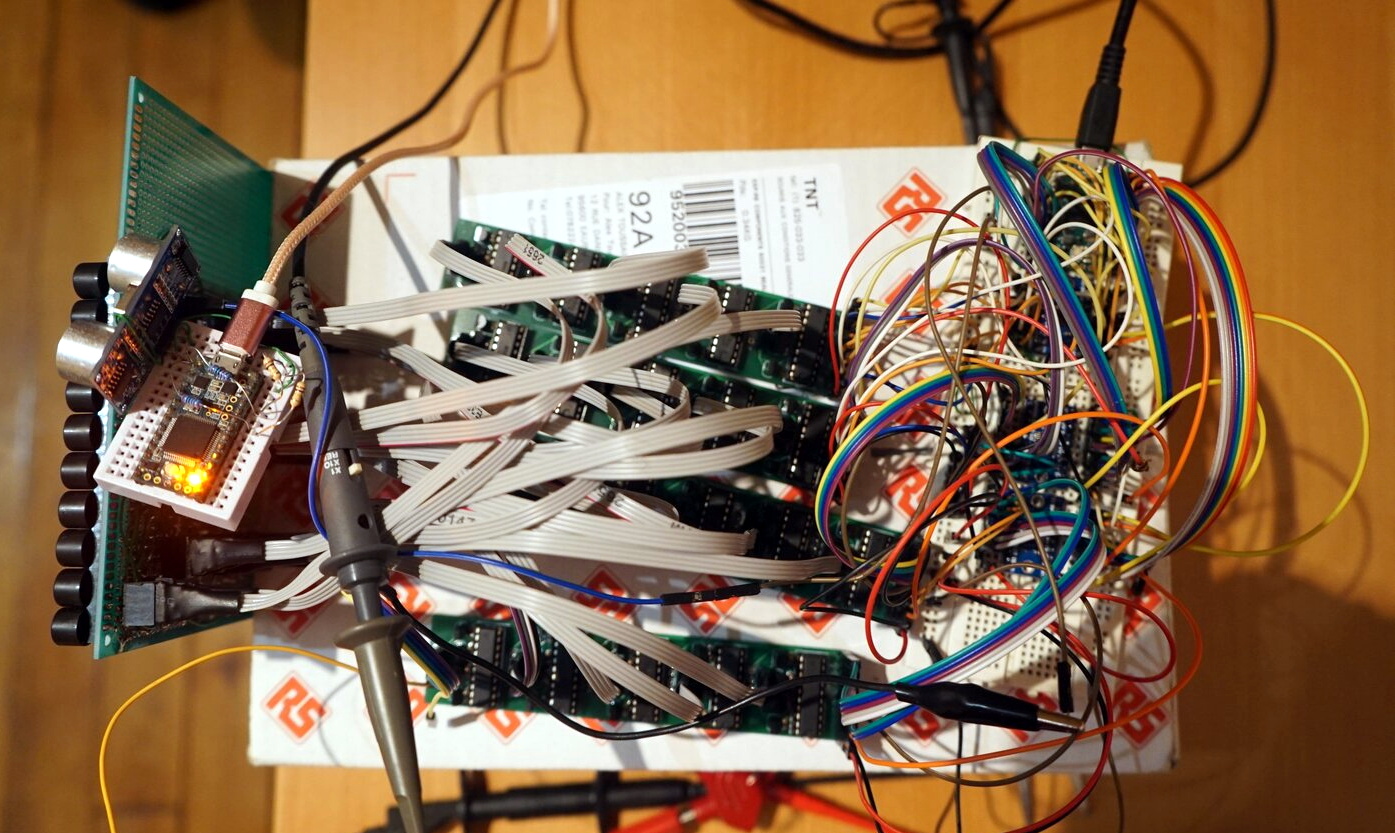
Who wouldn’t want an autonomous drone to deliver cans of fizzy drink fresh from the fridge? [Alex Toussaint] did, and in thinking how such a machine might work he embarked on a path that eventually led him to create a fully functional ultrasonic 3D scanner. In writing it up he’s produced a straightforward description of how the system works, which should also be of interest to anyone curious about phased array radar. He starts with an easy-to-understand explanation of the principle behind phased array beam forming, and there follows his journey into electronics as he uses this ambitious project to learn the art from scratch. That he succeeded is testament to his ability as well as his sheer tenacity.

He finally arrived at a grid of 100 ultrasonic emitters controlled from an Arduino through a series of shift register boards. Using this he can steer his ultrasonic beam horizontally as well as vertically, and receive echoes from objects in three-dimensional space. The ornamental bird example he uses for his scanning tests doesn’t quite emerge in startling clarity, but it is still clear that an object of its size and rough shape is visible enough for the drone in his original idea to detect it. If you would like to experiment with the same techniques and array then all the resources can be found in a GitHub repository, meanwhile we’re still impressed with the progress from relative electronics novice to this. We hope the ideas within it will be developed further.

We’ve seen ultrasonic arrays before, but mainly used in levitation experiments.

Using Ikea Guts To Add Sonos Compatibility To A Vintage Speaker

We’re in a fortunate position when it comes to audio gear, because advances in amplifier and signal processing technology have delivered us budget devices that produce a sound that’s excellent in comparison to those of a few years ago. That said, a decent quality device is good whichever decade it was manufactured in, and a speaker from the 1960s can be coaxed into life and sound excellent with a modern amplifier. It’s something [Sebastius] has explored, as he picked up an attractive-looking set of Swedish speakers from the 1960s. Wanting to bring them into the 21st century, he’s upgraded them for Sonos compatibility by hacking in the guts of an IKEA Symfonisk bookshelf speaker.

The speakers themselves looked good enough, but on closer examination they proved to bear the scars of many decades. After testing new wiring and drivers they still had a good sound to them. Their passive crossover meant that hooking them up to a single amplifier is as straightforward as it was decades ago, but a Symfonisk has an active crossover and two amplifiers. Fortunately there’s a neat hack by which those two amplifiers can be combined as one, and this is what he’s done with the resulting Symfonisk electronic package mounted on the reverse of the speaker.

The fate of the original speaker’s broken mid-range and tweeter drivers was a common enough one back in the day as speakers were ill-matched to amplifiers. Too small an amp would need turning up in volume to get a good sound resulting in distortion that would burn out the top end drivers, while too much power would result in the bass drivers being overloaded and failing. It’s unclear whether the drivers in a vintage speaker would be well-matched to an amplifier such as the Symfonisk, but we’re guessing they are safe while run at sensible volumes. Perhaps of more interest is whatever on-board DSP a Symfonisk contains, because while vintage speakers were designed for as flat a response as possible, modern compact speakers use DSP to equalise the frequency and phase responses of otherwise not-very-good-sounding enclosures. If the Symfonisk does this then those adjustments will appear as distortion in the sound of a different cabinet, but the question remains whether that distortion will be significant enough to be detectable by ear.

If the Symfonisk catches your attention, we’ve covered a teardown of it in the past.

Simple Encryption You Can Do On Paper

It’s a concern for Europeans as it is for people elsewhere in the world: there have been suggestions among governments to either outlaw, curtail, or backdoor strong end-to-end encryption. There are many arguments against ruining encryption, but the strongest among them is that encryption can be simple enough to implement that a high-school student can understand its operation, and almost any coder can write something that does it in some form, so to ban it will have no effect on restricting its use among anyone who wants it badly enough to put in the effort to roll their own.

With that in mind, we’re going to have a look at the most basic ciphers, the kind you could put together yourself on paper if you need to.

Continue reading “Simple Encryption You Can Do On Paper”