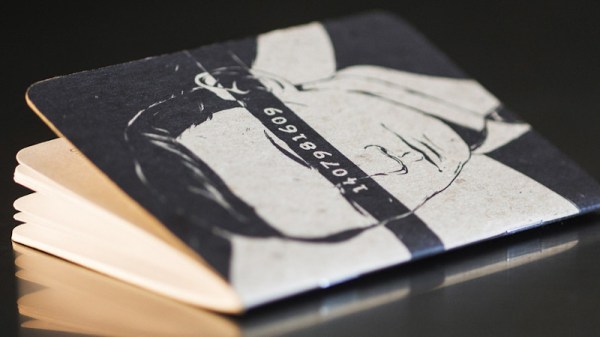
It’s a concern for Europeans as it is for people elsewhere in the world: there have been suggestions among governments to either outlaw, curtail, or backdoor strong end-to-end encryption. There are many arguments against ruining encryption, but the strongest among them is that encryption can be simple enough to implement that a high-school student can understand its operation, and almost any coder can write something that does it in some form, so to ban it will have no effect on restricting its use among anyone who wants it badly enough to put in the effort to roll their own.
With that in mind, we’re going to have a look at the most basic ciphers, the kind you could put together yourself on paper if you need to.
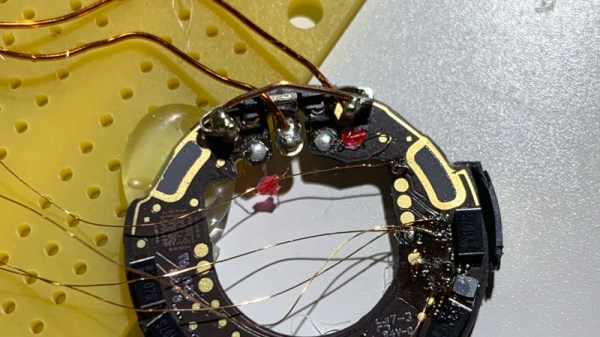
The Apple AirTag is a $29 Bluetooth beacon that sticks onto your stuff and helps you locate it when lost. It’s more than just a beeper though, the idea is that it can be silently spotted by any iDevice — almost like a crowd-sourced mesh network — and its owner alerted of its position wherever they are in the world.
The idea of a global network of every iDevice helping reunite owners with their lost possessions is on the face of it a very interesting one, and Apple are at great pains on the AirTag product page to reassure customers about the system’s security. On one hand this work opens up the AirTag as a slightly expensive way to get an nRF microcontroller for other applications, but the real value will come as the firmware is analysed to see how at the tag itself works.
Back at the start of the pandemic, a variety of hacker designs for life-saving machinery may have pushed the boundaries of patient safety. There are good reasons that a ventilator must pass extensive safety testing and certification before it can be attached to a patient, because were it to in some way fail, the patient would die. A year later, we have many much safer and more realistic ways to use our skills as part of the effort.
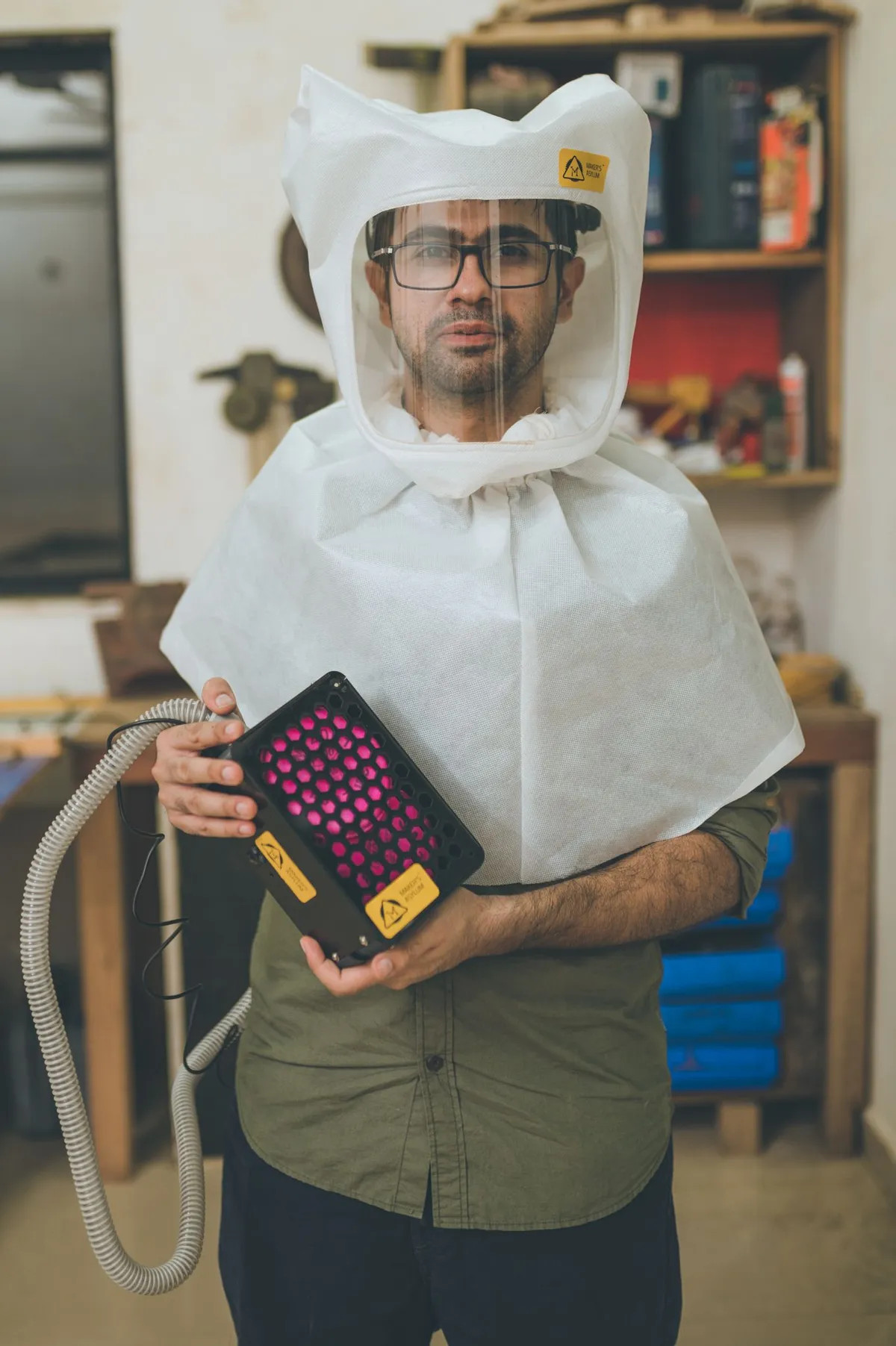
The team have proven their ability in manufacturing over the past year, here showing off the M19 motorised air purifying respirator.
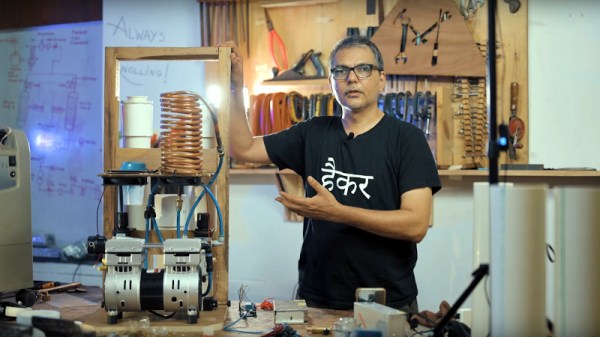
An oxygen concentrator is both surprisingly simple and imbued with a touch of magic. At its center are two columns of zeolite, a highly porous aluminosilicate mineral that performs the task of a molecular sieve. When air is pumped into the column, the zeolite traps nitrogen, leaving the oxygen-enriched remnant to be supplied onwards. There are two such columns to allow each to be on an alternate cycle of enrichment or purging to remove the accumulated nitrogen.
The point of the video is to show that such a device can be constructed from readily available parts and with common tools; as the title says it isn’t rocket science. Concentrators produced by the hackerspace coalition won’t save the world on their own, but as a part of the combined effort they can provide a useful and reliable source of oxygen that will make a significant difference in a country whose oxygen distribution network is under severe strain.
When we talk about a retrocomputer, it’s our normal practice to start with the hardware. But with [KnivD]’s ELLO 1A while the hardware is interesting enough it’s not the stand-out feature. We are all used to microcomputers with a BASIC interpreter, but how many have we seen with a C interpreter? The way C works simply doesn’t lend itself to anything but a compiler and linker, so even with a pared-down version of the language it still represents a significant feat to create a working interpreter.
The hardware centres around a PIC32MX, and has onboard SD card, VGA, sound, and a PS/2 keyboard port. The PCB is a clever design allowing construction with either through-hole or surface-mount components to allow maximum accessibility for less advanced solderers. Full information can be found on the project’s website, but sadly for those wanting an easy life only the PCB is as yet available for purchase.
We’re privileged to see a huge array of retrocomputing projects here at Hackaday, but while they’re all impressive pieces of work it’s rare for one to produce something truly unexpected. This C interpreter certainly isn’t something we’ve seen before, so we’re intrigued to see what projects develop around it.
Older readers may remember the Stylophone, a small battery powered electric organ using conductive PCB pads and a stylus to create notes. The simple multivibrators in those instruments made them monophonic, but here in 2021 we can do better than that! [Sjm4306] has gone the extra mile with a PCB organ, by making a capacitive-touch instrument that boasts four-note polyphony.
At its heart is an ATmega328p whose software sports four tone generators that each emerge on a different pin. These are summed using a set of 100 Ω resistors and fed to a tiny speaker. Power comes from a CR2032 lithium cell, and he notes that a higher voltage delivers more volume.
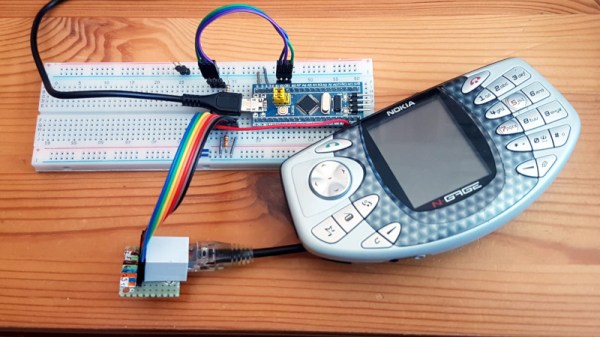
Today the Nokia brand can be found on a range of well-screwed-together Androind phones and a few feature phones, but as older readers will remember that before their descent into corporate chaos and the Windows Phone wilderness, there was once a time when the Finnish manufacturer dominated the mobile phone landscape and produced some of the most innovative and creative handset designs ever created. It’s for some of these that [Michael Fitzmayer] has done some work providing tools revive the devices from an unfortunate bricking.
The N-Gage was the phone giant’s attempt to produce a handset that doubled as a handheld game console, and though it was a commercial failure at the time it has retained a following among enthusiasts. The flaw comes as its Symbian operating system fills its user partition, at which point the infamous “White Screen Of Death” occurs as the device can no longer reboot. Rewriting the flash chip used to be handled by Nokia service tools, but these can no longer be found. His fix substitutes a “Blue pill” STMF103-based dev board that connects to the Nokia FBus serial port and does its job. It’s possible that it could be used on other Symbian devices, but for now it’s only been tested on the N-Gages.
It’s easy to forget when a smartphone is defined by iOS and Android, that Symbian gave us a smartphone experience for the previous decade. For those of us who still pine for their miniaturised Carl Zeiss Tessar cameras and candybar form factors, it’s good to see them receiving some love.
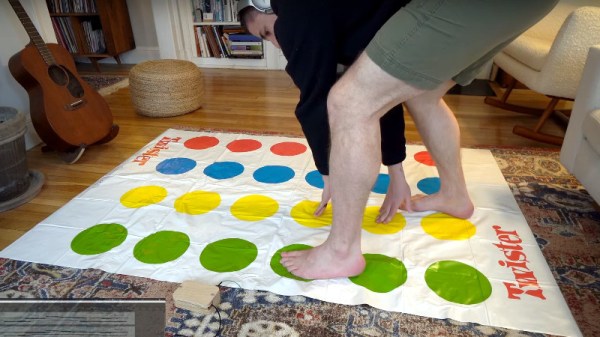
Twister, the mildly embarrassing but strangely enjoyable floor contortion game that most of us have vague youthful memories of from Christmas parties. Could a Twister mat be used as an input device? [Guy Dupont] took those 24 coloured dots and made just that, after a conversation with a friend.
Wiring up a floor-sized plastic mat isn’t as easy as it might seem, and early experiments with copper foil and capacitive touch sensor chips proved to be a failure. The replacement came in the form of force sensitive resistors, read by a brace of MCP3008 multiplexed analogue-to-digital converters. These are then read by an ESP32 that does all the MIDI magic. We’re treated in the video below the break to full details including the entertaining sight of him playing Twister to a beat, prompted by a robotic-voiced random move generator, and we can see that this devices has some potential.