Why Buy The Newer Model, When You Can Just Replicate Its User Interface?

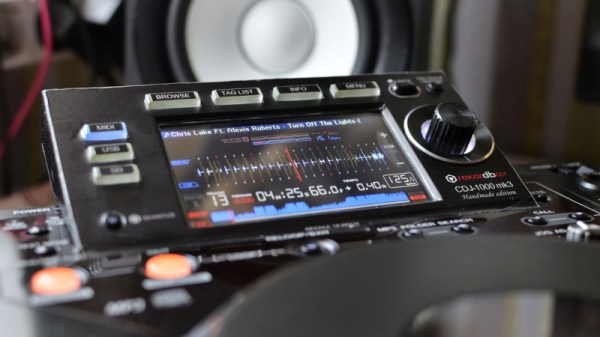
Every now and then, along comes an awesome hack from years past that we missed at the time. We kick ourselves for somehow missing such amazing work, and since it’s that good, we share it with you with apologies. Such is the case with [Andrei Anatska]’s faithful replication of the Pioneer CDJ-2000 user interface as an upgrade to the earlier CDJ-1000 DJ controller, a piece of work of such quality that you could almost mistake it for being a commercial product.

At its heart is the STM32F746G Discovery board, which for some reason it pleases us greatly in this context that he refers to as the Disco board. If you’re hazy on the details of the various STM dev boards, this is the all-singing all-dancing one with the fancy colour LCD display. Out comes the VFD on the CDJ-1000 and a set of wires are soldered to its main board, then the Disco board is hooked up with the project firmware installed. The piece de résistance is the case, for which he eschews 3D-printing and instead cuts out from black plastic. Full instructions can be found in this PDF, so should you happen to have a CDJ-1000 that’s seen better days, you can join in the fun. See it in action in the video below.

DJ controllers may be run-of-the-mill today, but to those of us whose DJing days were in the era of a pair of Technics SL1200s and a stack of vinyl to the sound of early ’90s house music they are still nothing short of miraculous. We’ve featured plenty of hacks involving them here but they don’t always involve professional kit. Even a game controller can be pressed into service.

Continue reading “Why Buy The Newer Model, When You Can Just Replicate Its User Interface?”
An Amiga Sampler 30 Years Later

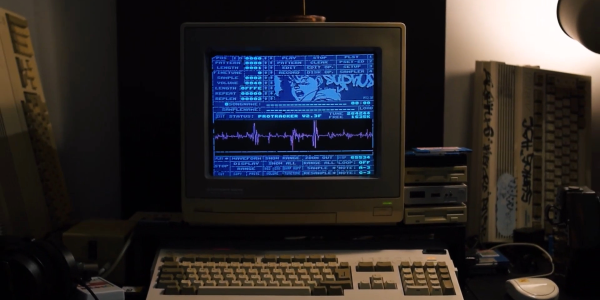
There was a magic moment for a few years around the end of the 1980s, when home computers were better than professional ones. That’s a mighty grand pronouncement, but it refers to the crop of 16-bit home computers that genuinely were far better than nearly all PCs at the time for multimedia tasks. You could plug a sampler cartridge into your Amiga and be in the dance charts in no time, something which sparked a boom in electronic music creativity. As retrocomputing interest has soared so have the prices of old hardware, and for those still making Amiga music that cart can now be outrageously expensive. it’s something [echolevel] has addressed, with an open-source recreation of an Amiga sampler.

As anyone who peered inside one back int he day will tell you, an Amiga sampler was a very simple device consisting of a commonly-available 8-bit A to D converter, a CMOS switch for right and left samples, and maybe an op-amp preamplifier. This is exactly what he’s produced, save fpr the CMOS switch as he points out that Amiga musicians use mono samples anyway. At its heart is an ADC0820 half-flash ADC chip, and the whole thing is realised on a very retro-looking through-hole PCB.

For a Hackaday scribe with a Technosound Turbo still sitting in a box somewhere it’s a real trip down memory lane. It was a moment of magic to for the first time be able to edit and manipulate audio on a computer, and we’re glad to see that something of those days still lives on. See it in action in the video below the break.

Continue reading “An Amiga Sampler 30 Years Later”

Lightning Analysis With Your SDR

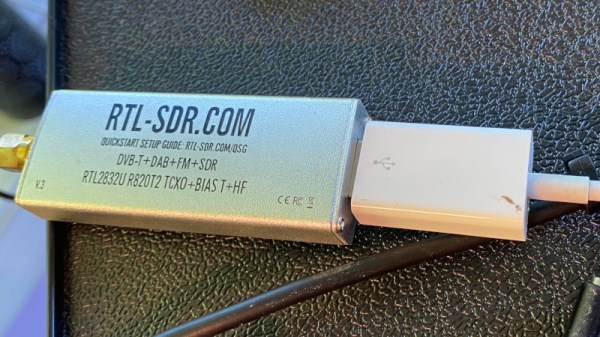
Perhaps it’s just one of those things adults dream up to entertain their children, but were you ever told to count slowly the time between seeing a lightning flash and hearing the rumble of thunder? The idea was that the count would tell you how far away the storm was, but from a grown-up perspective the calibration accuracy of a child saying “one… two…three…” in miles seems highly suspect. It’s a valid technique though, and it can be used to monitor thunderstorms by the radio emissions created through the electrical discharge. It’s an area the SAGE project has been working in, and they’ve posted some details including a fascinating run-down of the software techniques , on how lightning can be detected with an RTL-SDR.

A lightning strike produces a characteristic wideband burst that shows up in the time domain as a maximum point that can easily be detected but could also be confused with radio interference from another source. Thus after identifying maxima they zoom in and perform a Fourier transform to spot the wideband burst. It’s all done in Python, and the pleasant surprise is how straightforward to understand it all is.

SAGE are working on a distributed sensor network, so we hope this work might one day give us real-time open lightning data. The FFT approach should ensure that it won’t be fooled by false positives as a traditional detector might be.

Via RTL-SDR.com.

Just Who Makes Tubes These Days?

For most of us, electronic technology comes in the form of solid state devices. Transistors, integrated circuits, microcontrollers. But for the first sixty years or so of the field existing, these devices either hadn’t been invented yet or were at too early a stage in their development to be either cost-effective, or of much use. Instead a very different type of electronic component ruled the roost, the vaccum tube.

A set of electrodes in an evacuated glass envelope whose electrical properties depended on the modulation of the flow of electrons through them, these were ubiquitous in consumer electronics up until the 1960s, and clung on in a few mass-market applications even as far as the mid 1970s. As cheaper and more versatile semiconductors superseded them they faded from electronic parts catalogues, and the industry that had once produced them in such numbers disappeared in favour of plants producing the new devices. Consumer products no longer contained them, and entire generations of engineers grew up never having worked with them at all. If you were building a tube amplifier in the early 1990s, you were a significant outlier. Continue reading “Just Who Makes Tubes These Days?”

The Smell Of Space

In space, so the Alien tagline goes, nobody can hear you scream. One of the most memorable pieces of movie promotion ever, it refers to the effect of the vacuum of space on the things human senses require an atmosphere to experience. It’s a lesson that Joss Whedon used to great effect with the Serenity‘s silent engine light-ups in Firefly, while Star Wars ignored it completely to give us improbable weapon noises in space battles.

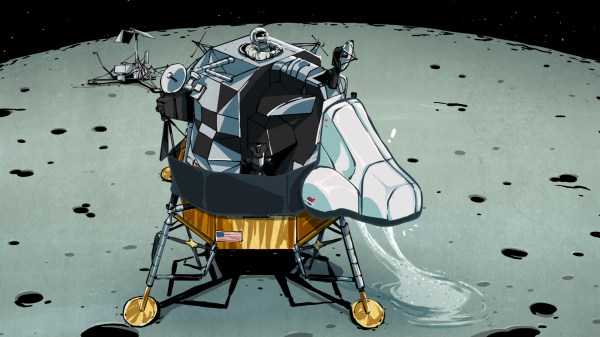
Sound may not pass through the vacuum of space, but that’s not to say there are not things other than light for the senses. The Apollo astronauts reported that moon dust released a smell they described as akin to burnt gunpowder once it was exposed to the atmosphere inside their lander, and by now you may have heard that there is a Kickstarter that aims to recreate the smell as a fragrance. Will it replace the cloying wall of Axe or Lynx Africa body spray that pervades high-school boys’ changing rooms, or is it a mere novelty?

Continue reading “The Smell Of Space”

The Game Boy As A Midi Synthesiser

In the world of chiptune music there are many platforms to choose from, each with their own special flavour tot heir sound. The Game Boy has a particular following, but it differs from some of its contemporary platforms in having a custom sound chip built into the same silicon as its processor. You can’t crank open a Game Boy and lift out the sound chip for your own synth project, instead you must talk to it through the Game Boy’s Z80 processor. This is something [Adil Soubki] knows well, as he’s completed a project that turns the handheld console into a MIDI synthesiser.

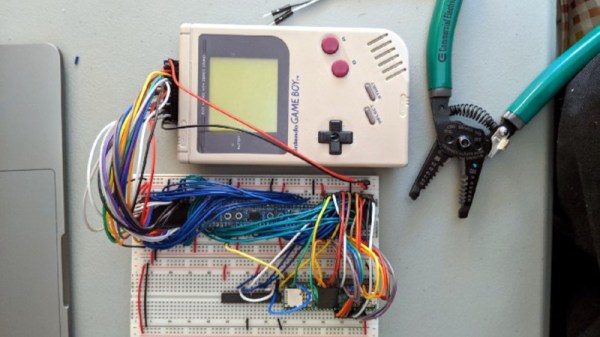
A Game Boy was designed to play games and not as a developer’s toy, so it doesn’t exactly roll out the red carpet for the hacker. He’s got under the console’s skin by mapping a section of its memory address map to the pins on a Teensy microcontroller board, and running some Game Boy code that reads the vaues there and uses them to configure the sound hardware. The Teensy handles the translation between MIDI and these byte values, turning the whole into a MIDI synthesiser. It’s a succesful technique, as can be seen in the video below the break. Best of all, the code is available, so you can have a go for yourself.

We’ve featured Game Boy synths before here at Hackaday, but usually they have been of the more conventional variety.

Continue reading “The Game Boy As A Midi Synthesiser”

Folding@Home And Rosetta, For ARM

Most readers will be aware of the various distributed computing projects that provide supercomputer-level resources to researchers by farming out the computing tasks across a multitude of distributed CPUs and GPUs. The best known of these are probably Folding@Home and Rosetta, which have both this year been performing sterling service in the quest to understand the mechanisms of the SARS COVID-19 virus. So far these two platforms have remained available nearly exclusively for Intel-derived architectures, leaving the vast number of ARM-based devices out in the cold. It’s something the commercial distributed-computing-on-your-phone company Neocortix have addressed, as they have successfully produced ARM64 clients for both platforms that will be incorporated into the official clients in due course.

So it seems that mundane devices such as mobile phones and the more capable Raspberry Pi boards will now be able to fold proteins like a boss, and the overall efforts to deliver computational research will receive a welcome boost. But will there be any other benefits? It’s a Received Opinion that ARM chips are more power-efficient than their Intel-derived cousins, but will this deliver more energy-efficient distributed computing? The answer is “probably”, but the jury’s out on that one as computationally intensive tasks are said to erode the advantage significantly.

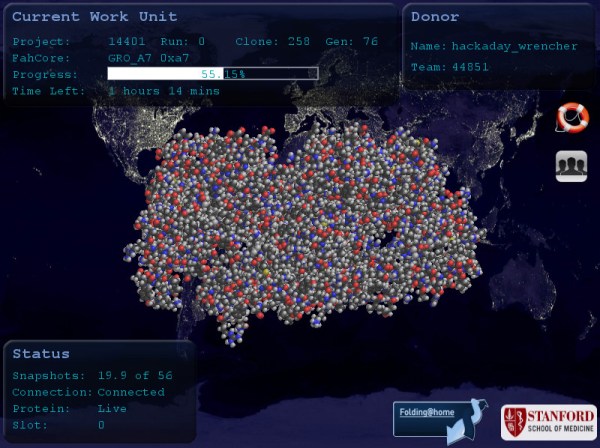
Folding@Home was catapulted by the influx of COVID-19 volunteers into first place as the world’s largest supercomputer earlier this year, and we’re pleased to say that Hackaday readers have played their part in that story. As this is being written the July 2020 stats show our team ranked at #39 worldwide, having racked up 14,005,664,882 points across 824,842 work units. Well done everybody, and we look forward to your ARM phones and other devices boosting that figure. If you haven’t done so yet, download the client and join us..

Via HPCwire. Thanks to our colleague [Sophi] for the tip.